Clear Sky Science · en
AI-based development and optimization of sealing materials for secondary grouting in methane recovery
Why better seals matter for cleaner gas
Coalbed methane is a cleaner-burning gas trapped in coal seams, but much of it slips away through tiny cracks before it can be captured. This paper explores how artificial intelligence can help design smarter sealing mixtures that plug those hidden leaks more effectively, making methane recovery safer, more efficient, and less wasteful.
Cracks in the rock and lost methane
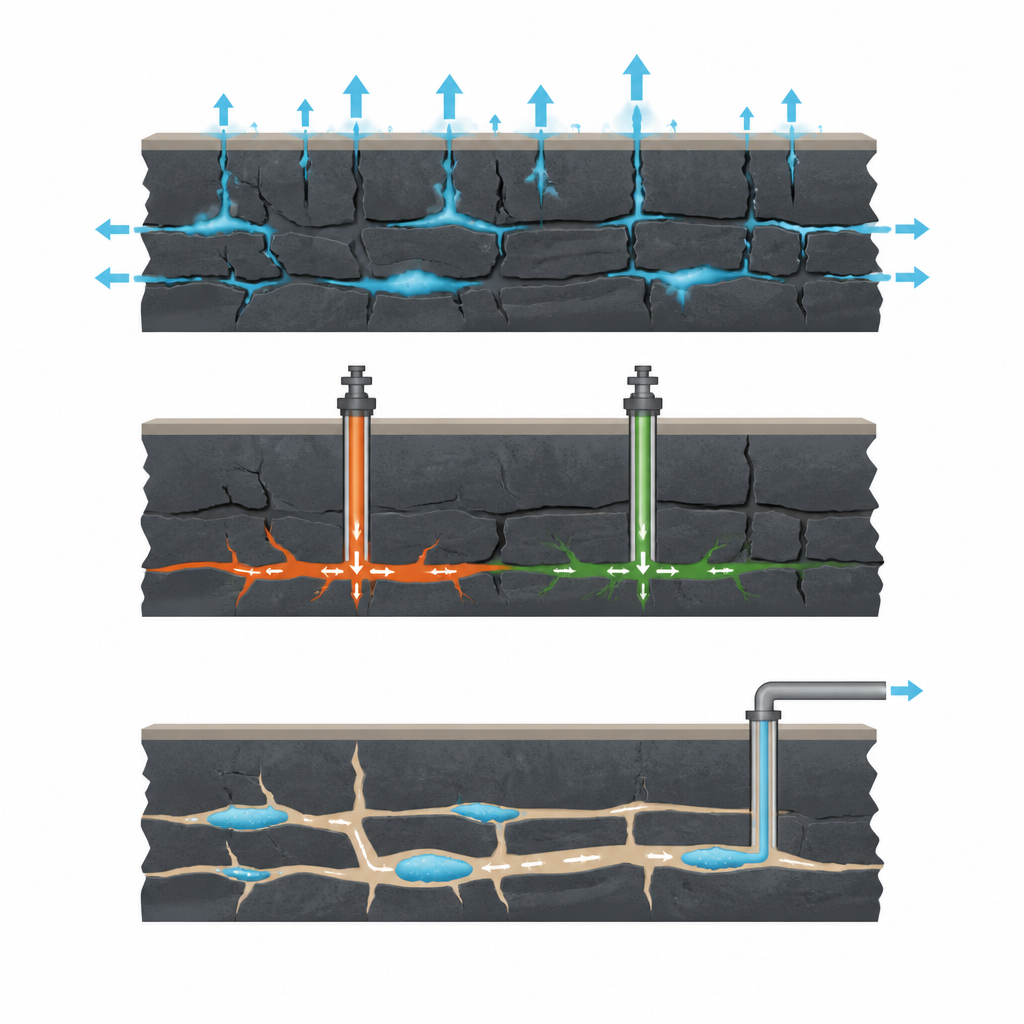
Deep underground, coal seams are shot through with natural fractures that act like secret escape routes for gas and water. When wells are drilled to drain methane, these fractures can open further, forming new pathways that let fresh air in and methane out. Traditional cement-based sealants often cannot flow far enough into these networks or stay tight as the rock shifts, so gas production drops and more methane escapes into the mine and the atmosphere. The study focuses on “secondary grouting,” a follow-up sealing step that aims to restore leaky wells by injecting special materials deep into these fractures.
What makes a good sealing mixture
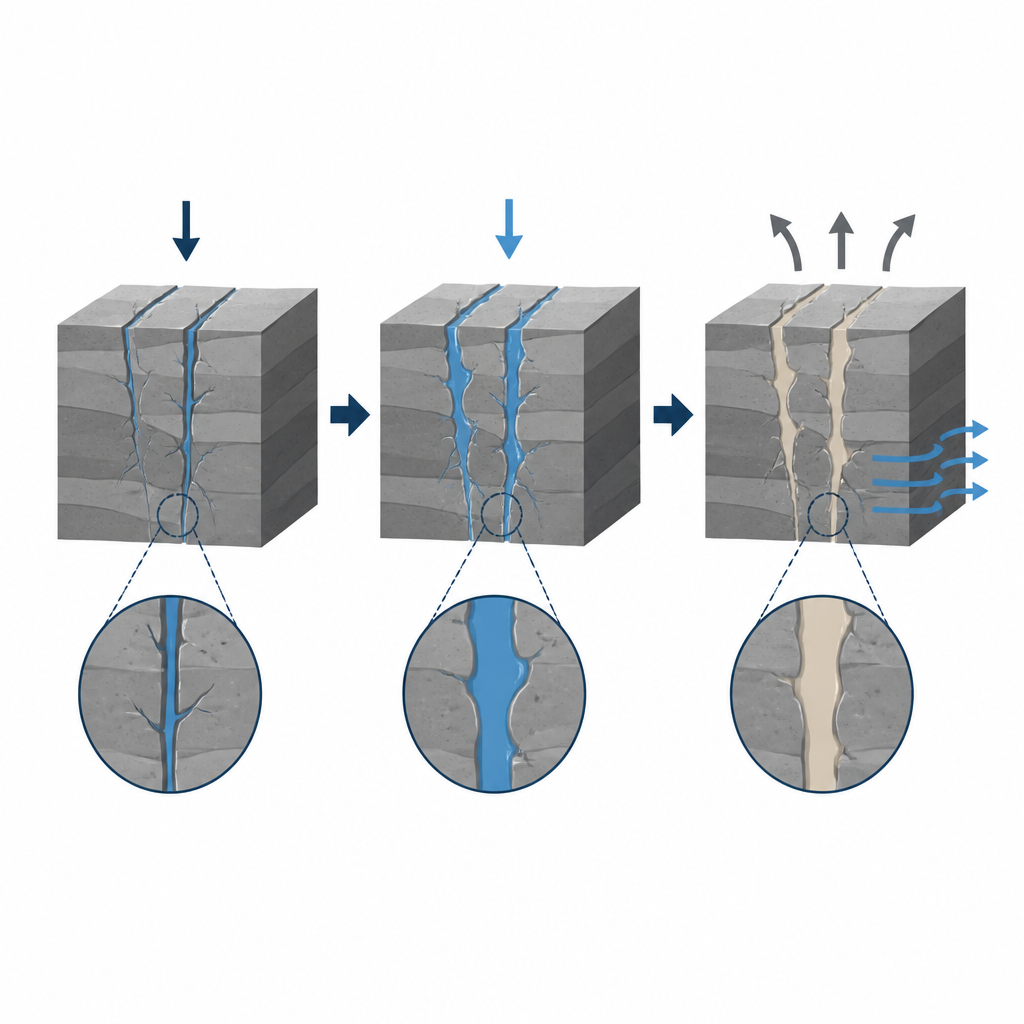
A useful sealing material has to solve several problems at once. It must be fluid enough at the start to be pumped and to penetrate fine cracks. It then needs to thicken and “gel” within a workable time, expand just enough to fill gaps, and finally harden into a strong, durable solid that holds back gas for months or years. Adjusting the ingredients that control water content, resin, crosslinking additives, and a foaming agent will change properties such as viscosity, hardening time, strength, and expansion. Improving one feature can easily harm another, so finding the right recipe by trial and error in the lab is slow, expensive, and may miss many promising combinations.
Teaching computers to predict material behavior
The researchers built a data-driven framework that learns from a relatively small set of lab-tested mixtures and then searches for better formulas on its own. They used two types of computer models called neural networks, each tuned by different evolutionary algorithms that mimic natural selection or swarm behavior. One model excelled at predicting how thick the mixtures would be and how strong they would become after hardening. The other was better at forecasting how long they would take to gel and how much they would expand inside fractures. By combining these models, the framework can estimate how any new recipe within the tested range is likely to behave without mixing and measuring it in the lab.
Balancing flow, strength, and expansion
Once the computer could reliably predict material behavior, the team linked it to a multi-objective optimizer that searches thousands of possible recipes at once. Instead of looking for a single “best” mixture, the optimizer produces a family of choices that trade off between easy pumping, quick setting, strong final seals, and controlled expansion. For example, very strong mixtures tend to be thicker, which may limit how far they can be pumped into distant fractures. More fluid mixtures travel deeper but usually cure to moderate strength. Additional analysis methods were then used to rank these candidates according to different field needs, such as deep penetration, fast sealing near the well, or maximum long-term stability.
From computer designs to cleaner gas
In plain terms, the study shows that computers can learn how complex sealing mixtures behave and then help engineers choose recipes that best fit real-world methane wells. The approach does not replace field testing, but it sharply cuts down on guesswork and the number of lab trials needed. With better-tailored sealants, more methane can be guided from coal seams into collection pipelines instead of leaking through cracks, supporting safer mining operations and making coalbed methane a cleaner, more efficient energy source.
Citation: Zandy Ilghani, N., Maleki, H. AI-based development and optimization of sealing materials for secondary grouting in methane recovery. Sci Rep 16, 15920 (2026). https://doi.org/10.1038/s41598-026-46891-2
Keywords: coalbed methane, borehole sealing, artificial intelligence, grouting materials, methane leakage