Clear Sky Science · en
Characterization of bacterial nanocellulose cultivated on polyethylene terephthalate (PET) monomers via raman and fourier transform infrared spectroscopy
Turning Plastic Waste into Helpful Fibers
Plastic bottles and food containers made from PET are everywhere, and tiny fragments of this plastic are now found in oceans, soil, and even our bodies. This study explores a creative way to tackle that problem: using bacteria to turn the basic building blocks of PET into ultra-fine, biodegradable cellulose fibers. These fibers, called bacterial nanocellulose, can form strong, flexible membranes that might one day replace some plastic products in packaging, medicine, and other everyday uses. 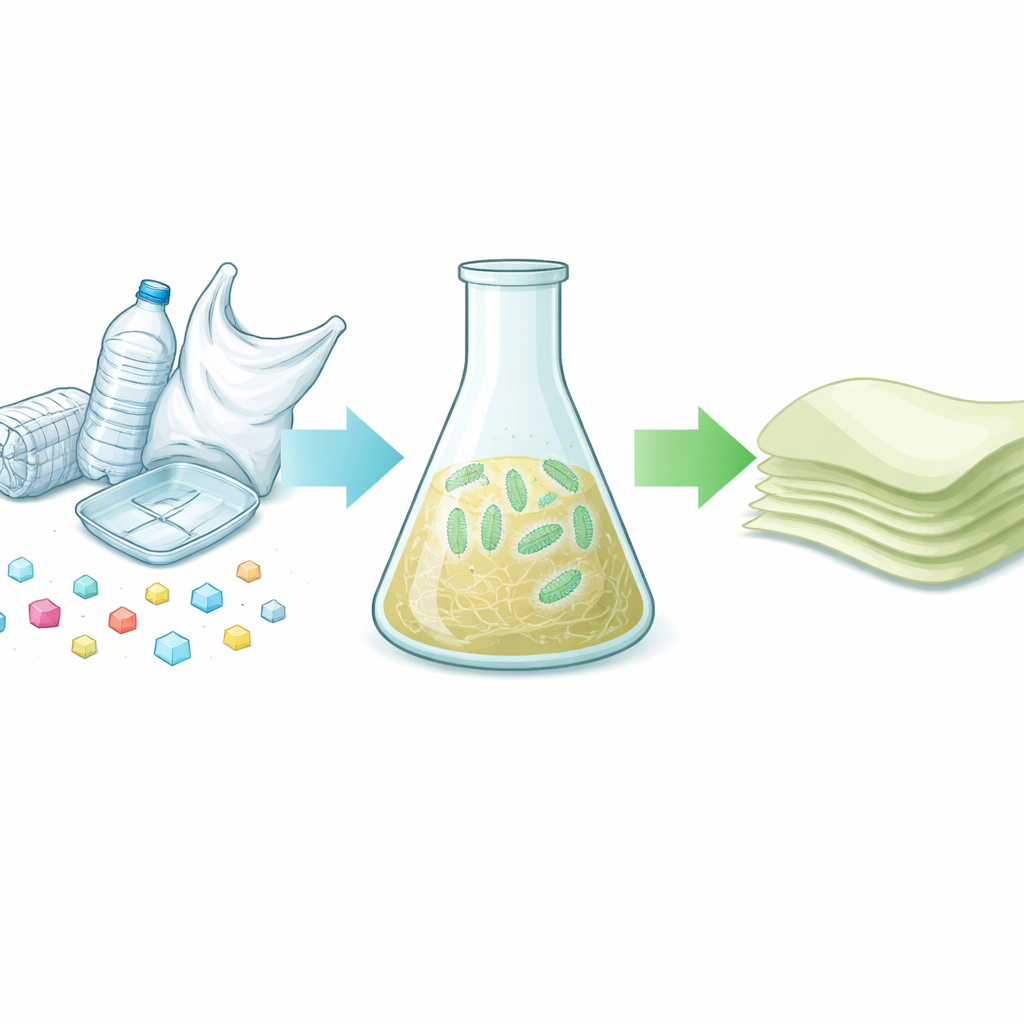
From Plants to Tiny Bacterial Factories
Cellulose is the main structural material in plants and is already used in paper, textiles, and many industrial products. But harvesting it typically depends on cutting down trees or growing large monoculture crops. Some bacteria, including a species called Komagataeibacter sucrofermentans, can instead spin cellulose directly from sugar during fermentation, building a web of nanofibers thinner than a hundred nanometers. This bacterial nanocellulose has appealing traits: it is pure (free of plant gums and lignin), absorbs water well, and can be molded into smooth membranes suited for food packaging or wound dressings.
Feeding Bacteria with Plastic Building Blocks
The researchers asked whether these bacteria could use PET’s building blocks—ethylene glycol (EG) and disodium terephthalate (TPA)—instead of relying only on conventional sugar (glucose). They cultivated K. sucrofermentans in three liquids that were identical except for the carbon source: one had glucose, one EG, and one TPA. After three weeks, they collected and dried the cellulose pellicles floating at the liquid surface and weighed them. Surprisingly, the highest yield came from EG, which produced more nanocellulose per liter than glucose, while TPA gave a lower yield. This shows that at least part of the carbon in PET monomers can be redirected into a useful, biodegradable material.
How the Fibers Look and How Ordered They Are
To see what kind of material had formed, the team imaged the membranes under a scanning electron microscope. Glucose-fed bacteria produced a dense, even mat of fine fibers with regular pores—a sign of well-organized growth. EG and TPA led to looser, more irregular networks, with TPA giving the most open and uneven structure, more like a composite than a pure, uniform film. X-ray diffraction measurements confirmed this visual impression: cellulose fibers from glucose showed the high crystallinity (tight packing) usually associated with strong, well-ordered cellulose, whereas EG-derived fibers were somewhat less ordered and TPA-derived fibers were far more disordered. 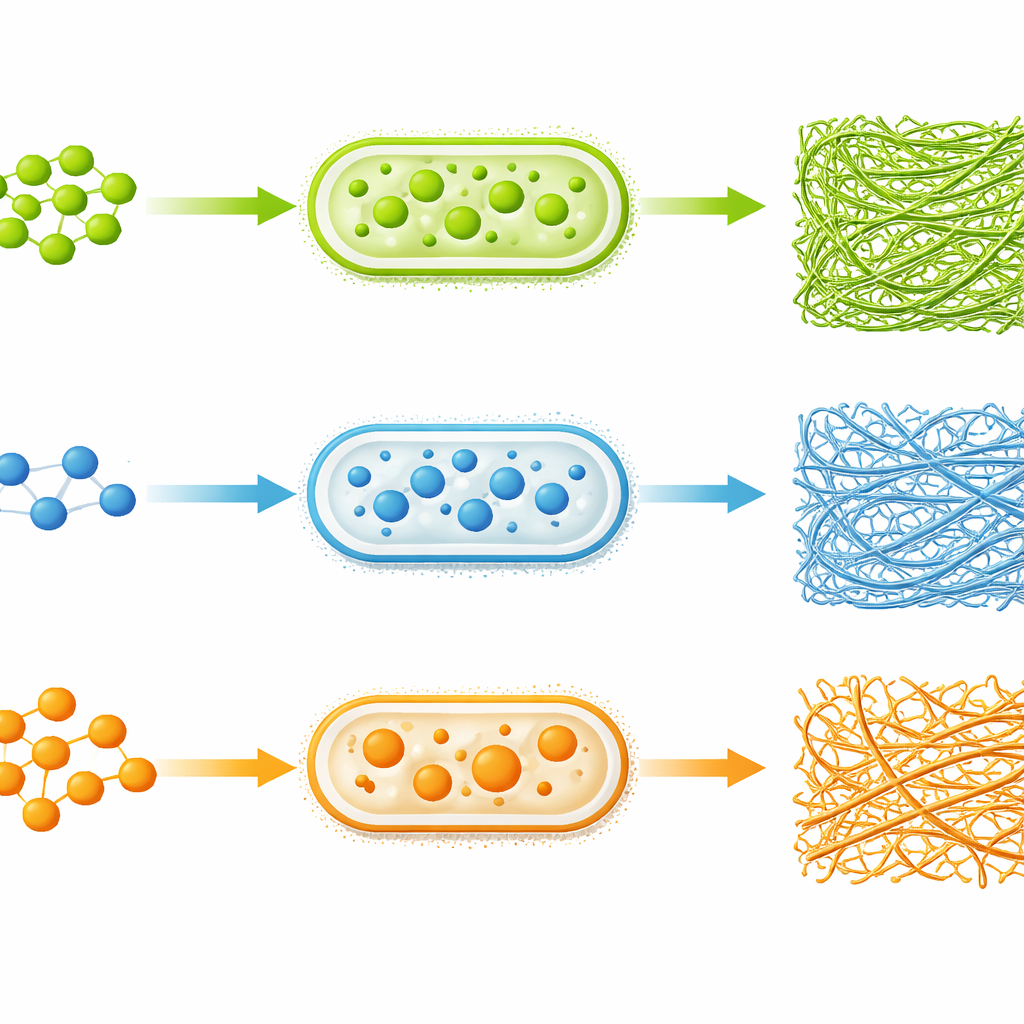
Listening to Molecules with Light
The scientists then used two light-based techniques—Raman and infrared spectroscopy—to “listen” to the vibrations of the molecules inside the membranes. These methods act like fingerprints, revealing what bonds are present and how neatly the chains are arranged. All three samples displayed the characteristic signals of cellulose, proving that the bacteria did build the expected polymer from each carbon source. But there were important differences: the EG and TPA samples showed stronger signatures of disordered, amorphous regions, while glucose-based nanocellulose showed clearer signs of ordered crystalline zones. In the TPA-fed material, extra spectral bands matched terephthalate groups, meaning some PET-related fragments remained trapped in the membrane and were not fully converted.
What This Means for Cleaner Materials
In everyday terms, the study shows that certain bacteria can eat parts of PET’s molecular leftovers and refashion them into sheets of cellulose, though the quality of those sheets depends strongly on the feedstock. Glucose still gives the cleanest and most orderly fibers, but EG in particular can boost the amount of material made, and TPA can be at least partly transformed while becoming embedded in a cellulose-rich film. The approach does not yet make PET disappear completely—some plastic-like fragments remain and would need to be removed—but it marks a promising route toward “bio-upcycling,” where persistent plastic is turned into more benign materials. With further optimization of the process and purification steps, bacterial nanocellulose grown on PET monomers could become part of a circular system that both manages plastic waste and supplies sustainable, high-performance membranes.
Citation: Eriksson, R., Mariam, I., Ramser, K. et al. Characterization of bacterial nanocellulose cultivated on polyethylene terephthalate (PET) monomers via raman and fourier transform infrared spectroscopy. Sci Rep 16, 13133 (2026). https://doi.org/10.1038/s41598-026-46886-z
Keywords: bacterial nanocellulose, PET upcycling, plastic pollution, biodegradable materials, Raman and FTIR analysis