Clear Sky Science · en
GroupCeptionNet: a lightweight model for classifying chili seed germination with macro images
Why tiny seeds matter for big harvests
For farmers and gardeners, every healthy seed is a promise of future crops and income. But not all seeds will sprout, and sorting good from bad has long relied on slow, hands-on checks or costly lab tools. This study shows how sharp close-up photos and a compact artificial intelligence model can quickly judge whether chili seeds are likely to germinate, using only a simple camera and modest computing power.
Seeing more by looking closer
Chili peppers are a valuable crop, and seed quality directly shapes yield and profit. Traditional tests, such as visual inspection, floating seeds in water, or staining them with chemicals, demand skill and time and can be inconsistent. High-tech scanners and hyperspectral cameras can do better, but they are expensive and not easy to deploy in ordinary seed plants or on farms. The authors instead rely on macro photography, the same close-up style many smartphones now offer. With this setup, each seed fills a large part of the image, revealing fine surface details like tiny cracks, wrinkles, or early signs of mold that are hard to see with standard photos.
Building a detailed picture of chili seeds
The team created a specialized dataset of 3840 macro images of a commercial chili pepper variety. Each seed was photographed on a dark background using a phone in macro mode under controlled lighting. The seeds then underwent a standard germination test over 14 days so each image could be tagged as “germinated” or “non-germinated.” Because naturally bad seeds are relatively rare, the researchers added more non-germinated examples by carefully damaging some seeds or exposing them to common fungi. They also removed the background from the photos and tightly cropped around each seed so the computer model would focus on the seed surface rather than noise in the surroundings. 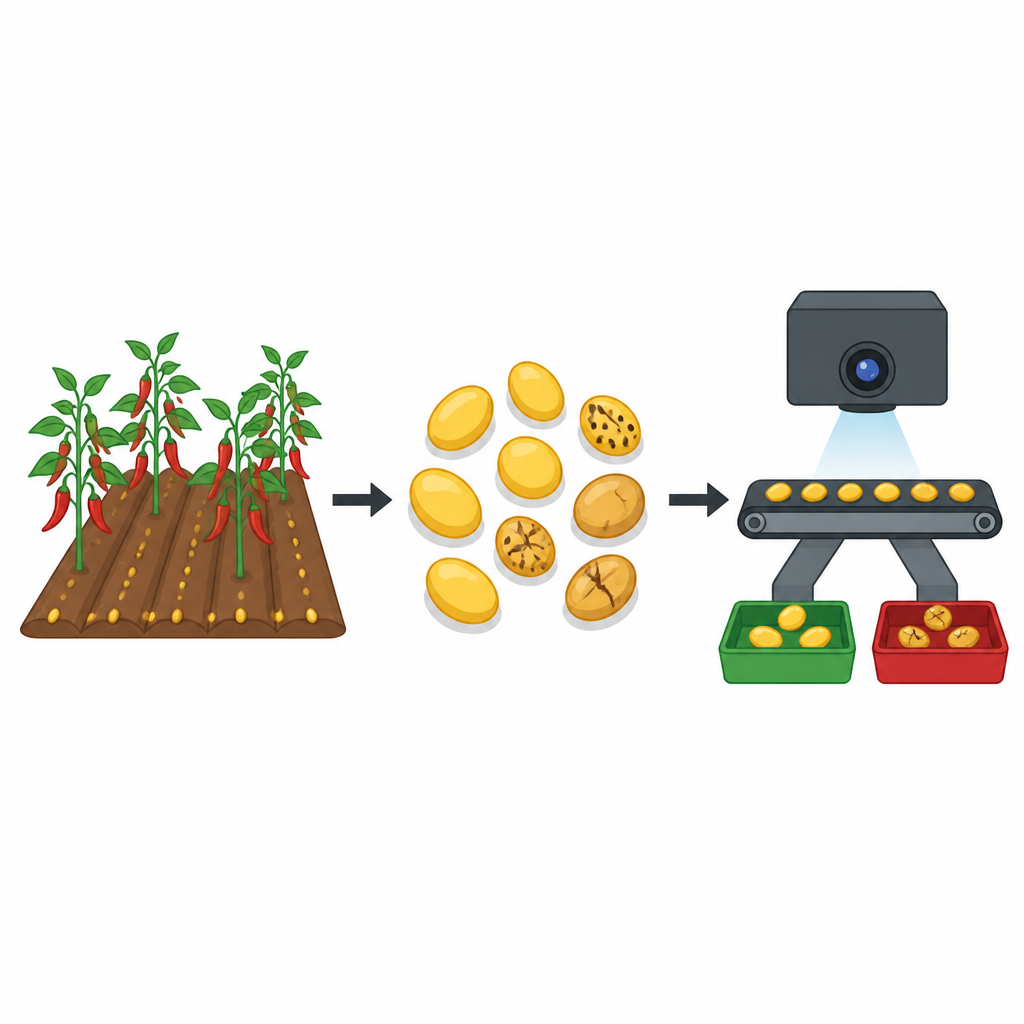
A compact model built for tight spaces
To turn these images into reliable decisions, the authors designed a lightweight neural network called GroupCeptionNet. It borrows ideas from two popular deep learning structures: splitting computations into groups to cut down on the number of calculations, and looking at image features at several different scales at once. Stacked in stages, this design lets the model gradually move from fine details to an overall view of each seed while keeping the total number of parameters very small. After extracting features, the network averages them into a single summary and outputs a simple two-way choice: likely to germinate or not. 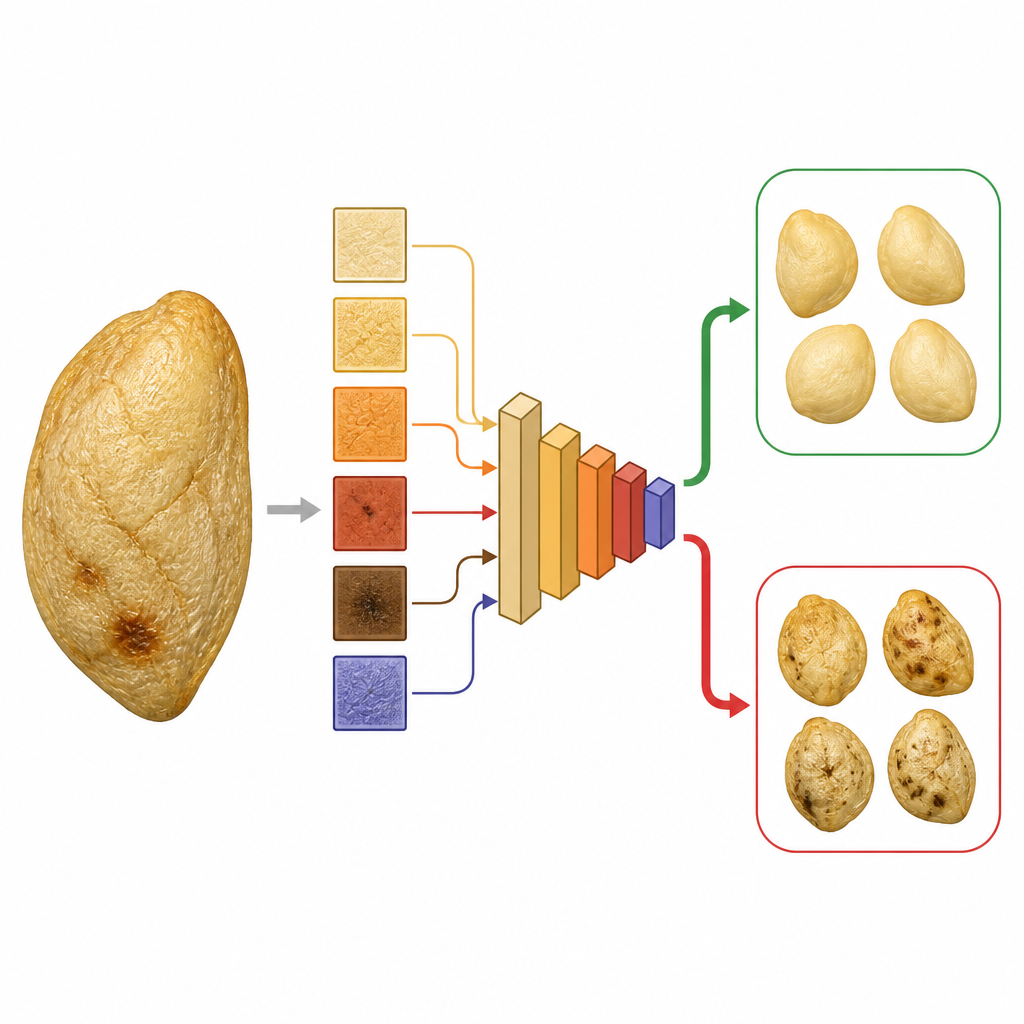
Testing speed, accuracy and image quality
The researchers compared GroupCeptionNet with a wide range of well-known image models, including heavy-duty networks and transformer-based systems. Despite having only about 1.4 million parameters, their model reached about 94.7% accuracy and a nearly identical F1-score, beating or matching larger competitors that used far more memory and computing power. Removing the image background generally boosted performance across all models, confirming that clean, seed-focused images help. The team also simulated what would happen if the seeds were captured at lower resolutions, like ordinary smartphone shots or distant views. Performance dropped noticeably, showing that macro images really do provide crucial fine-grained clues.
Looking where humans look
To check whether the model was focusing on meaningful regions, the authors visualized which parts of each seed image influenced its decision the most. For healthy seeds, GroupCeptionNet tended to cover the whole smooth surface. For bad seeds, it concentrated on spots of rot, mold, cracks or discoloration. These attention maps lined up well with areas human experts had marked in advance, and were more consistent than those from many rival models. Additional tests on variants of the network confirmed that combining grouped operations with multi-scale feature extraction was key to balancing accuracy with low resource use.
What this means for farmers
In plain terms, this work shows that inexpensive close-up photography and a small, carefully designed AI model can sort chili seeds almost as well as much heavier systems, while running on limited hardware. That makes it realistic to imagine compact devices that sit next to a seed conveyor and automatically separate strong seeds from weak ones in real time. While the study focuses on one chili variety, the same approach could be adapted to other crops, helping boost yields and reduce waste without demanding costly lab equipment.
Citation: Ao, C., Xu, T. GroupCeptionNet: a lightweight model for classifying chili seed germination with macro images. Sci Rep 16, 15619 (2026). https://doi.org/10.1038/s41598-026-46875-2
Keywords: chili seed germination, macro imaging, lightweight neural network, seed quality, smart agriculture