Clear Sky Science · en
Optimizing nuclear-renewable hybrid energy systems for cost efficiency based on energy security concerns in Puerto-Rico
Why Puerto Rico’s power future matters
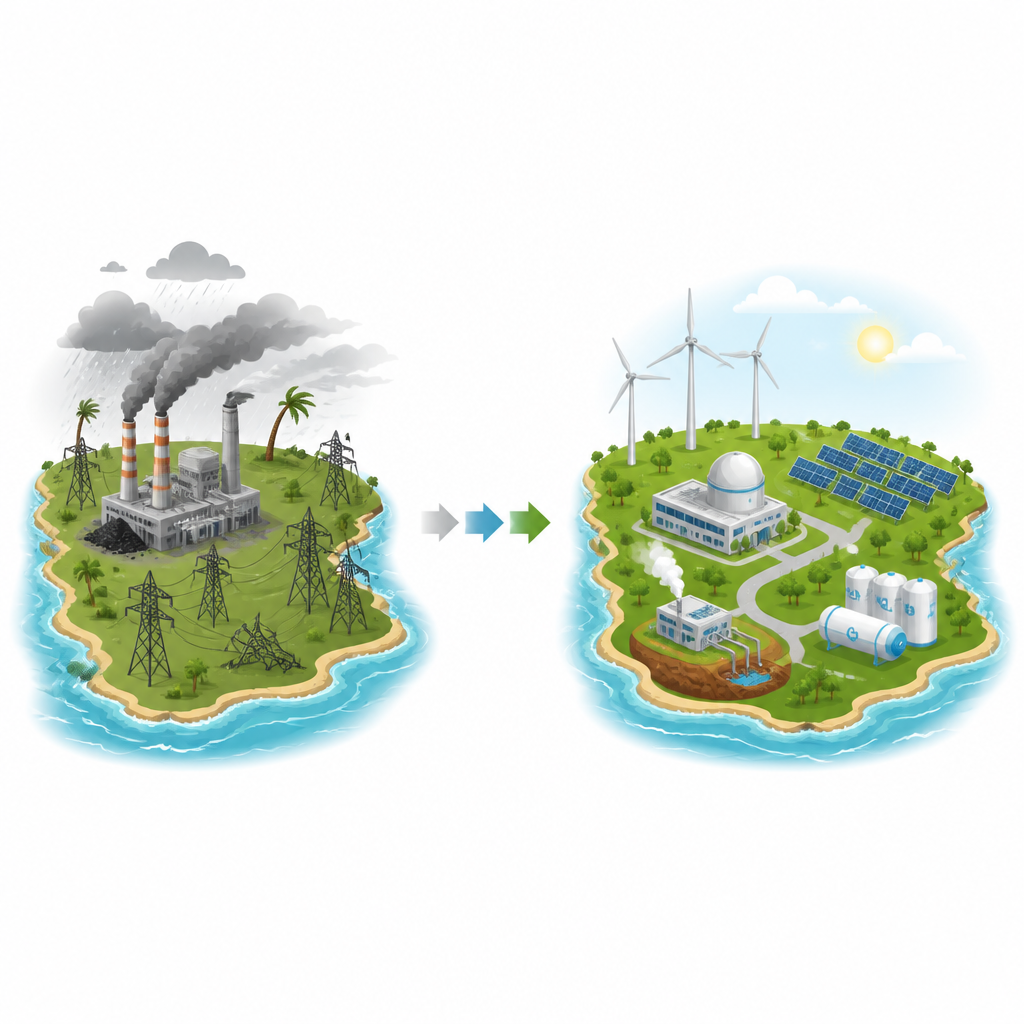
Puerto Rico depends heavily on imported fossil fuels and has a power grid that has been devastated by past hurricanes. This makes electricity expensive and unreliable for homes, hospitals, and businesses. The study summarized here asks a simple but urgent question: how can Puerto Rico move to cleaner energy while keeping lights on during storms and holding costs down? The authors explore new ways to blend nuclear, solar, wind, geothermal, and hydrogen technologies into a smarter, more secure power system that could also serve as a model for other islands.
From fragile grid to flexible hybrid system
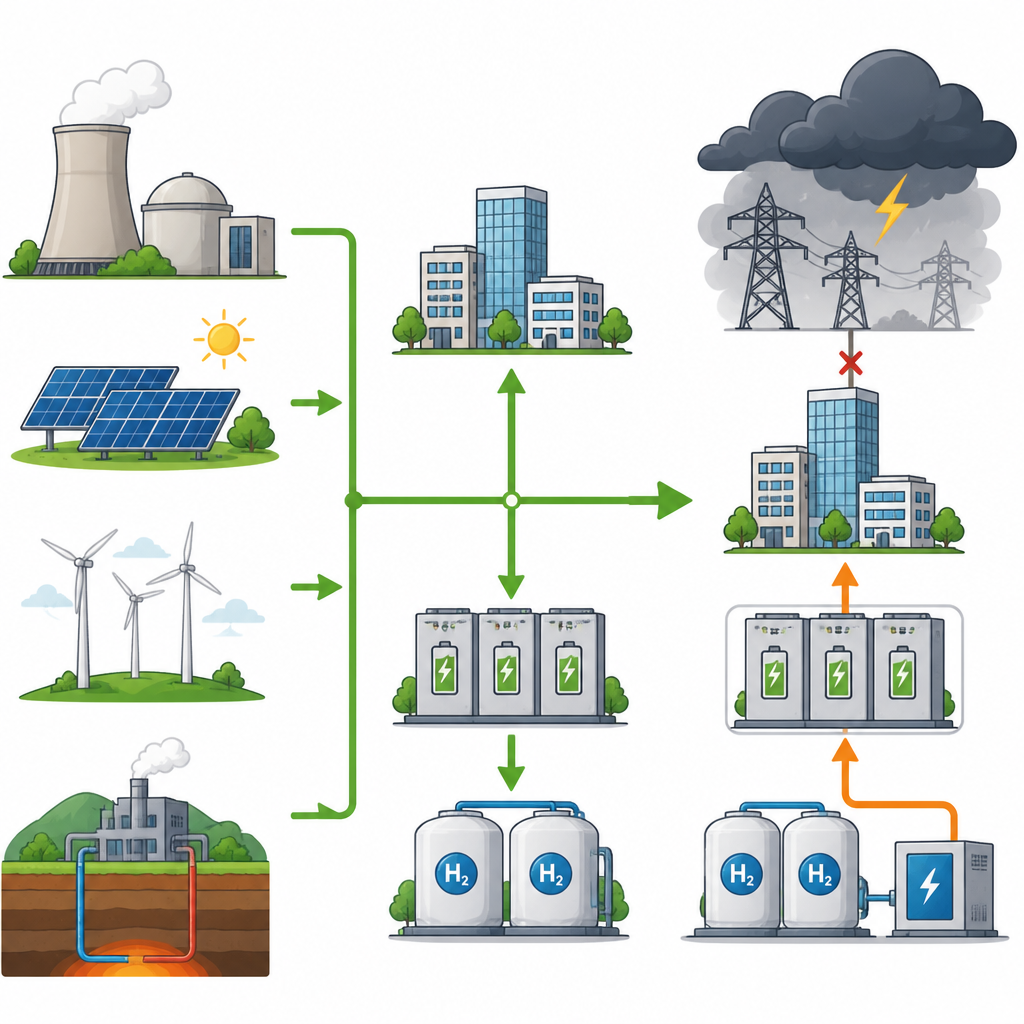
Today, most of Puerto Rico’s electricity comes from oil, coal, and gas plants connected by long transmission lines that are easily damaged by hurricanes. The authors argue that the island needs a more diverse “hybrid” energy system that mixes local renewable sources with small nuclear reactors and energy storage. They focus on combinations that include solar panels, wind turbines, geothermal plants, batteries, and hydrogen fuel cells, with some options adding a small modular nuclear reactor. The goal is to find energy mixes that keep costs reasonable, reduce dependence on fuel shipments, and help the grid bounce back faster after extreme weather.
Finding the cheapest secure mix
To sort through many possible combinations, the team builds a mathematical model that searches for the lowest overall power cost while meeting Puerto Rico’s electricity demand. The model accounts for each technology’s building cost, operating cost, fuel use, and typical output over the year. It enforces a safety margin so that generation capacity stays above peak demand and checks that the overall cost per unit of electricity stays below a policy target. Because running full hourly simulations for every option would be slow and complex, the authors also create a statistical “surrogate” model that can quickly predict cost and performance and highlight which technologies matter most.
New yardsticks for reliability and resilience
Comparing energy plans for different islands is hard because each system has its own size and units. To fix this, the study introduces three dimensionless scores called the “3R” metrics: Reliability, Resilience, and Renewability. Using a classic physics tool known as dimensional analysis, the authors turn six physical quantities such as total power capacity, peak demand, storage energy, outage duration, renewable output, and critical-load share into three simple ratios. One ratio measures how much capacity there is compared with peak demand, another shows how long storage can cover essential loads during an outage, and the third describes what share of total capacity is renewable. Because these scores are unit-free, they can be used to compare very different island grids on equal footing.
What the model says about good designs
The optimization produces five promising hybrid setups for Puerto Rico, each trading off cost, resilience, and clean energy share in different ways. A fully renewable mix built from solar, geothermal, and hydrogen storage offers very high resilience and renewability but is the most expensive. Adding wind in various ways changes the balance between cost and storm risk. The most affordable option combines nuclear, wind, and hydrogen storage, but its resilience and renewable share are somewhat lower. A slightly more expensive design that blends a small modular reactor with wind, solar, and hydrogen storage stands out as a balanced choice: it keeps costs near 10 cents per kilowatt-hour, delivers strong reliability, improves resilience, and raises renewables to about 70 percent of capacity while cutting total system cost compared with fossil-heavy mixes.
Explaining the hidden drivers
To understand why some mixes work better than others, the authors use a machine learning method that not only fits the results but also explains them. This analysis shows that nuclear capacity and battery storage tend to lower costs, while heavy use of wind and hydrogen can raise costs in high-penetration cases because they require larger storage and backup. For the resilience score, storage and hydrogen fuel cells are key, since they keep critical services powered through long outages. Solar and wind mostly influence the renewability score, as expected. The study also finds that financing terms such as the discount rate can swing costs by more than 30 percent, emphasizing the importance of low-cost capital and smart policy support.
A roadmap for hurricane-ready clean power
In plain terms, the article concludes that Puerto Rico and similar islands do not have to choose between affordable electricity, clean energy, and storm resilience. By carefully combining firm low-carbon sources such as small modular reactors or geothermal with solar, wind, and long-duration storage, planners can design systems that keep power flowing during hurricanes at reasonable cost. The new 3R metrics provide a common language to compare these options across different islands, helping decision makers judge how reliable, robust, and renewable each path really is as they plan for a more secure energy future.
Citation: Appiah, R., Aguilar, D., Quiñones, J. et al. Optimizing nuclear-renewable hybrid energy systems for cost efficiency based on energy security concerns in Puerto-Rico. Sci Rep 16, 15650 (2026). https://doi.org/10.1038/s41598-026-46862-7
Keywords: Puerto Rico energy, hybrid energy systems, nuclear renewable, energy resilience, island grids