Clear Sky Science · en
Quantifying channel width thresholds for safe inland navigation under excessive cross-flow conditions
Why sideways currents matter for river shipping
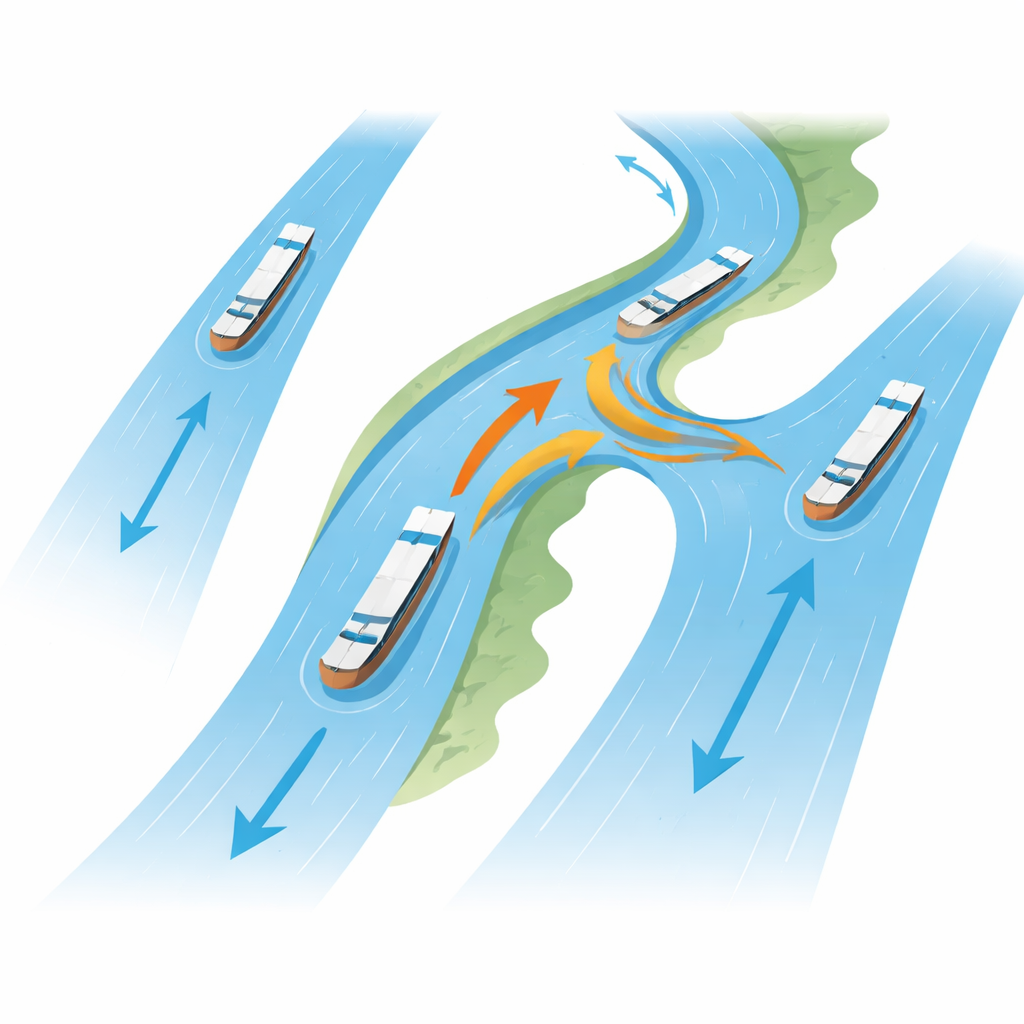
Inland waterways are the quiet workhorses of global trade, moving heavy cargo with far less fuel and pollution than roads or rails. But a hidden hazard lurks where rivers bend or smaller channels join a main one: sideways currents that shove ships toward the bank. This study asks a deceptively simple question with big practical consequences: how long can a ship safely travel through such a sideways current, and when do we need to make the channel wider to avoid accidents?
Rivers that don’t flow straight
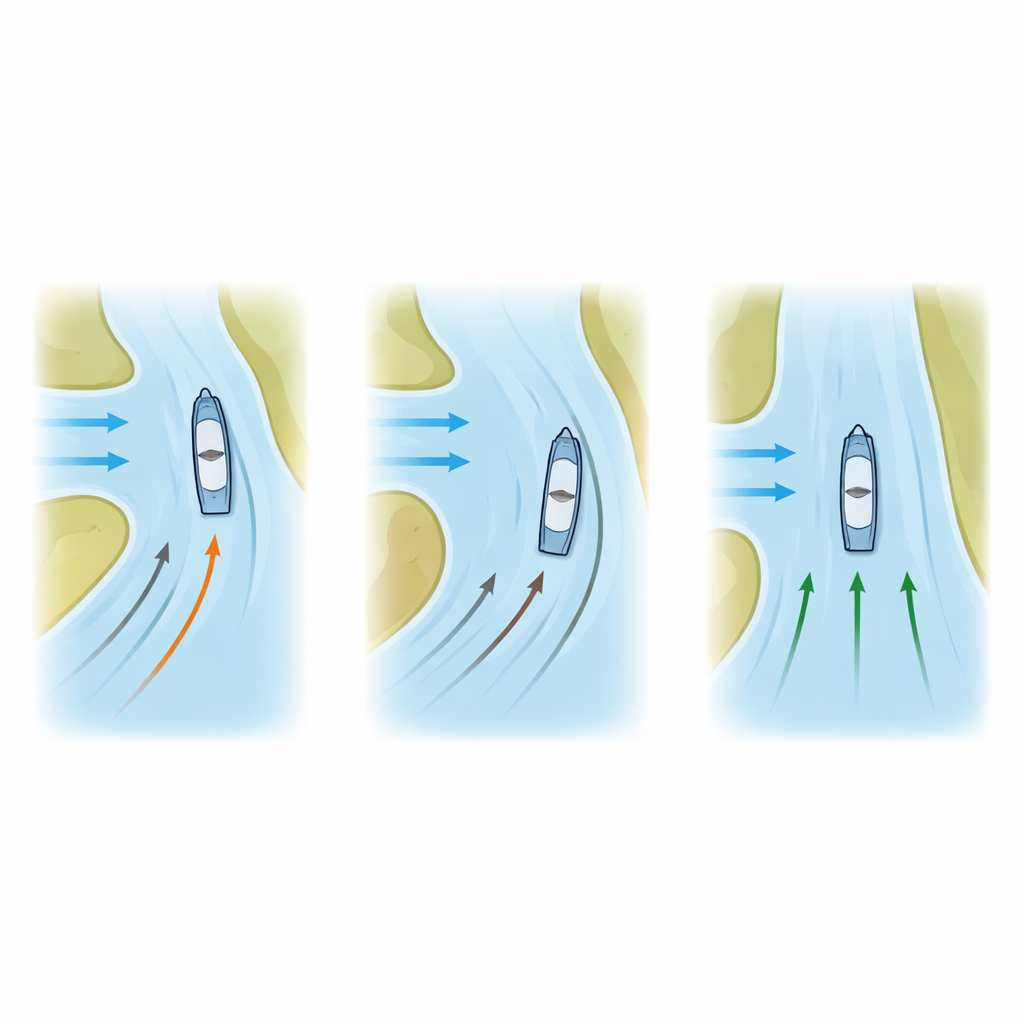
In a perfectly straight river, water flows mostly along the channel, and ships can hold their course with modest rudder corrections. Real rivers are messier. At bends, tributary junctions, and near dams or intakes, water can surge sideways, pushing on a ship’s hull like a strong wind on a billboard. Captains respond by turning the rudder into the flow, but the ship still drifts sideways as it moves forward. The longer it remains in this sideways current, the farther it is pushed toward the bank, shrinking the margin for error and raising the risk of grounding or collision.
From rule-of-thumb to measurable limits
Existing design rules for inland waterways mostly rely on a single number: the maximum sideways water speed that is considered acceptable, often about one-third of a meter per second. If the cross-flow exceeds this threshold, engineers might simply add a fixed extra strip of channel width as a safety margin. The authors point out that this approach ignores exposure time. Even a moderate sideways current can become dangerous if it persists for a long distance. To capture this cumulative effect, they ran detailed computer simulations that couple a river flow model with a ship motion model for representative cargo vessels operating in five classes of Chinese inland waterways, from small channels to large, busy arteries.
A new safety yardstick for sideways flow
From these simulations, the team introduces a practical new measure: the acceptable maximum safety cross-flow length, or AMSCL. In plain terms, this is the longest stretch of sideways current a ship can cross while still staying within its safe track, assuming the captain uses a realistic rudder angle but the channel itself is not widened. They show that this safe length shrinks as the sideways current grows stronger and also depends on the size of the ship and the class of the waterway. For moderate but “excessive” cross-flows between 0.35 and 0.60 meters per second, the safe length ranges from just under 8 meters in small low-class channels to about 55 meters in large high-class ones. Beyond these limits, steering alone cannot keep the ship away from the banks.
Turning simulations into design charts
Knowing that a given sideways current lasts too long is only half the story; engineers also need to know how much extra room to provide. The authors convert their simulated ship tracks into simple design charts that link three ingredients: the strength of the sideways current, the distance over which it acts, and the additional channel width required to stay safe. For each waterway class, they find that the required widening grows almost linearly with the length of the hazardous zone. A real-world test at the confluence of the Guangping River and the Pinglu Canal shows how this works in practice. There, an identified sideways current zone about 80 meters long caused large drifts and unstable headings. Applying the charts suggested a local widening of roughly 48 meters; after this widening, simulated ship paths became much more stable, with smaller drift angles and a comfortable clearance from the banks in both upstream and downstream directions.
What this means for safer, greener waterways
For non-specialists, the key message is that sideways currents in rivers are a two-dimensional problem: it is not just how strong they are, but also how far they extend. This study provides a way to turn those two pieces of information into concrete design decisions about channel width. By defining a safe maximum length of sideways current and offering easy-to-use charts for when that limit is exceeded, the work helps planners and engineers upgrade existing waterways, prioritize local widening where it is most needed, and avoid overbuilding in safer sections. In doing so, it supports the broader goal of making inland shipping a safer and more reliable backbone of low-carbon transport.
Citation: Wang, X., Tong, Sc., Zhang, Y. et al. Quantifying channel width thresholds for safe inland navigation under excessive cross-flow conditions. Sci Rep 16, 11707 (2026). https://doi.org/10.1038/s41598-026-46860-9
Keywords: inland waterway navigation, cross-flow currents, ship manoeuvring, channel width design, navigation safety