Clear Sky Science · en
CD204 regulates microglial/macrophage M1/M2 polarization and alleviates neuroinflammation following intracerebral hemorrhage
Why brain bleeding and the body’s response matter
When a blood vessel bursts deep inside the brain, the resulting bleed can leave survivors with lasting disability. Doctors know that the brain’s own immune cells rush to the injury and can either help repair tissue or make the damage worse, but how these cells are steered toward one role or the other is still being uncovered. This study looks at a single molecular "switch" on these cells, called CD204, and asks whether it can tilt the balance toward healing after a brain bleed in mice.
The two faces of the brain’s cleanup crew
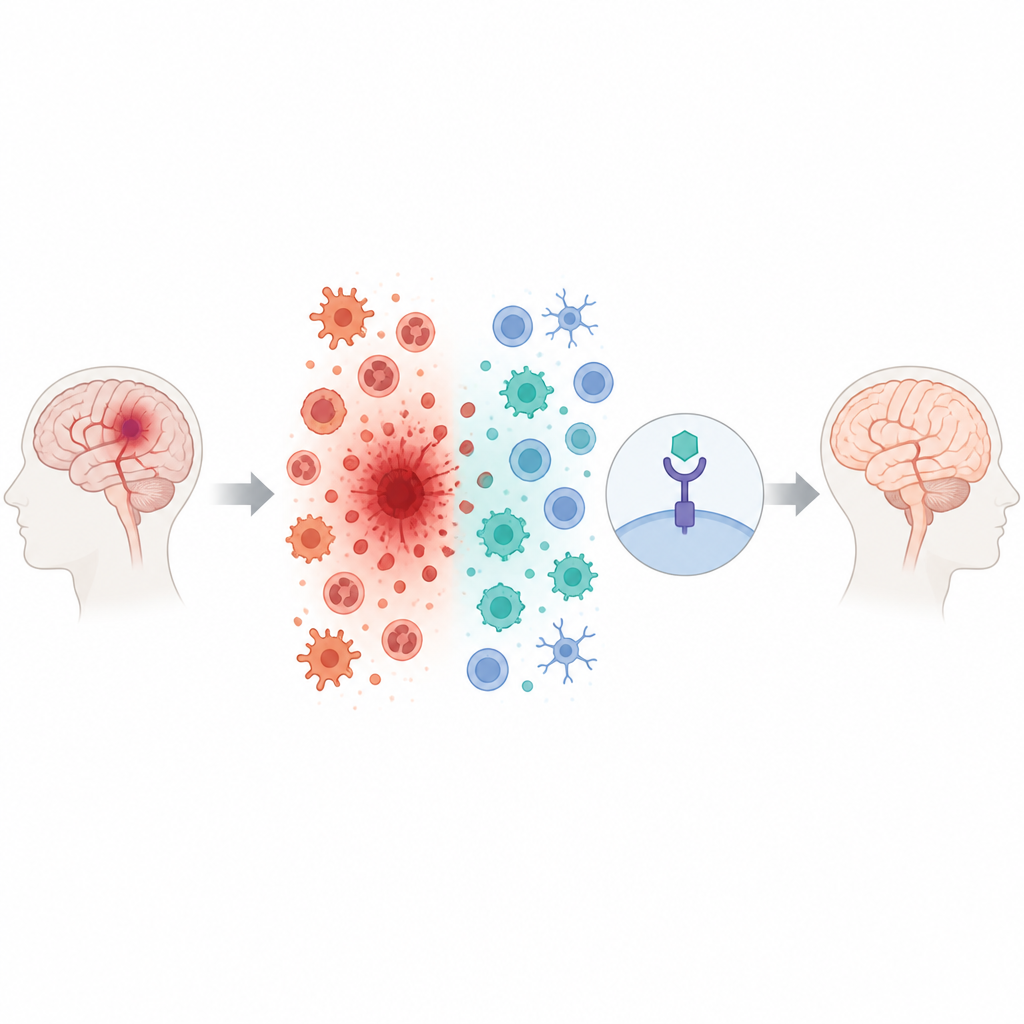
After an intracerebral hemorrhage, tiny immune cells called microglia, along with related cells called macrophages, swarm around the pooled blood. These cells can adopt a more aggressive state that releases toxic chemicals and worsens swelling, or a calmer state that supports cleanup and repair. Researchers often refer to these extremes as M1 and M2, but they can be understood simply as harmful versus helpful modes. The team first tracked when each mode appeared after a bleed in mice. They found that both harmful and helpful responses rose in the first week, suggesting that the brain is trying to fight off damage while also beginning to repair itself.
A surface receptor with a big influence
The scientists focused on CD204, a protein that sits on the surface of microglia and macrophages and helps them sense and absorb debris. In healthy brains, CD204 is present at low levels, but in this mouse model of brain bleed it rose quickly within 12 hours and peaked around day three near the injured area. Using fluorescent microscopy, the team showed that CD204 was especially abundant on activated immune cells clustered around the clot. This pattern hinted that CD204 might be part of the brain’s early response machinery, shaping how these cells behave in the critical days after injury.
Turning CD204 down makes injury worse
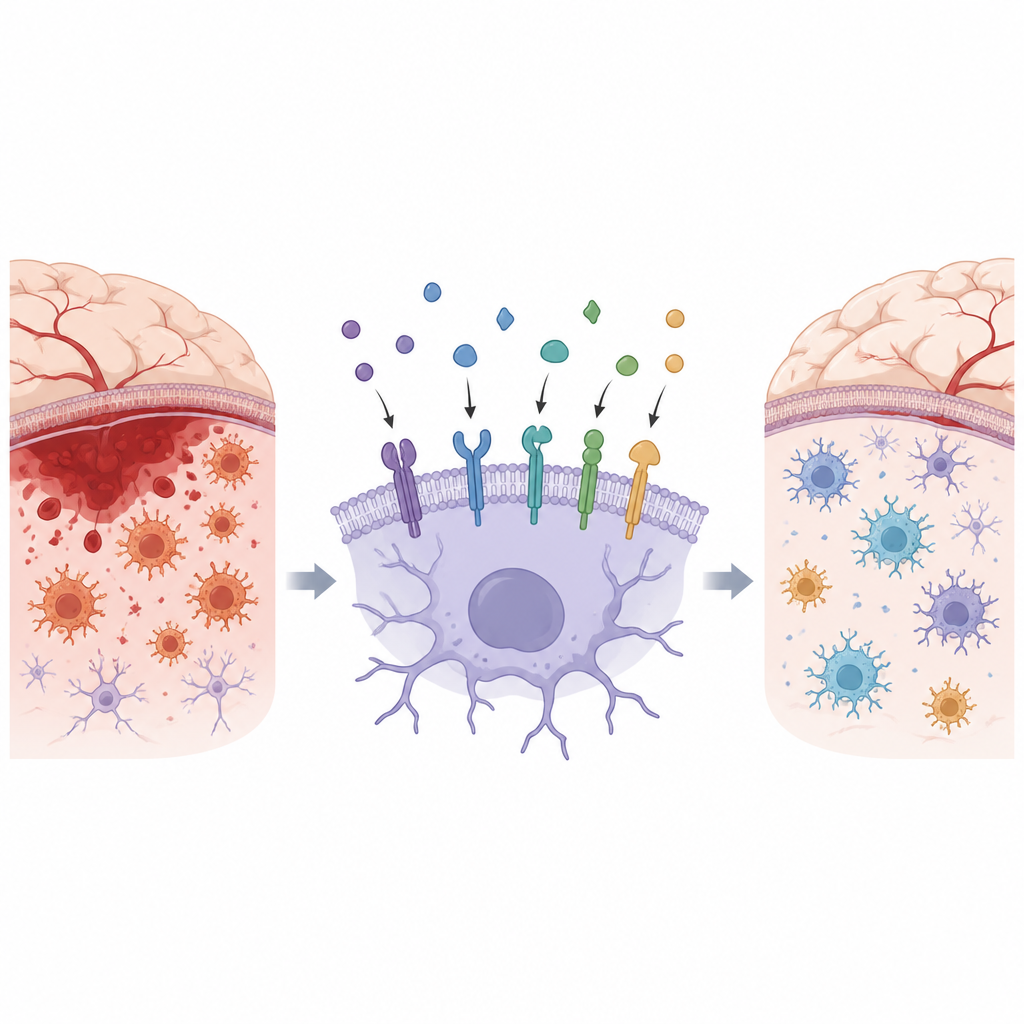
To test CD204’s role directly, the researchers used a genetic tool to reduce its levels in the brain before and just after the bleed. Mice with dampened CD204 performed worse on a series of movement and coordination tests, indicating more severe functional problems. Tissue staining revealed greater loss of neurons near the bleed in these animals. On a cellular level, more immune cells took on the harmful, aggressive mode and fewer adopted the helpful, repair-oriented mode. Levels of inflammatory molecules that can damage tissue climbed higher, while levels of a soothing, anti-inflammatory molecule fell. Together, these results point to CD204 as a protective factor that keeps the immune response from tipping too far toward self-harm.
Boosting CD204 tilts cells toward healing
The team then asked whether pushing CD204 activity in the opposite direction could help. They gave mice a drug called tamibarotene, known to stimulate CD204, at several time points after the bleed. Treated mice showed better scores in behavioral tests and had more surviving neurons near the injury. Their brain immune cells shifted away from the harmful mode and toward the helpful one, and the mix of inflammatory molecules in the tissue moved toward a calmer profile. When the researchers simultaneously knocked down CD204, tamibarotene no longer provided these benefits, suggesting that its helpful effects depend largely on this receptor. These experiments support the idea that CD204 acts as a key lever that can reprogram the brain’s immune response after a bleed.
What this could mean for future care
For people affected by brain bleeding, current treatments are limited and often cannot prevent long-term disability. This work in mice suggests that guiding the brain’s own immune cells into a healing mode, rather than an attacking one, could be a promising strategy. CD204 appears to help push microglia and macrophages toward a protective role, reducing inflammation and tissue loss. While more research is needed to confirm these findings in humans and to understand possible side effects, CD204 now stands out as a potential target for drugs aimed at softening the blow of brain hemorrhage.
Citation: Shi, W., Li, X., Meng, J. et al. CD204 regulates microglial/macrophage M1/M2 polarization and alleviates neuroinflammation following intracerebral hemorrhage. Sci Rep 16, 16197 (2026). https://doi.org/10.1038/s41598-026-46857-4
Keywords: intracerebral hemorrhage, microglia, neuroinflammation, macrophage polarization, CD204