Clear Sky Science · en
Microwave scattering signatures for distinguishing healthy and infested date palm trees
Why scanning palm trees matters
Date palm trees feed communities and support local economies across arid regions, but a tiny hidden pest can quietly hollow them from the inside. The red palm weevil often goes unnoticed until a tree is badly damaged or already dying. This study explores whether microwave signals, similar in frequency to those used by Wi Fi and microwave ovens, can be used from a distance to tell healthy palms from infested ones before the damage is visible. 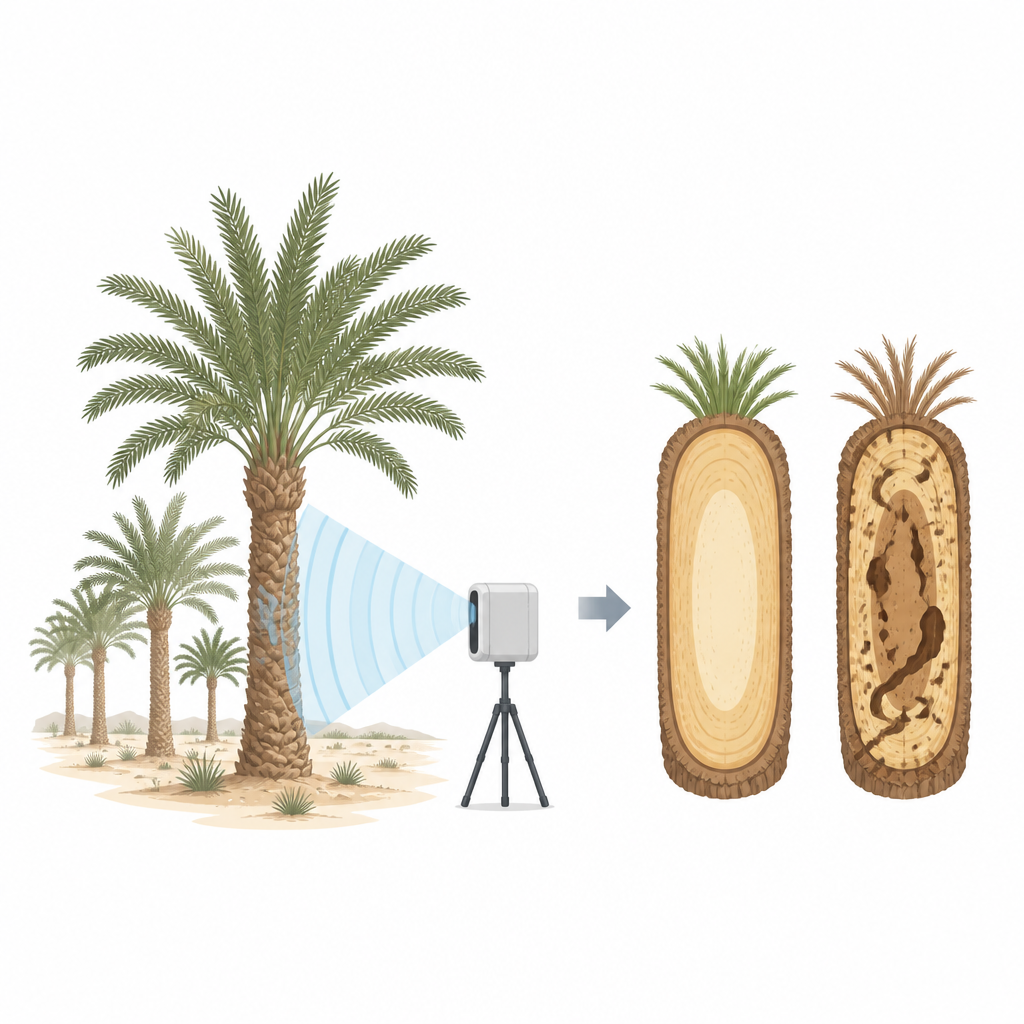
Hidden changes inside sick trees
When insects attack a date palm, they chew into the soft inner tissues, leaving behind tunnels, fermented material, and extra moisture. These changes alter how the tree’s trunk responds to electrical signals. The authors treat the trunk as a simple cylinder and focus on a property called its dielectric behavior, which describes how the material stores and loses electrical energy. Earlier measurements showed that damaged tissues usually hold more water than healthy ones and that this difference affects how they react to microwaves across a wide range of frequencies. These invisible changes become a kind of internal fingerprint of tree health.
Using microwaves as a health check
To turn this fingerprint into a practical test, the researchers model how a beam of microwaves strikes a palm trunk and scatters in different directions. They calculate a standard radar quantity that tells how strongly the tree reflects microwaves, treating the trunk as a long, smooth cylinder made of either healthy or infested tissue. They study two common ways to orient the microwave field relative to the trunk and consider normal head on illumination, which is easier to realize in the field than tilted beams. By computing how the reflected strength varies with angle around the tree, they identify ranges where healthy and infested trunks give clearly different responses.
Where the differences show up most
The analysis reveals that, at a widely used microwave frequency around 2.45 gigahertz, healthy and infested trees differ in reflected power by about one and a half decibels for certain angles, including the straight back direction toward the transmitter. For one polarization, the most useful viewing angles fall roughly within a 45 degree sector; for the other, useful differences extend over more than a quarter circle. At higher frequencies the contrast can grow even larger, but the waves do not penetrate as deeply into the trunk, making them less suitable for seeing into the tree’s interior. The chosen 2.45 gigahertz band offers a practical balance between reaching the inner tissues and preserving a measurable contrast in the reflected signal. 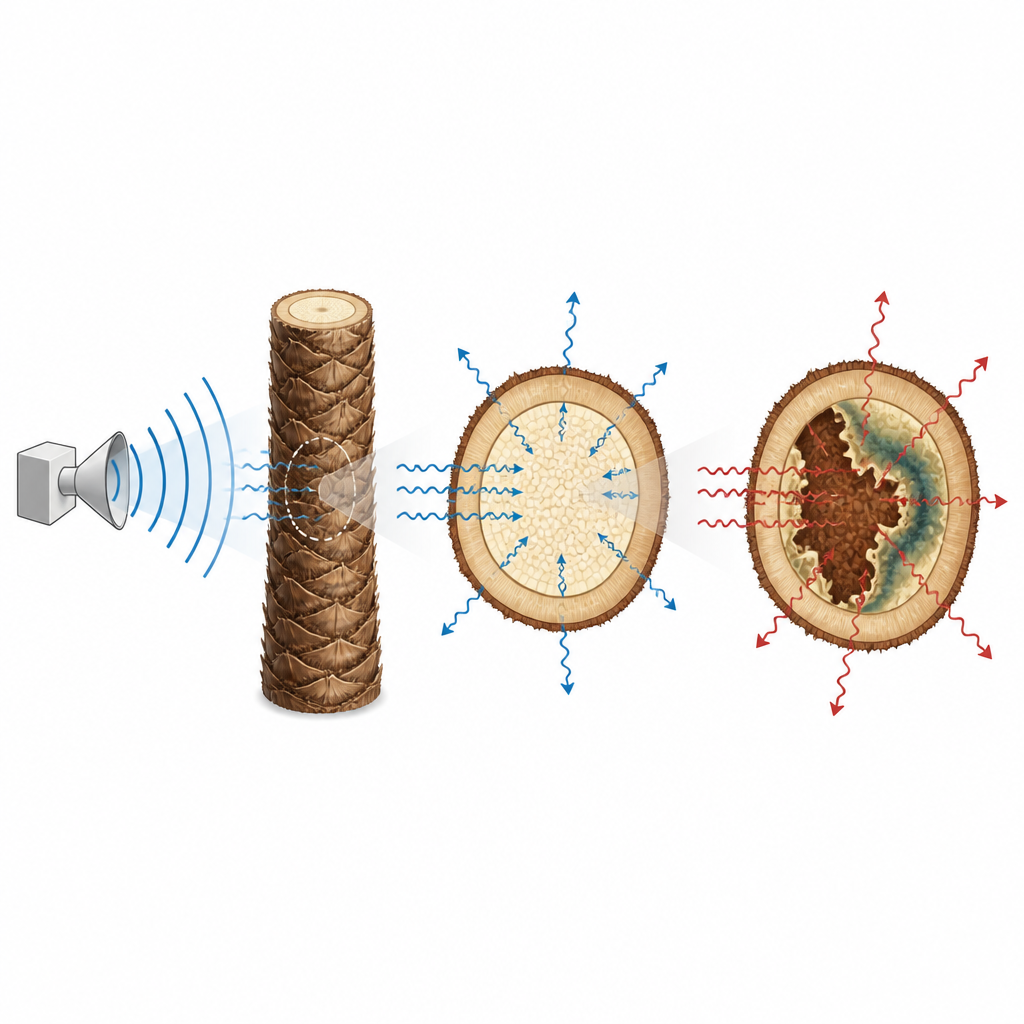
From theory to orchard tools
Because the model simplifies real trees by assuming smooth, uniform trunks and evenly spread damage, the authors discuss how surface roughness, layered bark and core, and patchy infestations might alter the patterns. They also outline strategies familiar from radar technology to cope with wind, ground reflections, and other clutter, such as averaging many measurements and choosing the most favorable angles and polarizations. The underlying message is that the key contrast in water content and structure between healthy and infested tissues dominates the microwave response, so a carefully designed sensor can still pick out the subtle but consistent differences in scattered power.
What this means for farmers
In plain terms, the study shows that sick and healthy date palms “look” different to a microwave radar because their damaged inner wood changes how they reflect incoming waves. By pinpointing the angles and signal settings that best highlight this contrast, the work lays the groundwork for portable or drone mounted systems that can scan orchards without cutting into trees or relying on slow visual checks. Such non invasive monitoring could flag suspect palms earlier, helping growers control pests more efficiently and protect both yields and the long term stability of date producing regions.
Citation: Moradi, A., Bait-Suwailam, M.M. Microwave scattering signatures for distinguishing healthy and infested date palm trees. Sci Rep 16, 15274 (2026). https://doi.org/10.1038/s41598-026-46851-w
Keywords: date palm, red palm weevil, microwave sensing, radar scattering, plant health monitoring