Clear Sky Science · en
Three dimensional magnetization structure of the Tofua Arc 12 seamount constrained by magnetization vector inversion
Hidden volcano under the sea
Far beneath the waves of the southwest Pacific, underwater volcanoes help shape the ocean floor and fuel hot springs that concentrate metals like copper and gold. This study peers inside one such hidden volcano, the TA12 seamount in the Lau Basin, to ask how it formed, how magma moves within it, and where hot fluids may be circulating today.
A young seafloor on the move
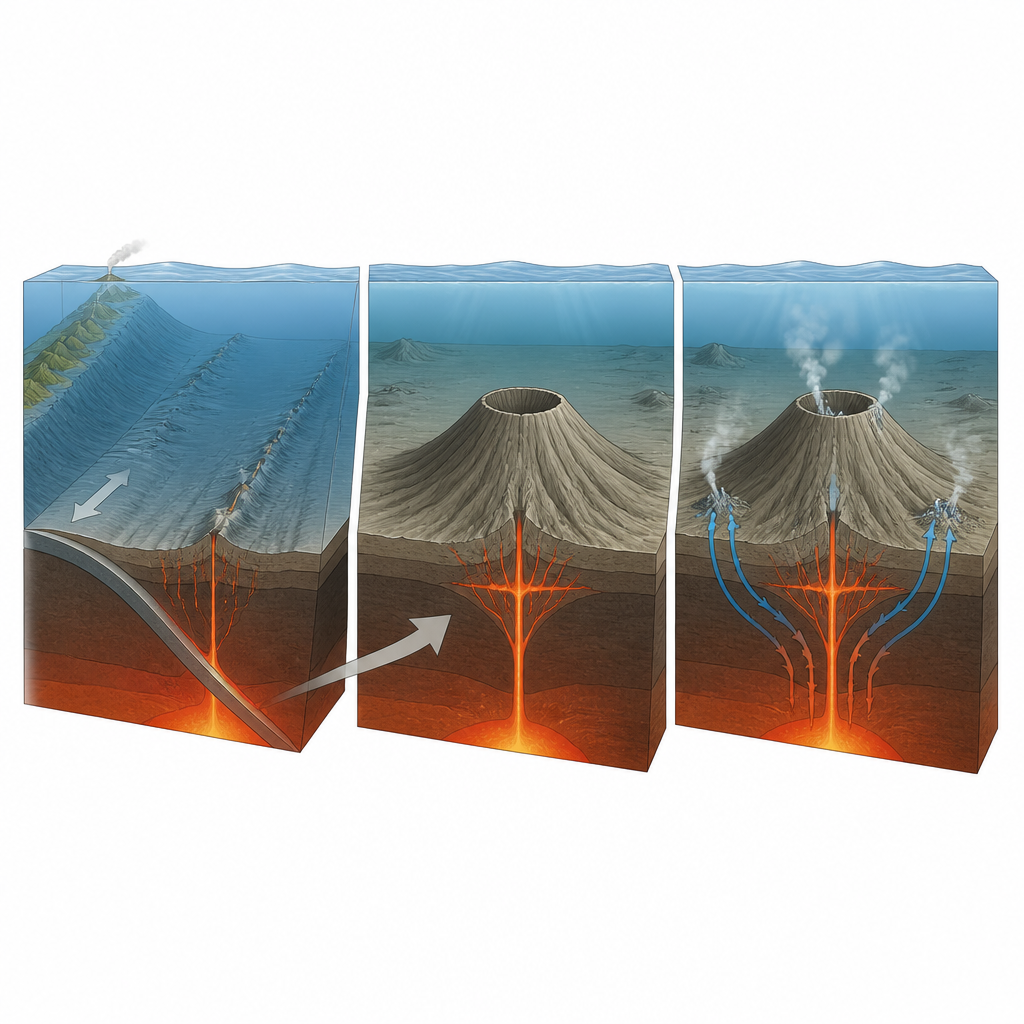
The TA12 seamount sits in a restless part of the Earth where one tectonic plate dives beneath another and the seafloor behind the trench is being pulled apart. This back-arc region, between the Tonga volcanic arc and the Lau Basin, hosts many undersea peaks scarred by collapse craters and cut by faults. Seawater can seep into these cracks, heat up near buried magma, and rise again as hot springs on the seafloor, leaving behind mineral-rich deposits. Understanding the internal build of a single seamount like TA12 helps scientists piece together how such volcanoes grow, break apart, and channel these metal-bearing fluids.
Reading the shape and magnetism of the seafloor
To probe TA12, the researchers combined high-resolution seafloor maps with measurements of tiny variations in Earth’s magnetic field collected from a ship in 2009. The bathymetry reveals a steep-sided volcano crowned by an elongated caldera, with a deep central depression and two small cones inside it. Steep inner walls and signs of landslides hint at a past collapse of the summit. Magnetic maps show strong signals around the caldera rim and weaker ones inside the depression and in slumped sectors, suggesting that the rocks there differ in how strongly they are magnetized. Because the survey lines are spaced nearly two kilometers apart, the team focused on overall patterns a few kilometers across rather than fine details.
Turning magnetic clues into a three dimensional picture
Magnetic data are tricky because rocks can carry both newly induced magnetization from the present field and a long-lived magnetic memory from when they first cooled. Instead of assuming a single fixed direction, the team used a method called magnetization vector inversion, which lets the strength and direction of magnetization vary throughout a three dimensional grid beneath the seamount. They corrected the raw data for Earth’s main field, explored how the results respond to changes in field direction, and then solved for the magnetization in each small volume of rock, balancing a good fit to the data against a smooth and geologically reasonable model.
What lies inside the underwater volcano
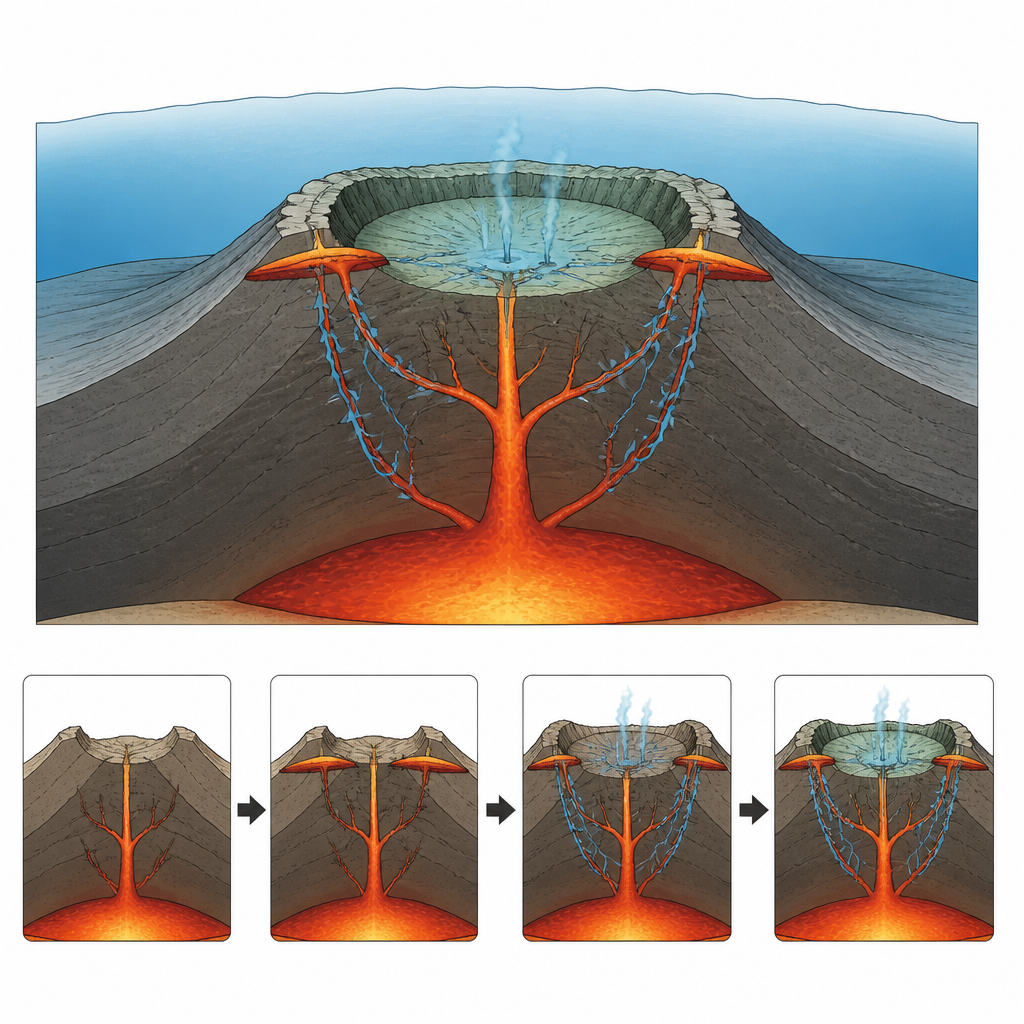
The resulting model shows that rocks shallower than about three kilometers below sea level are generally more strongly magnetized than deeper ones. High magnetization wraps around the caldera rim and extends beneath the volcanic flanks, with local highs under parts of the central depression and near the small inner cones. These patterns point to buried sill-like bodies and later intrusions that fed renewed cone growth after the main collapse. In contrast, zones of reduced magnetization inside the depression and in slump areas line up with features seen in previous seismic profiles, such as ring-shaped faults, chaotic collapse deposits, and a shallow basement surface. The authors argue that hot, chemically aggressive fluids likely moved along these faults, altering magnetic minerals and weakening their signal, although they caution that broken and redistributed volcanic debris may play a role as well.
A staged life story for TA12
Bringing the lines of evidence together, the authors outline a three step history for the seamount. First, a major eruption emptied a shallow magma reservoir and triggered caldera collapse, landslides, and a deep central depression. Second, magma rose again along fault-guided paths around the caldera rim, feeding shallow intrusions and building new cones within the depression. Third, the same faults and broken rocks became conduits for seawater, which circulated, heated up, and altered the surrounding rock, lowering its magnetization. While the model cannot resolve fine scale pathways and is not unique, it shows how carefully processed magnetic surveys, interpreted alongside seafloor maps and seismic profiles, can reveal the broad internal structure and evolution of submarine volcanoes and help steer future, closer-range exploration.
Citation: Choi, S.Y., Kim, H.R., Ko, Y.T. et al. Three dimensional magnetization structure of the Tofua Arc 12 seamount constrained by magnetization vector inversion. Sci Rep 16, 15960 (2026). https://doi.org/10.1038/s41598-026-46834-x
Keywords: submarine volcano, Lau Basin, magnetization inversion, hydrothermal circulation, caldera evolution