Clear Sky Science · en
Electricity consumption prediction using an advanced spatial-temporal deep learning framework
Why smarter power forecasts matter
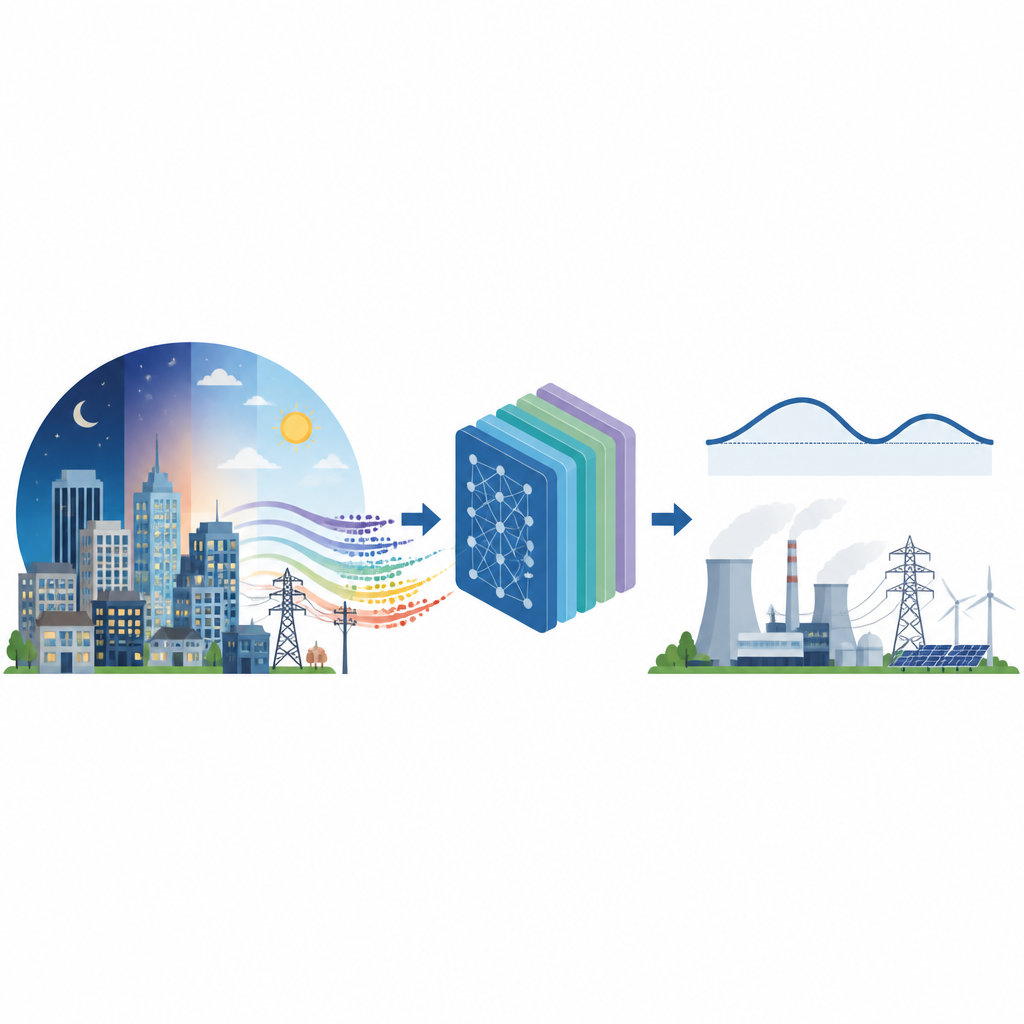
Every time you switch on a light or plug in a laptop, power grid operators have already guessed how much electricity you and millions of others will need. If they underestimate, blackouts and price spikes can follow; if they overshoot, costly power plants sit idle. This study explores how modern artificial intelligence can make those guesses more accurate, helping keep the lights on while cutting waste and cost.
The challenge of predicting daily power needs
Electricity demand rises and falls through the day, week, and year, shaped by work schedules, weather, holidays, and unexpected events. These patterns are not simple or smooth: a hot afternoon, a sudden storm, or a shift in work hours can all bend the curve in different ways. Traditional forecasting tools struggle with this mix of regular cycles and surprises, especially when they must read many signals at once, such as past demand, calendar information, and other context.
Looking at demand in space and time
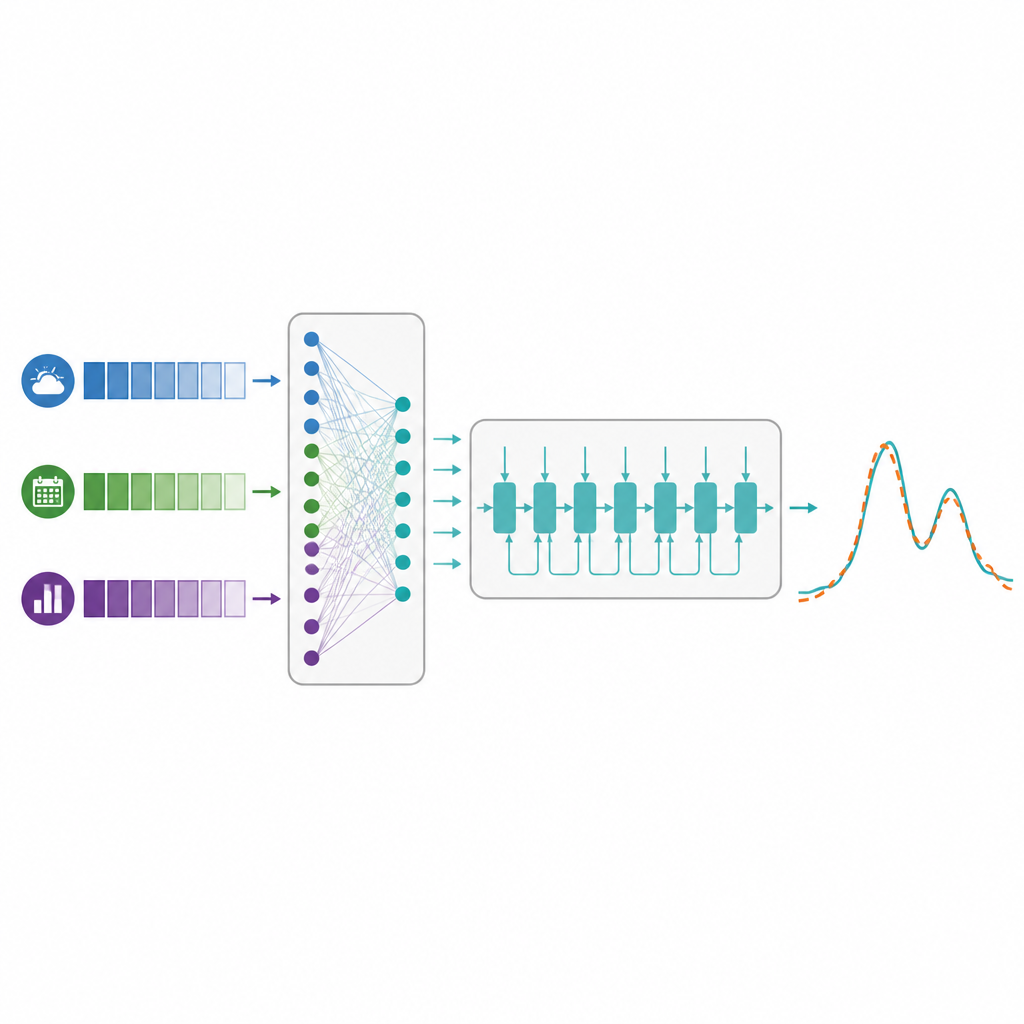
The authors argue that two kinds of patterns matter. First are relationships between the different input signals at a single moment in time, such as how temperature, time of day, and recent demand move together. They call these spatial relationships, but here “spatial” means connections among features, not geography. Second are changes across time, like the rise in use every morning or the weekend dip. Most older models look mainly at the time dimension and treat all input signals in a simple way, missing useful structure in how those signals interact.
A two stage deep learning model
To address this, the study introduces a deep learning model called a Spatial Temporal GRU, or ST GRU. It works in two stages. In the first stage, a special network looks only across the different input signals at each 15 minute step, learning how they relate and compressing them into a compact snapshot. In the second stage, another network takes the sequence of these snapshots and learns how demand evolves over hours and days. By separating these jobs, the model can pay close attention to both feature relationships and timing, instead of blending everything into a single process.
Putting advanced models to the test
The researchers did not just propose a new model; they pitted it against a wide range of rivals. Using two public datasets with electricity use measured every 15 minutes, they compared standard recurrent networks, attention based models, temporal convolutional networks, and transformer based designs. All models were trained and tuned carefully on one dataset and then tested both on held out data from the same source and on a second, independent dataset, mimicking how a forecasting tool would face new conditions in real grid operations.
What the results reveal
Across nearly all error and accuracy measures, the ST GRU delivered the most accurate forecasts. It reduced prediction error by several percent compared with a standard GRU model and by about a quarter compared with a popular LSTM model on the main dataset. It also held up well when exposed to new data, noisy measurements, and artificially added gaps, suggesting that its two stage design makes it more robust to quirks and glitches in real world signals. Some competitors, such as an optimized bidirectional LSTM, transformers, and temporal convolutional networks, performed strongly but still fell short of the ST GRU on average.
What this means for everyday life
For non specialists, the key message is that smarter, carefully structured AI can make electricity demand forecasts more reliable. By first learning how different signals relate at each moment and then how those relations change over time, the ST GRU model better tracks the ups and downs of power use. In practice, this can help grid operators schedule power plants more efficiently, integrate more renewable energy, and respond more smoothly to sudden changes in demand, all while reducing waste and improving the stability of the electric system that homes and businesses rely on.
Citation: A. Palan, V., N., S. Electricity consumption prediction using an advanced spatial-temporal deep learning framework. Sci Rep 16, 15425 (2026). https://doi.org/10.1038/s41598-026-46825-y
Keywords: electricity demand forecasting, deep learning, time series, energy systems, smart grid