Clear Sky Science · en
Bacterial species differentiation via real-time detection of microbial volatile organic compounds using a wavelength multiplexed photoionization detector and AI image-based analysis
Why smelling germs could change hospital care
Hospitals constantly battle infections that patients pick up while receiving treatment, often caused by bacteria that resist common antibiotics. Doctors need to know quickly which germ is present to choose the right drug, but current tests can take days. This study explores a new approach that listens to the “smell” of bacteria in real time and uses artificial intelligence to tell different species apart, aiming to speed up diagnosis and improve patient care.
Germs that leave a chemical scent
Just as coffee, flowers, or paint each give off a recognizable smell, bacteria release their own mix of tiny airborne chemicals. These are called volatile organic compounds, or VOCs, and each species tends to emit a particular blend as it grows. The authors focused on four common hospital troublemakers, including E. coli and Staphylococcus aureus, which are major causes of urinary, blood, and lung infections. If these chemical blends can be read quickly and reliably, they could serve as a kind of fingerprint that reveals which germ is present without needing to touch the bacteria themselves.
A compact sensor that sniffs out invisible clues
To capture these bacterial scents, the team built a small device based on a technology called photoionization detection. Inside the sensor, four tiny lamps shine high‑energy light on the incoming VOCs. Each lamp has a different light energy, so each one preferentially responds to a slightly different slice of the chemical mix. As the chemicals are hit by the light, they form charged particles that generate a weak electrical current. Over a 20‑minute period, each lamp produces its own current curve, reflecting how the bacterial scent changes over time. Together, these four curves form a kind of multi‑color pattern that is specific to each species and to how many bacteria are present. 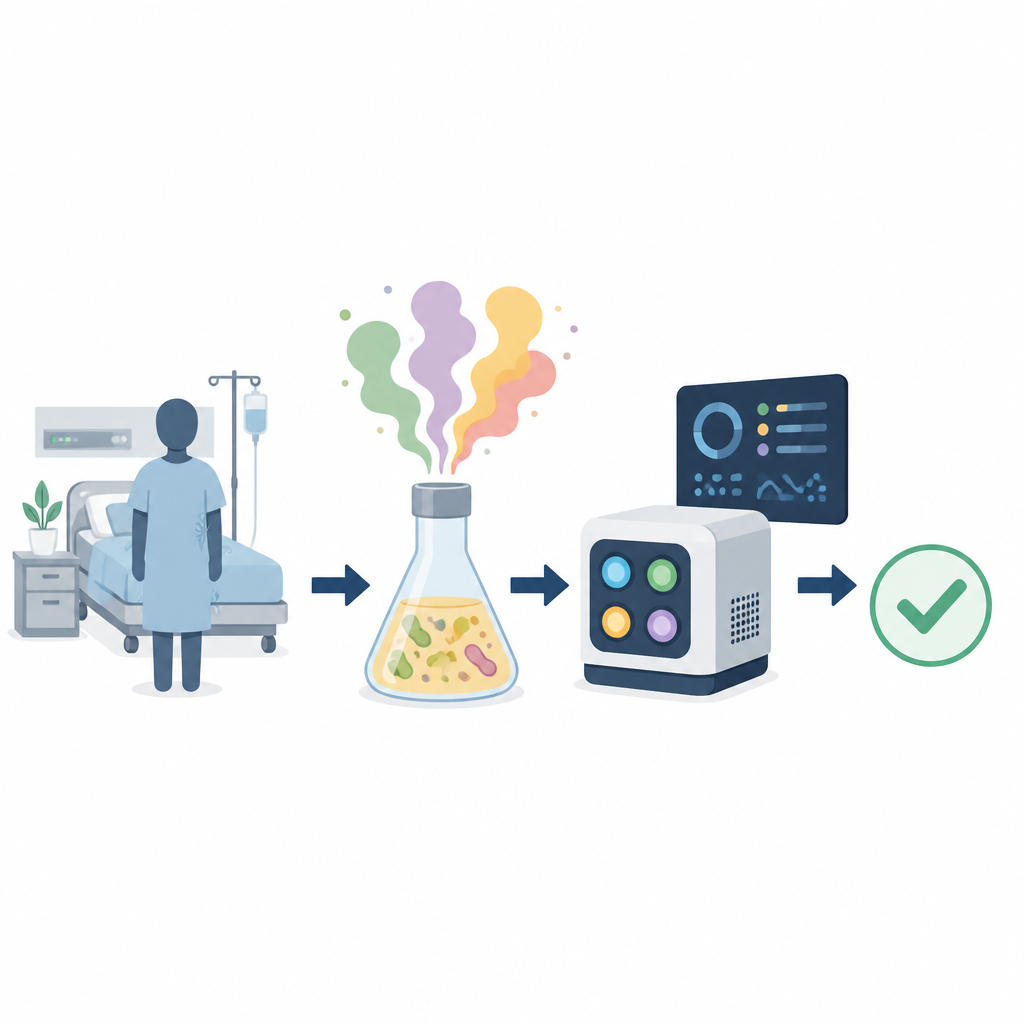
Turning sensor signals into pictures for AI
The raw electrical curves are complex and not easy for a human to interpret by eye. The researchers therefore converted the curves into images, filling in the area under each line and combining the four lamp signals into a single picture. They then used a pre‑trained image recognition network, originally designed to classify everyday photographs, and adapted it for this task using a strategy called few‑shot learning. This approach is designed to work even when only a small number of examples are available, which is often the case when a new sensor is first developed. The AI model learned to spot the subtle differences in shape and intensity between images from different bacteria and from different concentration levels.
What the system can already tell us
In tests, the sensor reliably told apart the four bacterial species based on their VOC patterns, achieving more than 88 percent accuracy for species identification. It detected very low bacterial levels, down to about one hundred cells per milliliter, which overlaps with the range seen in early bloodstream infections and is well below typical levels found in urinary tract infections. The system also distinguished between low and high contamination levels, an ability that could help clinicians decide whether an infection is significant or still at an early stage. When the team generated a more balanced dataset, the AI model’s performance improved even further, showing that more consistent data would make the method even more powerful. 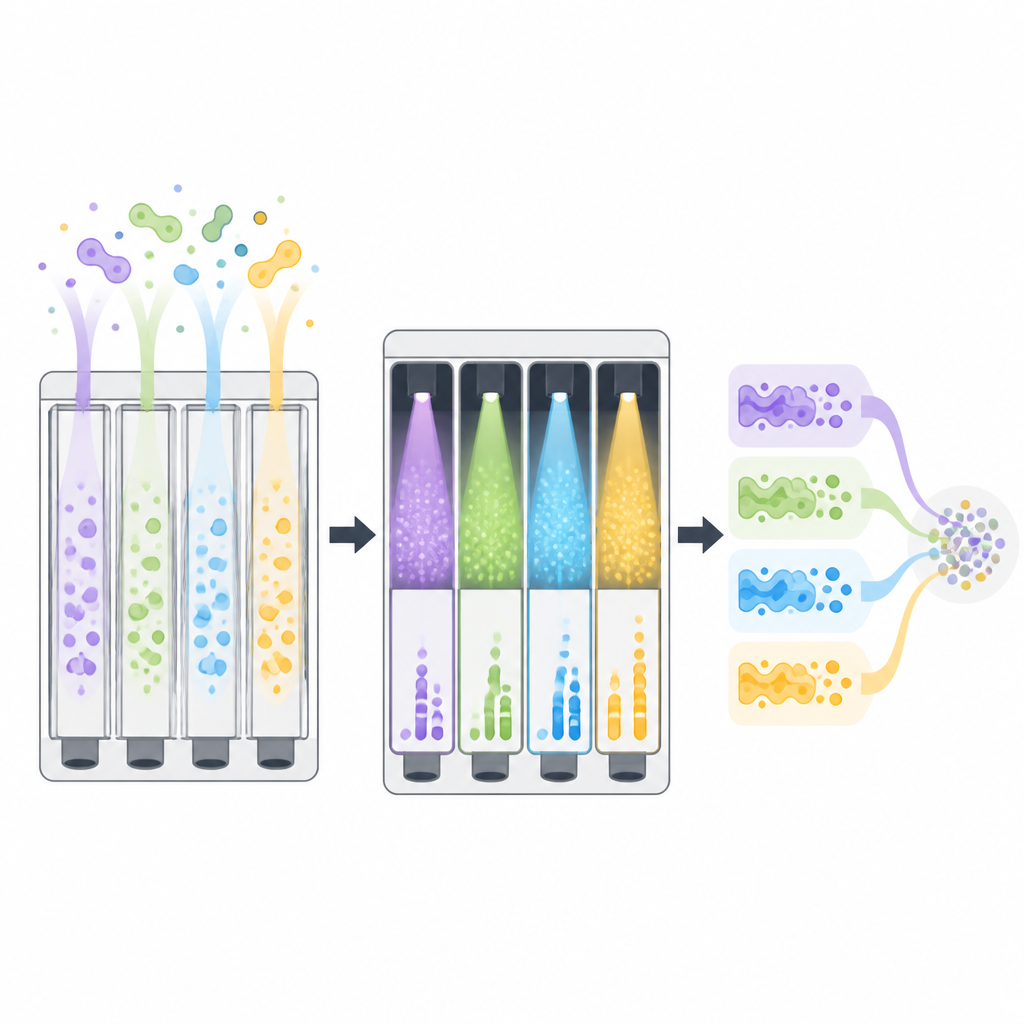
What this might mean for patients
This work does not replace standard lab tests yet, but it shows that combining a simple smell‑based sensor with modern AI can quickly flag which bacteria are present and how abundant they are. Because the device is compact, uses no special labels or complex sample preparation, and reads the air above a culture directly, it could be adapted for bedside or near‑patient use. In the future, similar tools might help doctors react faster to hospital infections, tailor treatments more precisely, and reduce the unnecessary use of broad‑spectrum antibiotics, supporting better outcomes for patients.
Citation: Costa, S.P., Cardoso, A., Mahmoodnia, H. et al. Bacterial species differentiation via real-time detection of microbial volatile organic compounds using a wavelength multiplexed photoionization detector and AI image-based analysis. Sci Rep 16, 15924 (2026). https://doi.org/10.1038/s41598-026-46818-x
Keywords: bacterial detection, volatile organic compounds, photoionization sensor, artificial intelligence, healthcare infections