Clear Sky Science · en
An auto-validation method for a complete IoT pivot irrigation model based on the Penman–Monteith equation
Smarter watering for fields
Across the world, farmers struggle to grow more food with less water. This study describes a smart irrigation system that uses sensors, wireless links, and a well known water-use formula to give crops just the water they need. It focuses on circular "pivot" irrigation machines and explains how to check sensor readings automatically so that bad data does not lead to wasted water or thirsty plants.
Why water use is hard to get right
Giving crops the right amount of water is not as simple as turning on a tap. Plants lose water through their leaves while the soil loses water to the air, and both depend on sunshine, temperature, wind, and humidity. Traditional systems often guess or follow fixed schedules, which can mean overwatering or underwatering. The authors show that many earlier smart systems either ignore some of these factors, lack clear performance tests, or are too expensive or narrow in scope, leaving farmers without a complete and reliable solution.
The idea behind the new system
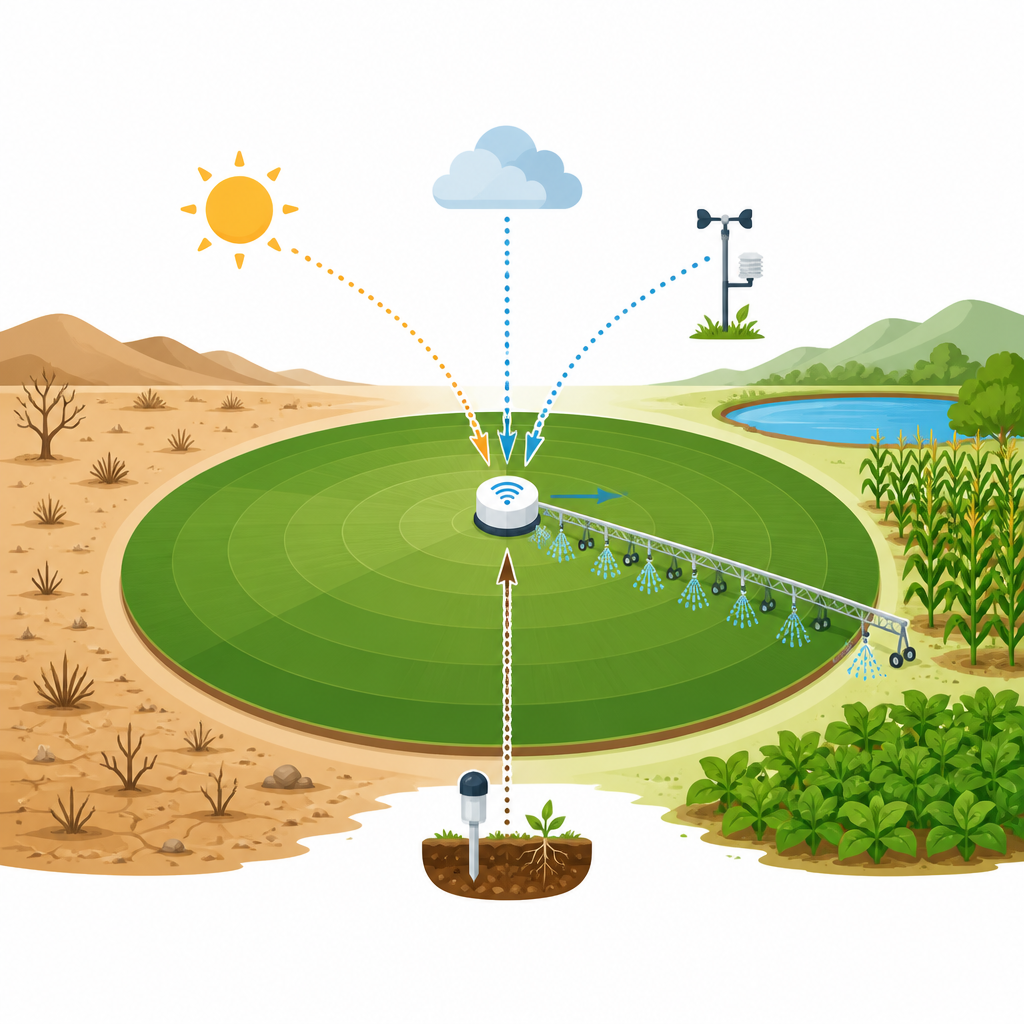
This work brings together three pieces into one complete model. First, it uses a standard formula from agricultural science to turn weather and soil conditions into a daily estimate of how much water each square meter of land needs. Second, it builds an Internet of Things setup around a pivot irrigator, with low cost sensors that track soil temperature, air temperature, humidity, wind, and air pressure, plus simple controllers and valves to deliver water to small sections of the field. Third, it defines clear rules for judging whether the system is working well, including how accurately it estimates crop water needs and how easily it can be scaled and maintained.
How the sensors and checks work
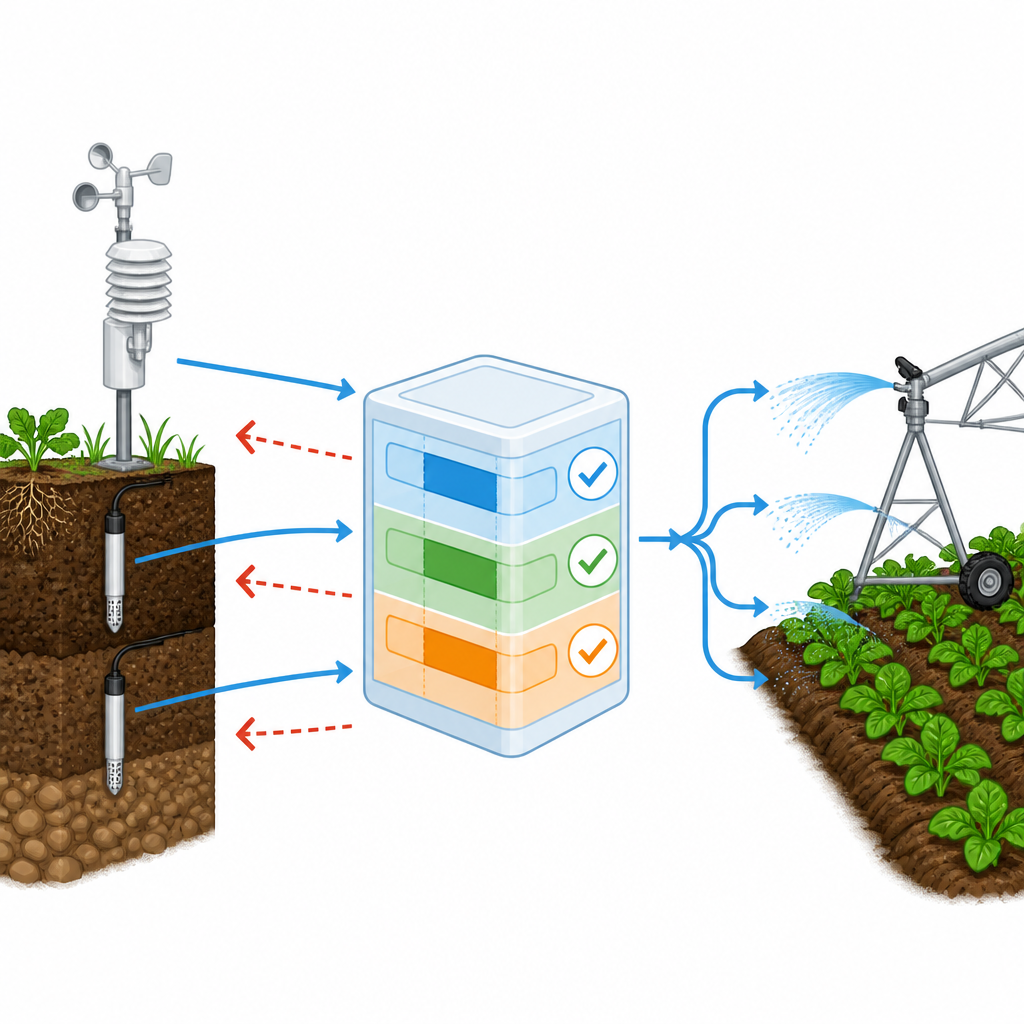
The field test uses two sensor stations. One sits on or in the soil and measures soil temperature at different depths, air temperature, humidity, and pressure. The other is mounted about two meters above the ground and measures wind speed and air conditions. These stations send their readings over WiFi to a base unit, which runs a web application that displays the data and calculates how much water should be applied over time. To avoid mistakes when a sensor fails or a wireless link glitches, the authors create simple pass/fail rules for each measurement, such as acceptable ranges for radiation from the sun, soil heat, air temperature by season, wind speed, and moisture in the air. Readings outside these ranges are treated as suspect, protecting the system from misleading inputs.
What the field trial showed
The system was tested on a grass field at the University of Tabuk over 49 days. During this period, the sensors collected data every few hours, and the software turned these data into daily water needs for each square meter of land. The researchers compared the estimated water needs with the actual amount of water the field managers applied using the pivot system. While the real irrigation amounts were often higher than the calculated needs, the estimates followed the same overall pattern and explained much of the day to day change in water demand. The team also used standard statistics to show how closely their estimates tracked the water that was actually applied.
What this means for farming
For a lay reader, the key message is that it is now possible to build a practical, relatively low cost system that watches the weather and soil, checks the quality of its own data, and then advises how much to irrigate a field. In this early trial on grass, the approach provided a solid baseline for smarter watering and highlighted where extra water is likely being wasted. The authors argue that their combination of complete sensing, automatic checks, and clear design guidelines can serve as a template for future systems on other crops and in other climates, helping farmers conserve water, cut costs, and maintain healthy yields.
Citation: Elfaki, A.O., Albelwi, S.A., Lakhouit, A. et al. An auto-validation method for a complete IoT pivot irrigation model based on the Penman–Monteith equation. Sci Rep 16, 15670 (2026). https://doi.org/10.1038/s41598-026-46804-3
Keywords: smart irrigation, pivot irrigation, IoT agriculture, water management, evapotranspiration