Clear Sky Science · en
Evolution mechanism of pore structures in sandstone under coupled effect of hygrothermal cycles and Na2SO4 solution
Why Crumbling Rock Matters
On the surface, sandstone hills and cliffs look solid and timeless. Yet in many valleys, reservoirs, and road cuts, these rocks weaken over just a few years, triggering landslides and rockfalls that threaten people and infrastructure. This study explores a quiet but powerful culprit: repeated cycles of wetting and heating in the presence of salty water. By watching how tiny pores inside sandstone change under these conditions, the researchers reveal why some slopes slowly lose strength and how engineers might better protect them.
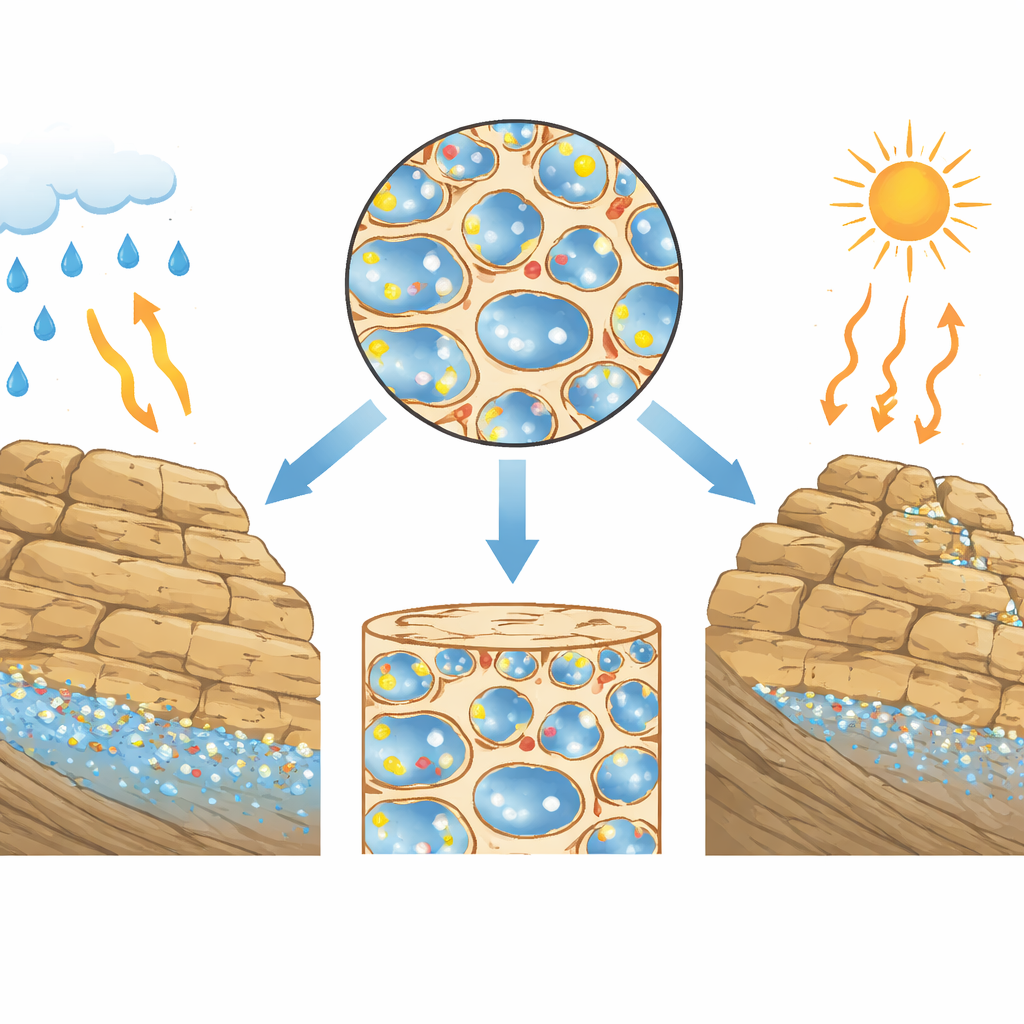
Rain, Sun and Salt Working Together
In many mountainous regions, sandstone slopes are exposed to a regular rhythm of rain, sun, and more rain. Water in these settings is rarely pure: it often carries dissolved salts, including sodium sulfate. The team focused on sandstone collected from a slope in Wanzhou District, Chongqing, China, and prepared small cylindrical samples. They then soaked these samples in sodium sulfate solutions of three different strengths, as well as in distilled water for comparison. Each sample was repeatedly cycled: an hour of soaking at room temperature, an hour of drying at 60 °C—similar to a hot sunny rock surface—and then cooling back to room temperature.
Watching Rock Change from the Inside Out
After every ten cycles, the researchers measured how the sandstone changed. They tracked mass loss as tiny grains broke away, checked surface hardness, used sound waves to probe internal stiffness, and applied low-field nuclear magnetic resonance to map the pore structure. Over 50 cycles, samples in salty solutions lost more mass than those in pure water, with the strongest solution producing about 4.5% mass loss. Hardness fell by up to 10%, especially after about 20 cycles, signaling that the rock surface was becoming looser and less resistant to wear.
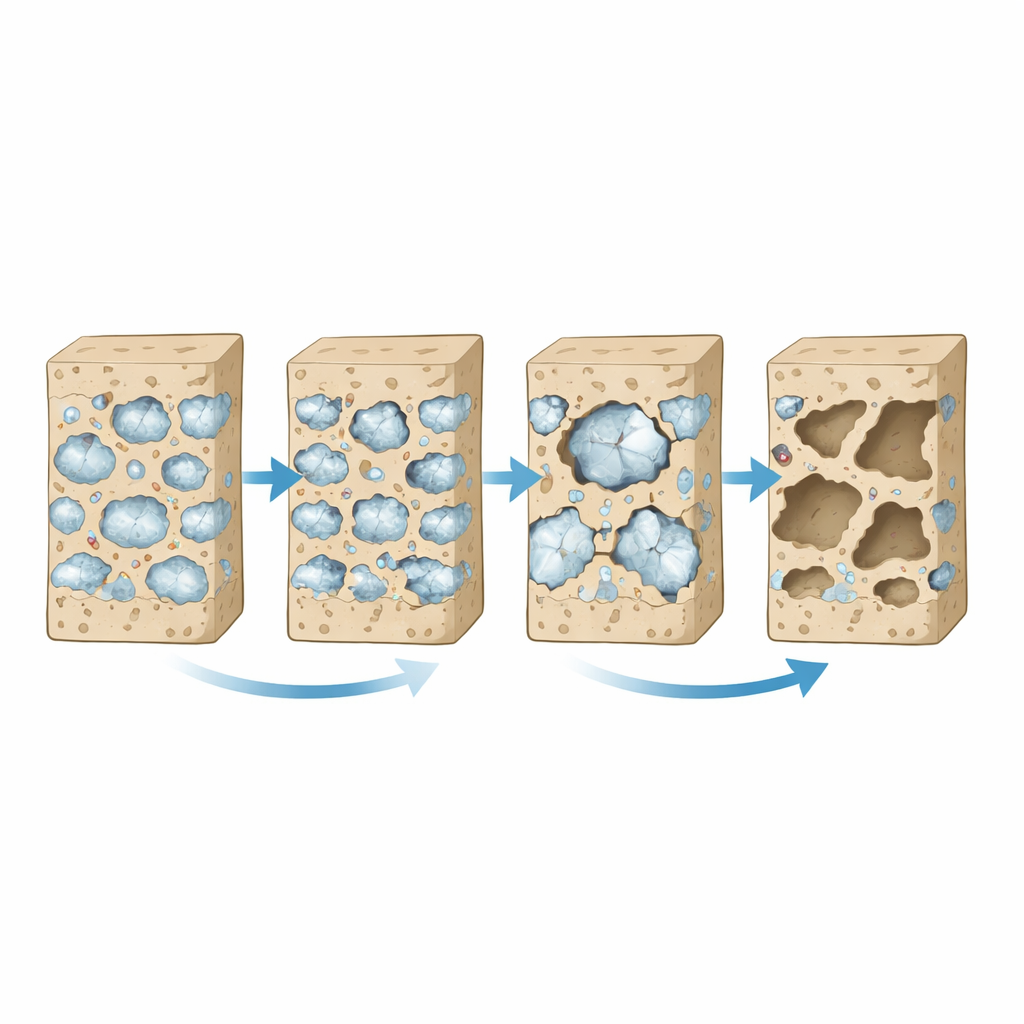
From Tiny Pores to Big Cavities
The pore-scale measurements reveal how this weakening unfolds. At first, as salt-rich water soaks in and then evaporates, sodium sulfate crystallizes inside the smallest pores. Early on, the crystals can actually fill gaps and make the rock seem slightly tighter and faster for sound waves to travel through. But as wetting and drying repeat, crystals grow and shrink again and again, exerting pressure on pore walls. This eventually ruptures the walls between neighboring pores, turning many micropores into fewer but larger pores and even microcracks. The overall porosity rises, particularly at higher salt concentrations, and the sound-wave speed peaks around 20 cycles before dropping as damage accumulates.
Salt as a Hidden Engine of Slope Damage
Taken together, the experiments show that sodium sulfate–bearing moisture cycles are an efficient engine for rock damage. Saltwater first sneaks into existing pores, then crystallization and recrystallization gradually pry them open and link them together. As the population of tiny pores shifts toward more medium and large voids, the sandstone becomes lighter, softer and less able to transmit waves—signs of a weakened internal framework. For engineers designing or maintaining slopes near reservoirs, roads or cultural heritage sites, the message is clear: not all water is equal. Salt content and climate-driven wet–dry cycles can quietly transform seemingly strong sandstone into a far more fragile material, raising the risk of erosion and failure over time.
Citation: Geng, J., Li, X., Wu, Y. et al. Evolution mechanism of pore structures in sandstone under coupled effect of hygrothermal cycles and Na2SO4 solution. Sci Rep 16, 10554 (2026). https://doi.org/10.1038/s41598-026-46746-w
Keywords: sandstone weathering, salt crystallization, pore structure, slope stability, wetting-drying cycles