Clear Sky Science · en
A novel computational study of reverse degree topological indices and entropies for nanostar dendrimers
Why tiny branching molecules matter
Dendrimers are man‑made, tree‑shaped molecules only a few billionths of a meter across. Because they can be tailored with great precision, they are promising carriers for drugs, genes, and imaging agents, as well as building blocks for advanced materials and nano‑electronics. But their intricate branching makes it hard to link structure to behavior. This paper develops a mathematical toolkit to read the “hidden wiring diagram” of two nanostar dendrimers and to quantify how their complexity grows, with the long‑term goal of helping chemists design better nanomedicines and nanomaterials.
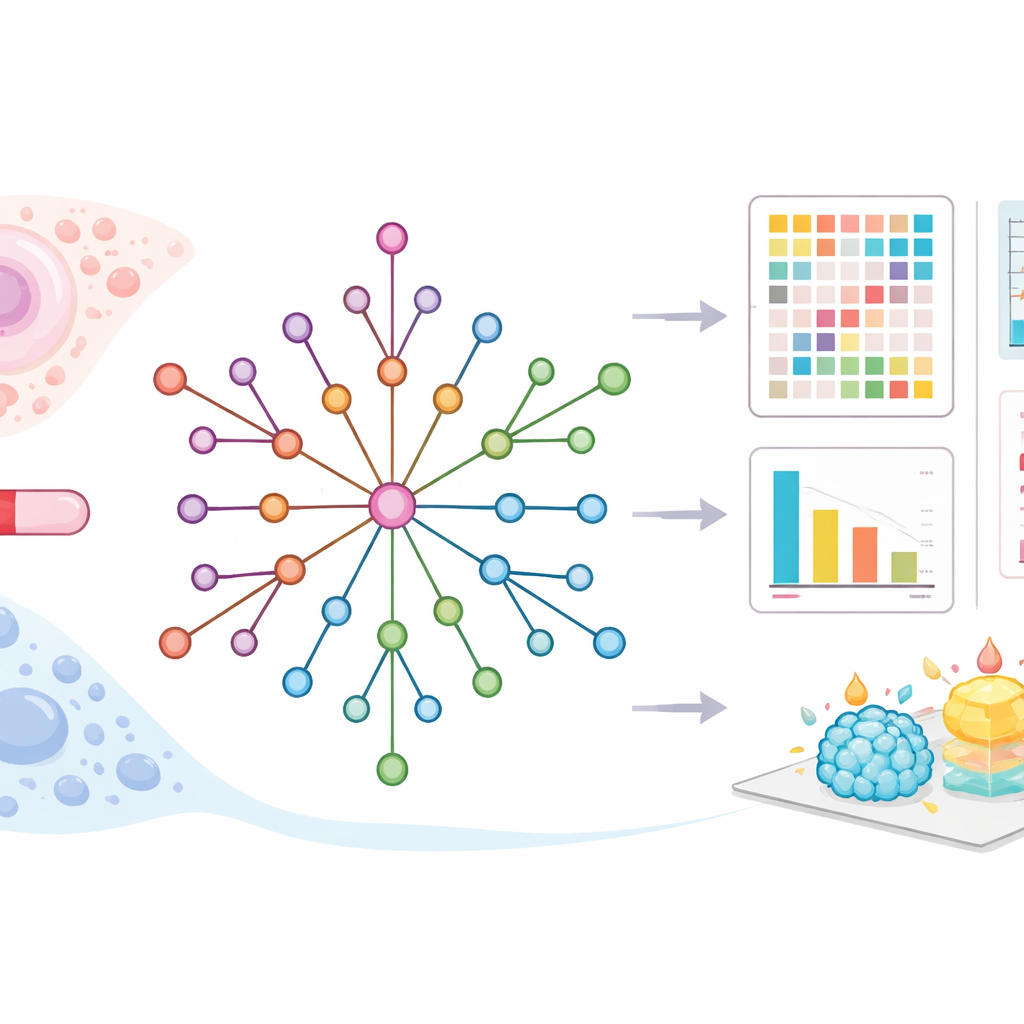
Tree‑like molecules built for precision
The authors focus on nanostar dendrimers, a family of molecules whose branches repeatedly split from a central core, much like a perfectly symmetric tree. Two specific types are studied: polypropylenimine octaamine dendrimers, which are widely explored as drug and gene delivery vehicles, and fullerene‑centered dendrimers, which use a soccer‑ball‑shaped carbon cage as a hub and are attractive for electronics, solar cells, and therapy. Because these architectures can be grown generation by generation, researchers need compact numerical descriptors that summarize how the branches, connection points, and overall size evolve as the molecule becomes larger and more complex.
Turning molecules into networks of points and links
To achieve this, the dendrimers are treated as abstract networks. Each atom becomes a point (a “vertex”) and each chemical bond becomes a link between points (an “edge”). Traditional measures of such networks often count how many bonds meet at each atom and then combine these counts into so‑called topological indices. These indices have been successfully used for decades to correlate molecular structure with properties like boiling point, stability, or biological activity. The present work goes a step further by using reverse degree: instead of rewarding highly connected atoms, it mathematically emphasizes the less connected ones, which often sit at the molecule’s periphery where drugs, genes, or other cargo are attached.
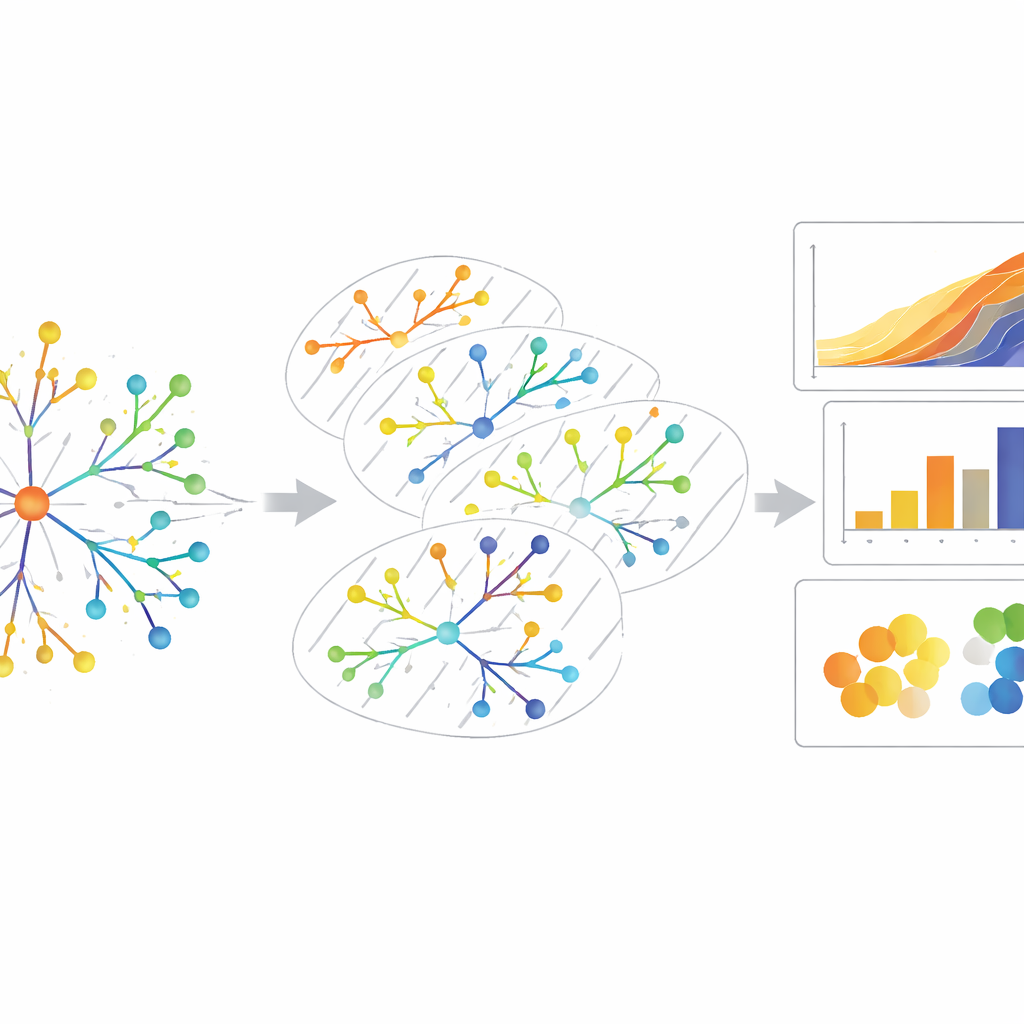
New numbers for branching and hidden order
Building on the reverse‑degree idea, the authors systematically compute a broad collection of indices—for example, variants of the Zagreb index, atom‑bond connectivity index, and several newer “Gourava” and “hyper‑Gourava” measures—for both kinds of dendrimers across many generations. Each index collapses the detailed graph of atoms and bonds into a single number, but different indices react differently to added branches or changing patterns of connection. By using precise counting formulas rather than brute‑force simulation, the team derives exact expressions that show how each index grows as the dendrimer’s generation increases. Plots of these values reveal which indices are especially sensitive to added layers of branching and which grow more gently, making them better suited to compare molecules of very different sizes.
Measuring molecular complexity with entropy
The study then introduces entropy‑based measures that treat the pattern of connections in a dendrimer like a probability distribution. In simple terms, entropy captures how evenly or unevenly connections are spread across the molecule: higher entropy corresponds to more varied local environments for atoms and more structural richness. Using formulas tied to their reverse‑degree indices, the authors compute entropies for both the polypropylenimine and fullerene dendrimer families. These entropy values provide a compact way to compare different dendritic architectures and generations, and can be plugged into standard structure–property and structure–activity models used by chemists to predict stability, reactivity, and performance in drug delivery or materials applications.
From abstract math to better nanomedicine
In everyday terms, this work shows that it is possible to translate extremely complex, tree‑like molecules into a handful of meaningful numbers that capture how they are built and how their complexity grows. By focusing on reverse‑degree indices and related entropies, the authors highlight aspects of dendrimer structure that are especially relevant for how these nanostars interact with their surroundings—such as the dense, functional outer shell where drugs or other active components are attached. These mathematically defined fingerprints could help scientists rapidly screen candidate dendrimers on a computer before synthesizing them in the lab, guiding the design of more efficient carriers and functional nanomaterials.
Citation: Qummer, A.A., Saqib, M., Ali, S. et al. A novel computational study of reverse degree topological indices and entropies for nanostar dendrimers. Sci Rep 16, 11700 (2026). https://doi.org/10.1038/s41598-026-46739-9
Keywords: nanostar dendrimers, molecular topology, graph-based descriptors, entropy of molecular networks, nanomedicine design