Clear Sky Science · en
Advancing sustainable machining of inconel 718 through nanoparticle-enhanced coconut oil and RSM–GA optimization
Why this matters for everyday technology
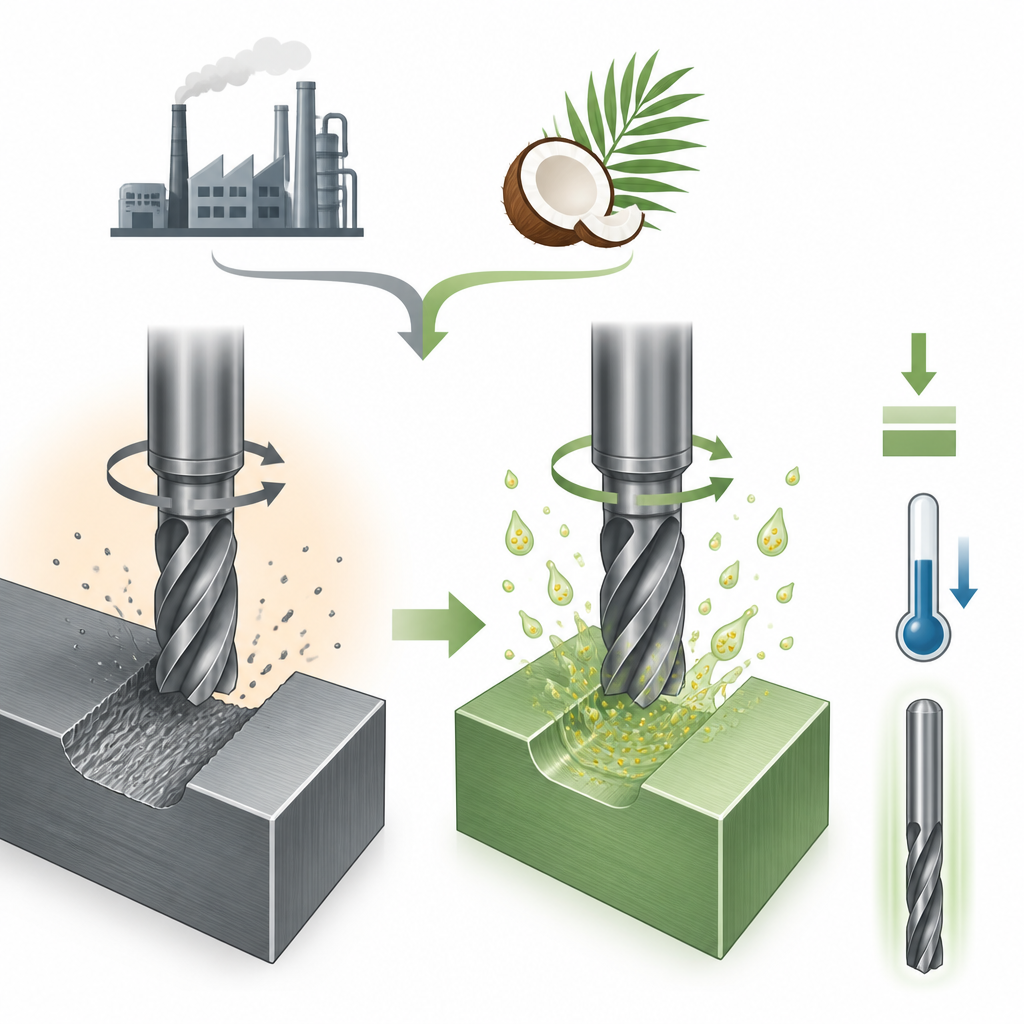
From jet engines to power plants, many machines rely on tough metal parts that must be cut and shaped with great precision. Making these parts usually consumes a lot of energy, wears out tools quickly, and often depends on harsh chemical oils. This study explores whether a kitchen staple—coconut oil—enhanced with tiny solid particles can make cutting these metals cleaner, cooler, and more efficient while using less fluid and creating less waste.
A tough metal that is hard to cut
The research focuses on Inconel 718, a nickel based alloy widely used in aircraft engines, gas turbines, and marine hardware. Its strength at high temperatures makes it ideal for demanding jobs but also very difficult to machine. Cutting tools face intense heat and friction, leading to rough surfaces, high cutting forces, and rapid tool wear. Industry traditionally relies on synthetic oils to cope with these problems, but disposing of these fluids is costly and raises environmental concerns. The authors therefore looked for a greener lubricant that still protects tools and improves the quality of the machined parts.
Turning coconut oil into a smart cutting fluid
Coconut oil was chosen as the base fluid because it is biodegradable and naturally slippery. On its own, however, it can break down at high temperature. To upgrade its performance, the team dispersed extremely small alumina and silica particles into the oil at different concentrations, creating what is known as a nanofluid. They used controlled stirring, sound waves, and a mild surfactant to keep the particles evenly spread, then measured how well the mixtures stayed stable, how easily they flowed, and how effectively they conducted heat. They found that a concentration of 0.8 percent particles struck the best balance, boosting heat transfer and viscosity without clumping.
Putting the new fluid to the test
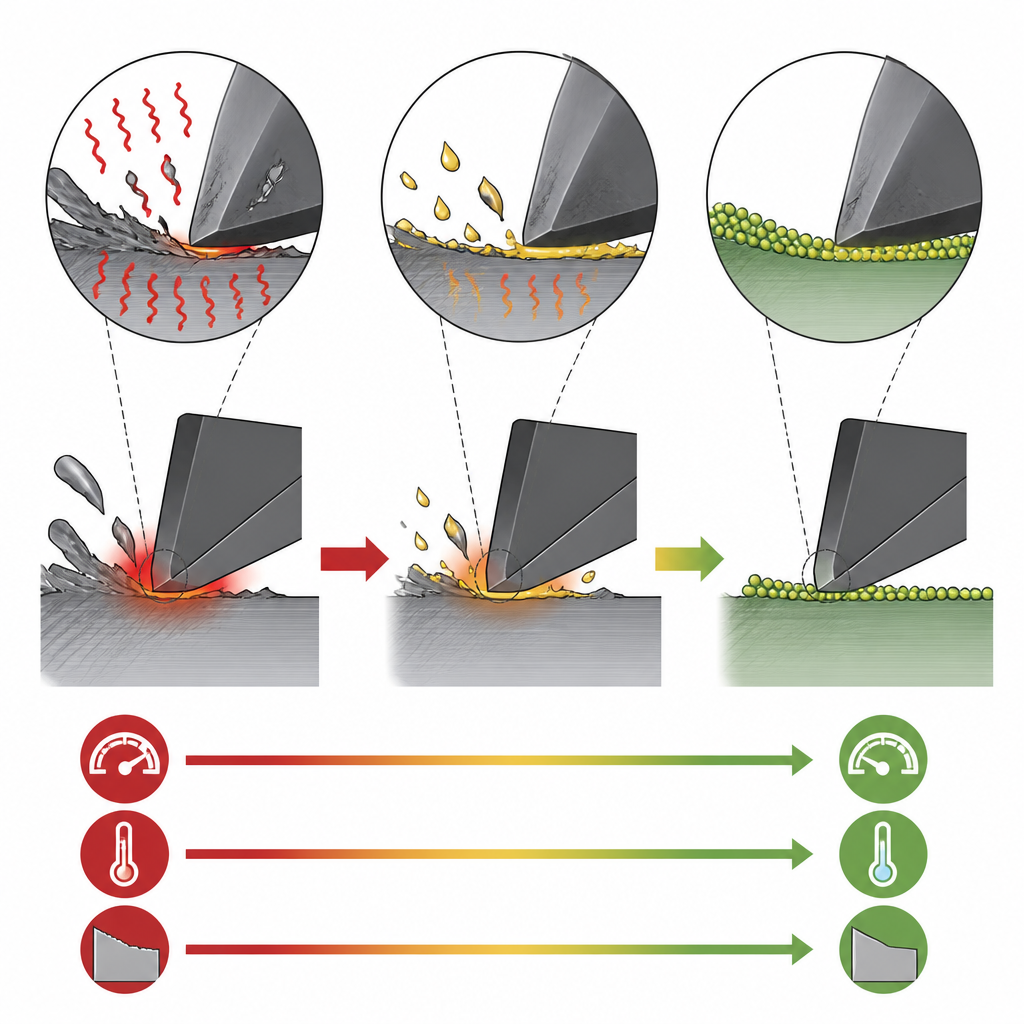
The scientists then performed milling tests on Inconel 718 under four conditions: completely dry cutting, plain coconut oil, coconut oil with alumina nanoparticles, and coconut oil with silica nanoparticles. They held the cutting settings fixed while they measured surface smoothness, cutting forces, temperature near the tool, and how fast the tool edge wore away. Compared with dry cutting, the alumina based nanofluid reduced surface roughness by about 43 percent, cutting force by about 27 percent, cutting temperature by about 23 percent, and tool wear by nearly 46 percent. Even against plain coconut oil and the silica mixture, the alumina nanofluid consistently delivered the best results, likely because it formed a more stable lubricating film and carried heat away more effectively.
Finding the best cutting recipe
After confirming that alumina enriched coconut oil was the most effective lubricant, the team asked a second question: what combination of cutting speed, feed rate, and depth of cut gives the best overall performance with this fluid? To answer it, they designed a structured set of experiments that systematically varied these three settings and built mathematical models linking them to the four key outcomes. They then combined these models into a single score that rewarded smoother surfaces, lower forces, cooler operation, and slower tool wear. A computer based search method, inspired by natural evolution, explored different parameter combinations until it found a set that maximized this combined score.
How close prediction came to reality
To check that the models and search method were trustworthy, the researchers ran confirmation tests using the optimized cutting settings. The measured roughness, forces, temperatures, and wear were all very close to the predicted values, with an average difference of only about 2.6 percent. Microscopic images of the cutting tools showed that, although the same basic wear processes still occurred, their severity was greatly reduced when the alumina nanofluid was used. Tools stayed sharper for longer, and the machined surfaces were cleaner and more even.
What this means for greener manufacturing
In simple terms, this work shows that a carefully tuned mix of coconut oil and tiny alumina particles can help machines cut very tough metals more smoothly, with less effort and less heat, while extending tool life. By coupling this eco friendly fluid with smart, computer guided choice of cutting conditions, factories could lower their energy use, reduce waste oil, and decrease the cost of replacing worn tools. The study suggests a practical path toward cleaner, more sustainable metalworking that still meets the strict demands of aerospace and power generation industries.
Citation: Almomani, O., Rajput, V., Rao, A.C.U. et al. Advancing sustainable machining of inconel 718 through nanoparticle-enhanced coconut oil and RSM–GA optimization. Sci Rep 16, 15283 (2026). https://doi.org/10.1038/s41598-026-46713-5
Keywords: Inconel 718, nanofluid machining, coconut oil lubricant, sustainable manufacturing, genetic algorithm optimization