Clear Sky Science · en
Modeling how penalty sequences influence decisive scoring in elite judo
Why small penalties matter in big matches
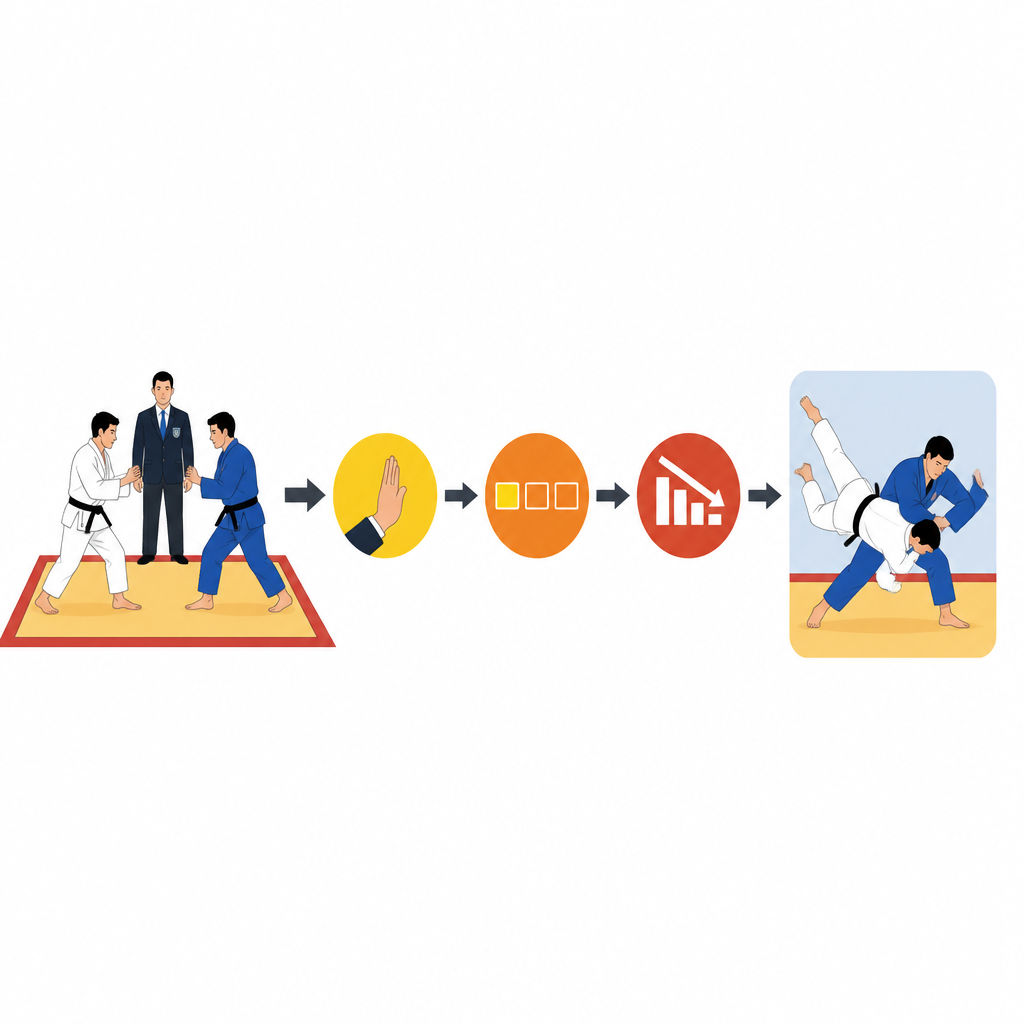
For spectators, a judo bout can flip in an instant: a brief pause, a referee’s hand signal, and suddenly one fighter is on the brink of defeat. This study looks closely at those small penalties, called shido, and asks a simple question with big implications for coaches and fans alike: after a penalty is given, how long does it usually take before a decisive match-ending throw, or ippon, occurs, and does that timing change as the pressure of repeated penalties builds?
Connecting referee calls to fight tempo
The researchers treated each penalty not just as a warning on the scoreboard but as the start of a new phase in the fight. Using detailed records from the Tokyo 2020 and Paris 2024 Olympic Games and four recent World Judo Championships, they tracked exactly when penalties and ippon scores occurred in nearly three thousand elite bouts. They then measured the time from an opponent’s first or second penalty to a later ippon, or to the end of the match if no such throw happened. This approach allowed them to see penalties as turning points that could speed up or slow down the path to a decisive finish.
Two different worlds after first and second penalties
To capture how the match environment changes, the team built separate statistical models for the interval after the first penalty and after the second. In the first-penalty phase, the timing of ippon depended on several factors. Bouts that moved into Golden Score overtime took much longer to reach a decisive throw. When the eventual winner already carried more penalties, the remaining time to ippon also tended to stretch, suggesting a more cautious pace under the risk of disqualification. Differences in world ranking played a modest role, with higher-ranked winners taking slightly longer to finish, and heavier weight categories generally closing the contest more quickly once the first penalty had been issued.
Pressure narrows the options as penalties add up
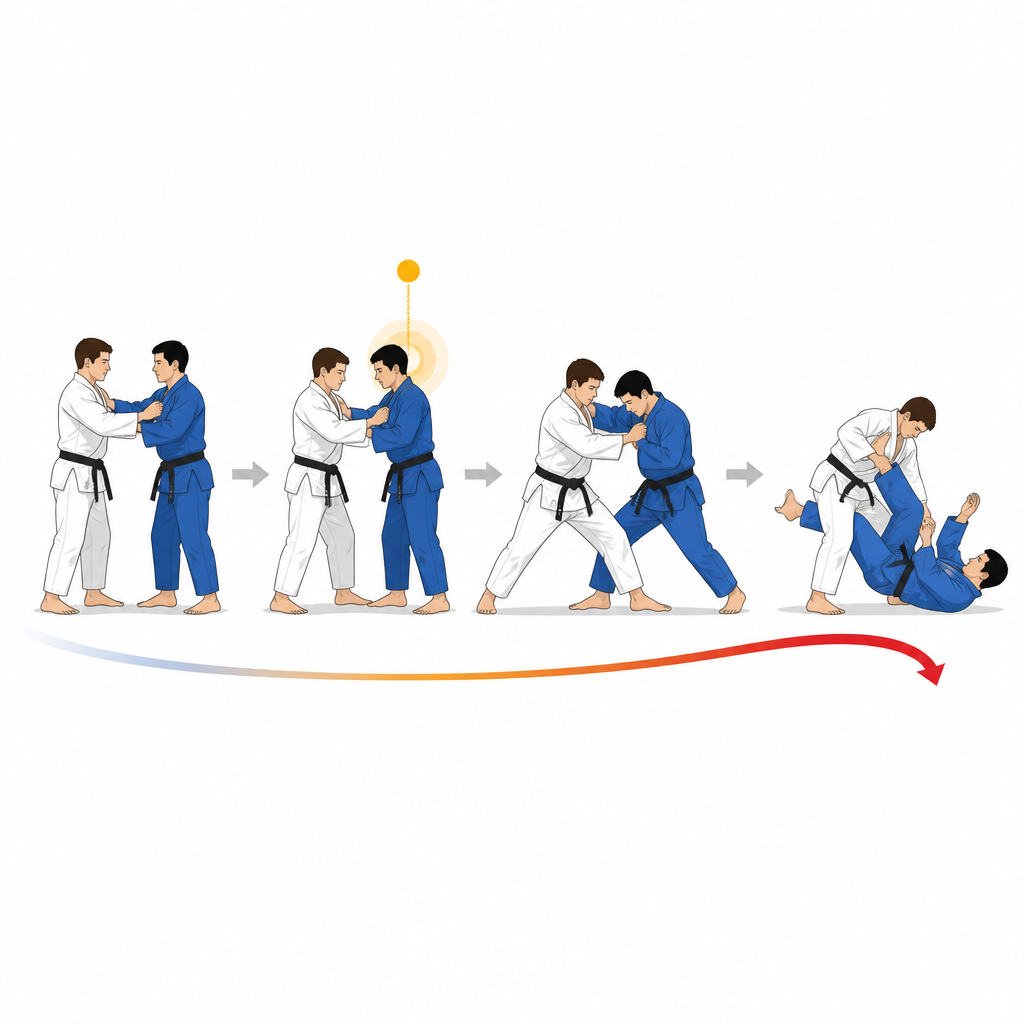
In the second-penalty phase, the picture became simpler and more constrained. Golden Score overtime again had the strongest link to longer time before ippon, and the winner’s own penalty count still pointed to slower resolution. Weight category continued to matter, indicating that the physical and tactical style of different divisions shapes how fast fights end under heavy penalty pressure. But other details that mattered earlier, such as how far apart the athletes were in the world rankings, no longer showed a clear effect. Once both fighters are deep into a high-penalty state, the usual status signals appear to lose their influence on when the final throw happens.
What a scoring lead does and does not tell us
The authors also tested whether having already scored a half-point (waza-ari) before the penalty phase made a decisive throw arrive sooner. Surprisingly, they found no strong link in either the first- or second-penalty phases. This suggests that, at the very top level, a technical lead does not automatically translate into a quicker finish once a penalty reshapes the tactical landscape. Instead, athletes may slow the tempo to protect their advantage or manage risk, making the simple presence of a lead a poor guide to how quickly the bout will end in ippon.
How this changes our view of penalties in judo
Overall, the study shows that penalties in elite judo do more than mark good or bad behavior: they shift the rhythm and structure of the fight in phase-specific ways. After the first penalty, many contextual details still shape how long it takes to see a match-ending throw. After the second, the game tightens, and a few structural features, especially overtime and penalty pressure, dominate the timing of decisive scores. For coaches, this means training should focus not only on avoiding shido, but on making smart decisions about pace and attack under different penalty states. For fans, it offers a clearer way to read the clock after each referee call and to understand why some bouts explode into quick throws while others grind on under mounting pressure.
Citation: Su, MY., Wen, TH. Modeling how penalty sequences influence decisive scoring in elite judo. Sci Rep 16, 15579 (2026). https://doi.org/10.1038/s41598-026-46709-1
Keywords: judo penalties, ippon timing, elite combat sports, Golden Score, tactical pacing