Clear Sky Science · en
Failure mechanism of surrounding rock and synergistic control of strong support-strong pressure relief for lower-seam roadways in close-distance coal seam groups
Why safer coal tunnels matter
Deep underground, miners rely on narrow tunnels to reach coal seams. When the rock around these tunnels suddenly shifts or breaks, it can cause dangerous bursts, collapses, and costly closures. This study looks at a particularly tricky situation in a Chinese mine, where two coal seams lie close together and the lower tunnels sit beneath old mined-out areas and leftover coal blocks. The authors explain why the rock on one side of these tunnels fails more easily, and they test a combined approach that both strengthens the tunnel walls and gently relieves built-up pressure in the surrounding rock.
Hidden stress from old mining
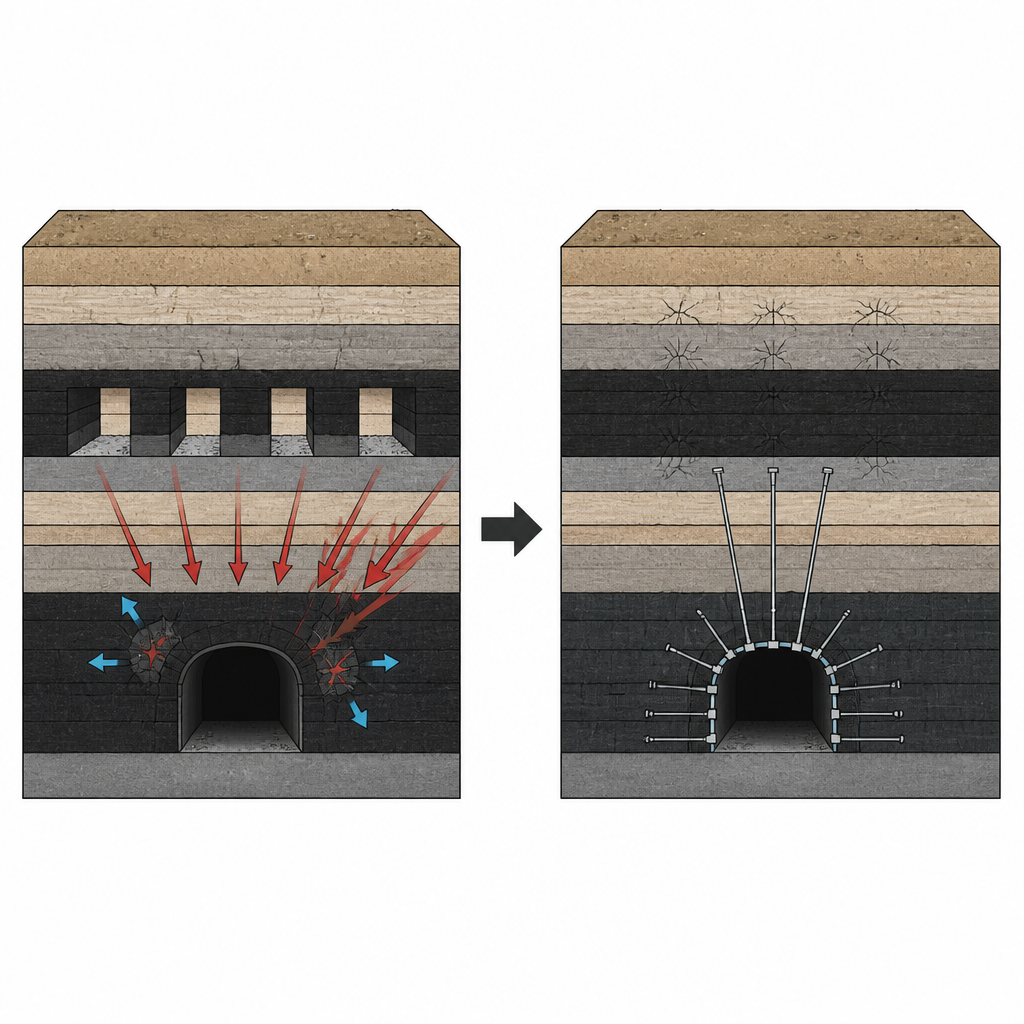
In the Jiaoping mining area, one coal seam has already been mined, leaving behind empty spaces called goafs and stiff coal pillars that hold up the roof. A second, deeper seam is now being extracted below. The weight of the overlying rock and the stiff pillars does not press evenly on the lower tunnels. Instead, stress concentrates on the side below the coal pillar, while the other side sits beneath a partly relaxed zone. Water that seeps into the old goaf can also soften coal and rock, raising the risk that floors and walls lose strength over time. Calculations and geological measurements show that the damage from the upper seam reaches about 10 to 15 meters downward, which is enough to affect where and how new tunnels should be placed.
Choosing a better tunnel path
Using rock mechanics theory, the team estimated how deeply the floor beneath the upper seam had been cracked by past mining and by the concentrated load of residual coal pillars. They then compared different ways of aligning the new lower roadway with respect to the old workings. If the lower tunnel overlaps the high-stress zone under the pillar, it faces strong, uneven loading. If it is shifted outward, it can still lie within that zone. The most favorable choice is to stagger the lower roadway inward toward the previously mined-out space, where pressure has partially been relieved. This internal staggered layout avoids the most heavily loaded rock and reduces the natural tendency for one side of the tunnel to deform more than the other.
Strong support plus pressure relief
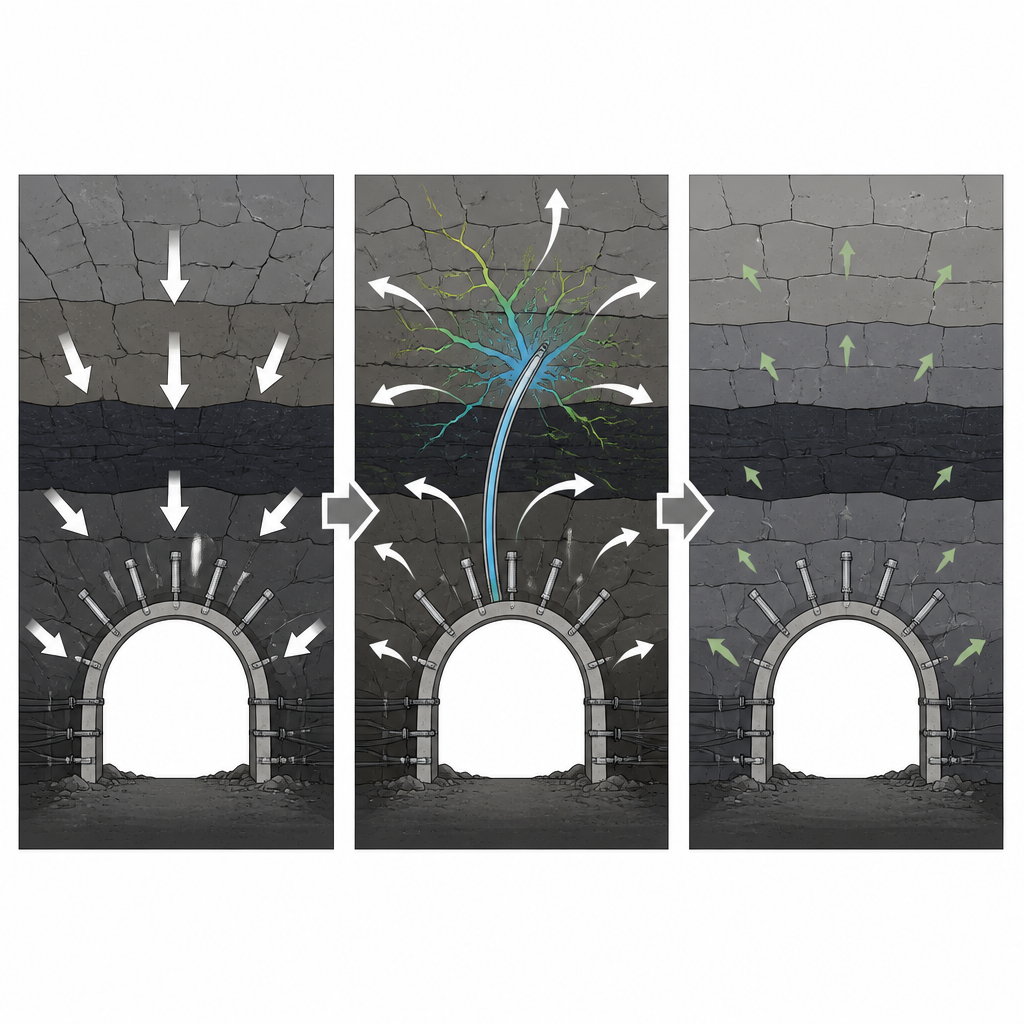
Good tunnel support is still essential. The mine adopted a "strong support" scheme using dense steel bolts, steel strips, wire mesh, and high-tension cable bolts anchored into the roof and walls. This system clamps fractured rock together and allows the shallow rock around the opening to act like a single bearing shell. To go further, the researchers added a "strong pressure relief" step: they drilled long, angled boreholes from the roadway into the overlying coal and rock and pumped high-pressure water to create controlled fractures. Careful analysis of how fluid pressure interacts with the natural stress field guided the choice of borehole angles so that fractures would start and spread with relatively low pumping pressure, opening up paths for stress and energy to redistribute away from the tunnel.
Watching the rock respond
The team used computer simulations and underground measurements to see how the rock reacted under both slow loading and sudden impacts, which mimic minor seismic events. Under static conditions, the reinforced tunnel deformed only slightly, and movements stayed well below safety limits, though stresses and bolt forces were clearly higher on the coal-pillar side. When impact loads were added in the models, two patterns emerged. Impacts hitting mainly above the roof tended to cause tension cracking in the roof center. Impacts near the corner where roof and rib meet caused large sideways squeezing of the rib and sinking of the roof as a whole, a more severe damage mode. After hydraulic fracturing, electrical surveys showed broad low-resistivity zones where water-filled cracks had formed, confirming that the rock had been weakened and stress had been shifted. Field gauges recorded that bolt and cable forces stayed within safe ranges and that the "loosened" rock zone, although growing, remained controlled by the support system.
What this means for mine safety
For the studied mine, the work shows that uneven loading caused by leftover coal pillars is the main reason one side of lower seam tunnels fails more easily. By placing the roadway in a pressure-relieved zone, firmly anchoring the nearby rock, and using targeted hydraulic fracturing to bleed off deep stresses, engineers can keep deformation within safe bounds even when the rock experiences small shocks. The authors argue that this paired strategy of strong support plus strong pressure relief, backed by careful monitoring, offers a practical path to safer and more efficient coal extraction in other mines that have stacked seams and complex stress conditions.
Citation: Yu, S., Suo, Y., Cai, C. et al. Failure mechanism of surrounding rock and synergistic control of strong support-strong pressure relief for lower-seam roadways in close-distance coal seam groups. Sci Rep 16, 15843 (2026). https://doi.org/10.1038/s41598-026-46700-w
Keywords: coal mining, roadway stability, rock burst, hydraulic fracturing, numerical simulation