Clear Sky Science · en
Optimization of precursor proportions and performance characteristics of iron ore tailings-based one-part geopolymers
Turning Mine Waste into Building Material
All around the world, mountains of waste sand and rock called iron ore tailings are left behind after mining. These piles take up land, can leak into waterways, and pose safety risks if storage dams fail. This study explores a way to turn that problem into a resource: blending iron ore tailings with other industrial by‑products to make a new kind of cement-like material that is easier to use and potentially far better for the climate than traditional concrete.
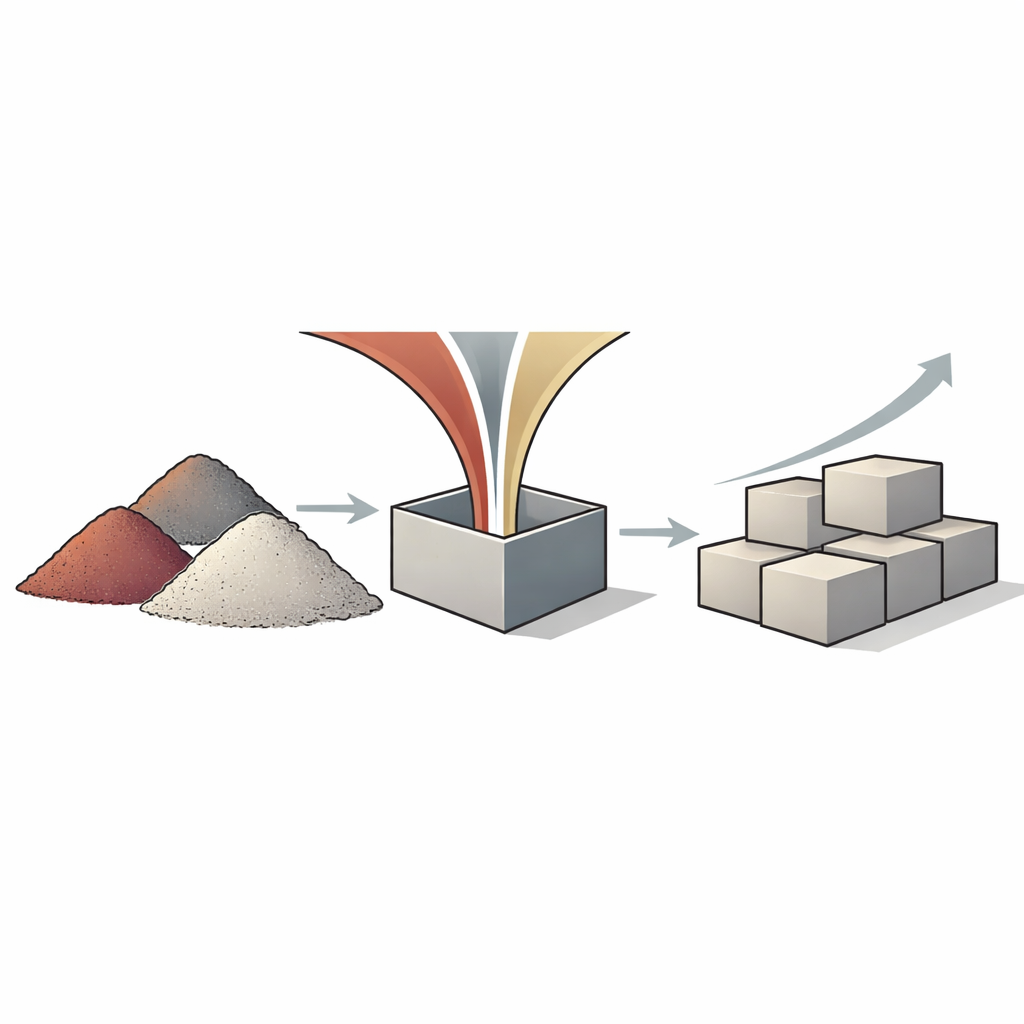
Why Tailings and Ash Matter
Iron ore tailings are rich in the same basic ingredients that go into cement and glass—mainly silica and alumina—but in a form that does not react easily on its own. At the same time, coal-fired power plants and steel mills produce huge amounts of fly ash and blast furnace slag, powders that can react strongly in alkaline conditions. Bringing these three waste streams together raises a tantalizing possibility: use them to form a geopolymer, a hardened binder that can rival or surpass ordinary Portland cement while cutting carbon emissions by more than half.
A Simpler, Safer Way to Make Geopolymers
Many earlier experiments with iron ore tailings relied on liquid caustic solutions to activate the reactions, which are difficult and hazardous to handle on construction sites. Here, the researchers focused on a “just add water” approach known as a one-part geopolymer. They dry-mixed iron ore tailings, fly ash, slag, and solid powdered alkali, then simply added water to make a paste. By systematically varying the proportions of the three powders and keeping the activator and water content fixed, they mapped how the fresh mix flowed and how strong it became as it hardened.
Finding the Sweet Spot in the Recipe
The team first compared simpler two-material blends. Mixtures of fly ash and slag kept getting stronger over time, while blends of iron ore tailings and slag gained strength early but then stalled. This showed that tailings alone could not carry the load; they acted mostly as a filler unless helped by other reactive powders. In the full three-material mixes, strength depended strongly on the recipe. Using a design approach borrowed from statistics, the researchers built mathematical models that predict the 28‑day strength and flow of the paste from the percentages of tailings, fly ash, and slag. These models fit the test data well and pointed to an optimal composition of roughly one‑third iron ore tailings, two‑fifths fly ash, and one‑quarter slag.
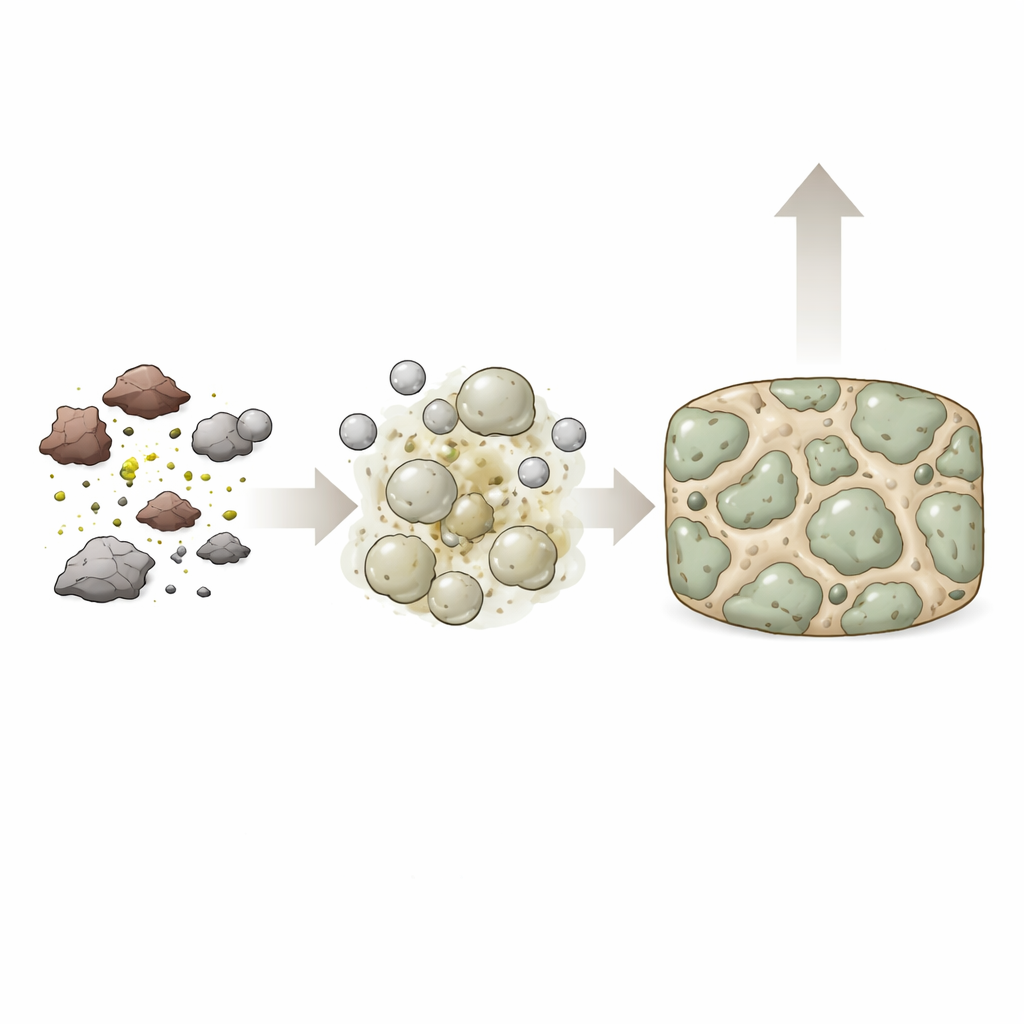
How the Mix Works from the Inside Out
Microscope images and infrared analysis revealed what happens at the tiny scale. When fly ash and slag are present together, they form intertwined gel networks that glue everything into a dense, crack-resistant mass. In the best three‑part mixes, iron ore tailings do more than just sit inert: their particle shape helps fill gaps between grains, and the overall chemical balance allows them to join in the binding network. By contrast, mixes with only tailings and slag had too much silica and too little aluminum in reactive form; large patches of material failed to dissolve, leaving unbonded grains and internal weak spots that limited strength.
From Waste Heaps to Greener Concrete
In practical terms, this work shows that iron ore tailings can make up a large share of a solid, easy‑to‑handle geopolymer binder when paired with the right amounts of fly ash and slag. The optimized blends achieve high strength while flowing well enough to be cast in molds, all without using liquid caustic solutions. For a layperson, the message is simple: with careful recipe tuning, mine waste and industrial by‑products can be transformed into a new building material that helps reduce the environmental footprint of construction and shrinks the legacy of mining waste at the same time.
Citation: Kou, W., Gao, M., Zhao, T. et al. Optimization of precursor proportions and performance characteristics of iron ore tailings-based one-part geopolymers. Sci Rep 16, 10659 (2026). https://doi.org/10.1038/s41598-026-46673-w
Keywords: iron ore tailings, geopolymer concrete, industrial waste recycling, low-carbon construction, fly ash and slag