Clear Sky Science · en
Morphology and energetics of the wake behind a continuously swimming crucian carp at different flow velocities
Why fish swimming matters to rivers and people
When a fish swims through a river, it does much more than glide through water. Each flick of its tail stirs up swirling patterns that tell a story about energy, effort, and survival. This study looks closely at crucian carp, a common freshwater fish, to understand how they move most efficiently and how hard they have to work at different water speeds. These insights can help engineers design fish passages around dams and restore rivers in ways that give fish a fair chance to migrate, feed, and reproduce.
Watching fish in a controlled water tunnel
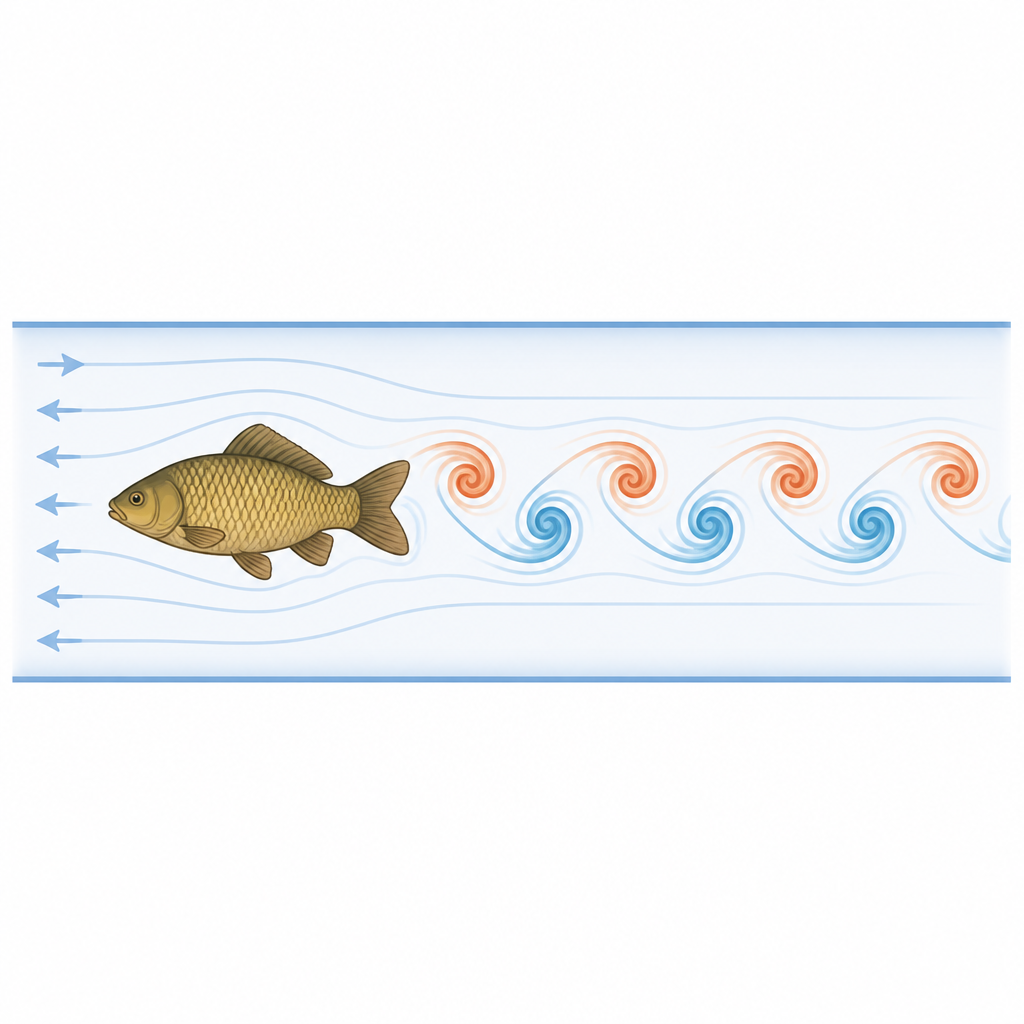
To uncover these patterns, the researchers placed crucian carp in a special swimming tunnel where water speed could be adjusted very precisely. High speed cameras recorded the fish as they swam, capturing how fast and how far their heads and tails moved with each beat. At the same time, a laser based imaging system lit up tiny particles in the water, allowing the team to map the flow around the fish and the swirling “wake” they left behind. This setup let them connect body motion, water motion, and energy use in one integrated picture.
Finding the sweet spot for steady swimming
As water speed increased, the carp responded by beating their tails faster and adjusting how widely they swung both head and tail. The fish could maintain steady swimming up to a critical speed of about 0.85 meters per second, beyond which they could no longer keep pace. The most interesting changes occurred at slightly lower speeds, around 0.60 to 0.75 meters per second. In this range, the distance covered per tail beat and the size of the tail swings shifted in a way that signaled a transition in how the fish were managing their effort. A dimensionless measure linked to tail motion and speed, known from prior work as a marker of efficient swimming, also fell in its favorable range here.
Reading the swirling footprints in the water
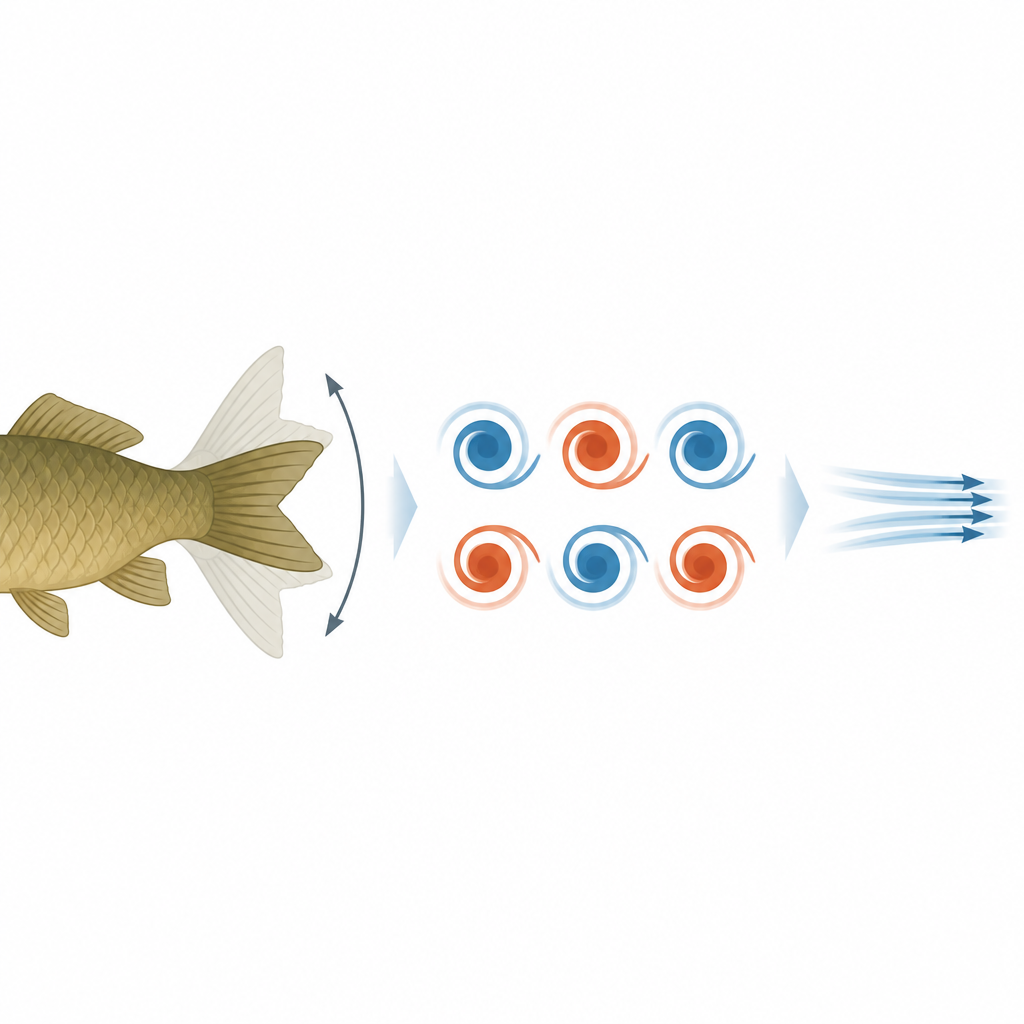
The laser imaging revealed that every tail beat sheds a pair of spinning water structures, called vortices, which line up behind the fish like a moving chain. Between these paired swirls, a narrow jet of water shoots backward, providing forward push. As the carp swam faster, the strength of these vortices and the energy contained in them rose steadily. By treating each pair like a tiny engine, the researchers calculated how much of the wake energy contributed to thrust versus how much simply stirred the water. Across a wide range of speeds, the carp converted about 62 to 84 percent of the wake energy into useful push, a high level of hydrodynamic efficiency that changed surprisingly little with speed.
When swimming becomes a strain
Earlier work by the same team, using the same fish, measured oxygen use and showed that crucian carp begin to rely on short term, oxygen poor energy sources between 0.60 and 0.75 meters per second. The new wake measurements line up with this metabolic shift: in that same speed band, tail and head motion change character, stride length behavior shifts, and wake patterns adjust while overall efficiency stays high. The drag that the fish experience during active tail beating also turned out to be several times larger than what simple formulas for rigid bodies predict, reinforcing that living, flexible swimmers face very different forces than solid test objects.
What this means for rivers and future robots
Taken together, the study shows that crucian carp swim most efficiently at about 70 to 88 percent of their top sustainable speed. Above this range, they must tap into energy reserves that are harder to replace, which can reduce endurance and long term health. For river managers, this suggests that water velocities in fishways and restored channels should stay below this threshold to help more fish pass safely. For engineers who build fish like robots, the detailed link between tail motion, wake structure, and efficiency offers guidance for designing flexible, energy saving propulsion systems that mimic the subtle ways real fish move water.
Citation: Hou, Y., Wang, X., He, F. et al. Morphology and energetics of the wake behind a continuously swimming crucian carp at different flow velocities. Sci Rep 16, 15970 (2026). https://doi.org/10.1038/s41598-026-46672-x
Keywords: fish swimming, hydrodynamics, wake vortices, crucian carp, fishway design