Clear Sky Science · en
Active aeration enhances tissue hydration and fresh mass in hydroponic lettuce and modulates calcium-mobilizing biostimulant efficacy
Why lettuce tipburn matters to growers and eaters
Anyone who has bought a head of lettuce only to find brown, dead patches along the inner leaves has seen tipburn. This cosmetic defect makes lettuce less appealing and leads to waste for farmers and retailers. In modern greenhouses and vertical farms, lettuce often grows without soil, with roots sitting in nutrient-rich water. While this method can boost yields, it can also worsen tipburn when the plant cannot move enough calcium into fast-growing young leaves. This study explores how improving oxygen around the roots and adding a special calcium-helping product can change lettuce growth, water content, and tipburn in a practical hydroponic setup.
How water, air, and nutrients shape lettuce health
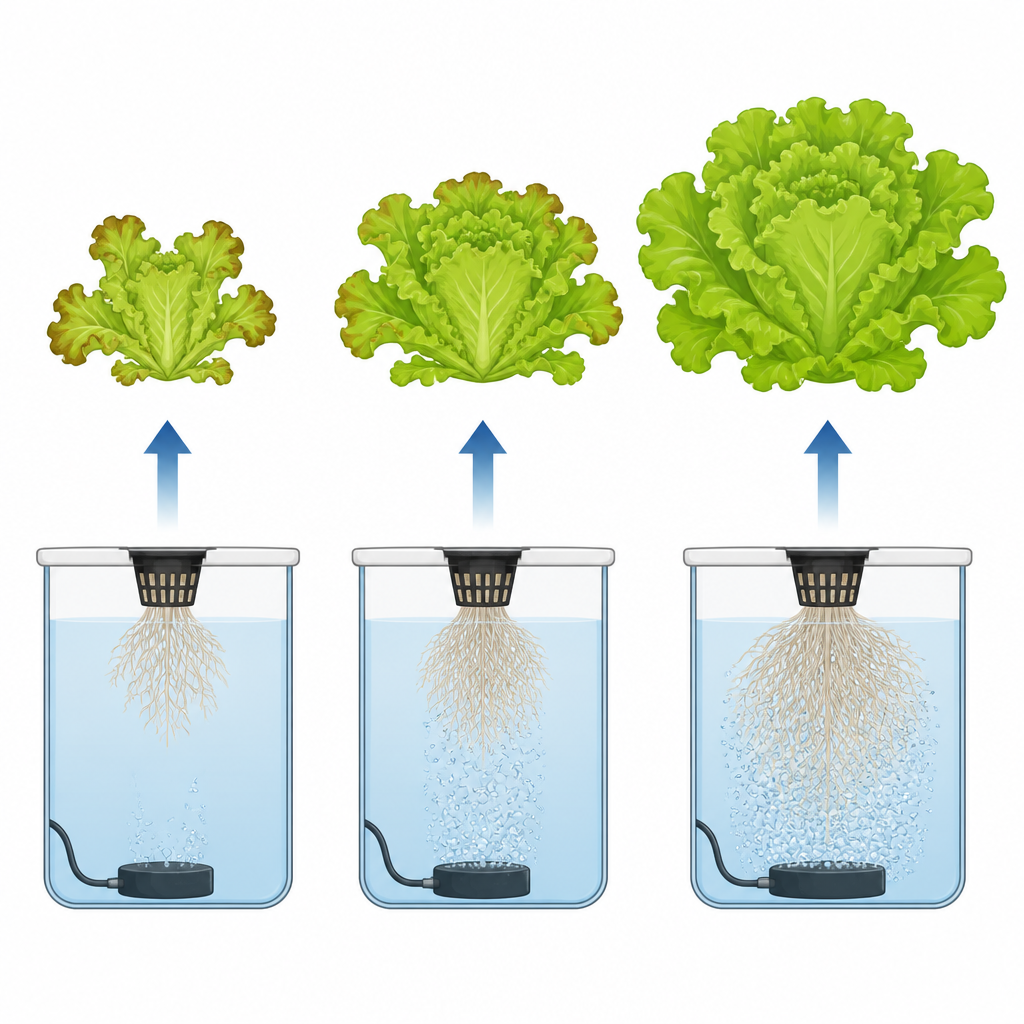
In water-based growing systems, roots depend on dissolved oxygen in the nutrient solution to breathe and power the uptake of water and minerals. If oxygen runs low, roots become stressed, water flow slows, and tender inner leaves may not receive enough calcium, even when the solution itself contains plenty. The authors tested three levels of oxygen in the root zone, created by adjusting how much air was pumped into large water-filled trays. They also tested three doses of a calcium-mobilizing biostimulant, a commercial additive designed to help plants move calcium more effectively inside their tissues. Butterhead lettuce plants were grown in a greenhouse, and the team tracked growth, leaf number, water content, and the extent of tipburn over four weeks.
More air to the roots made plants bigger and juicier
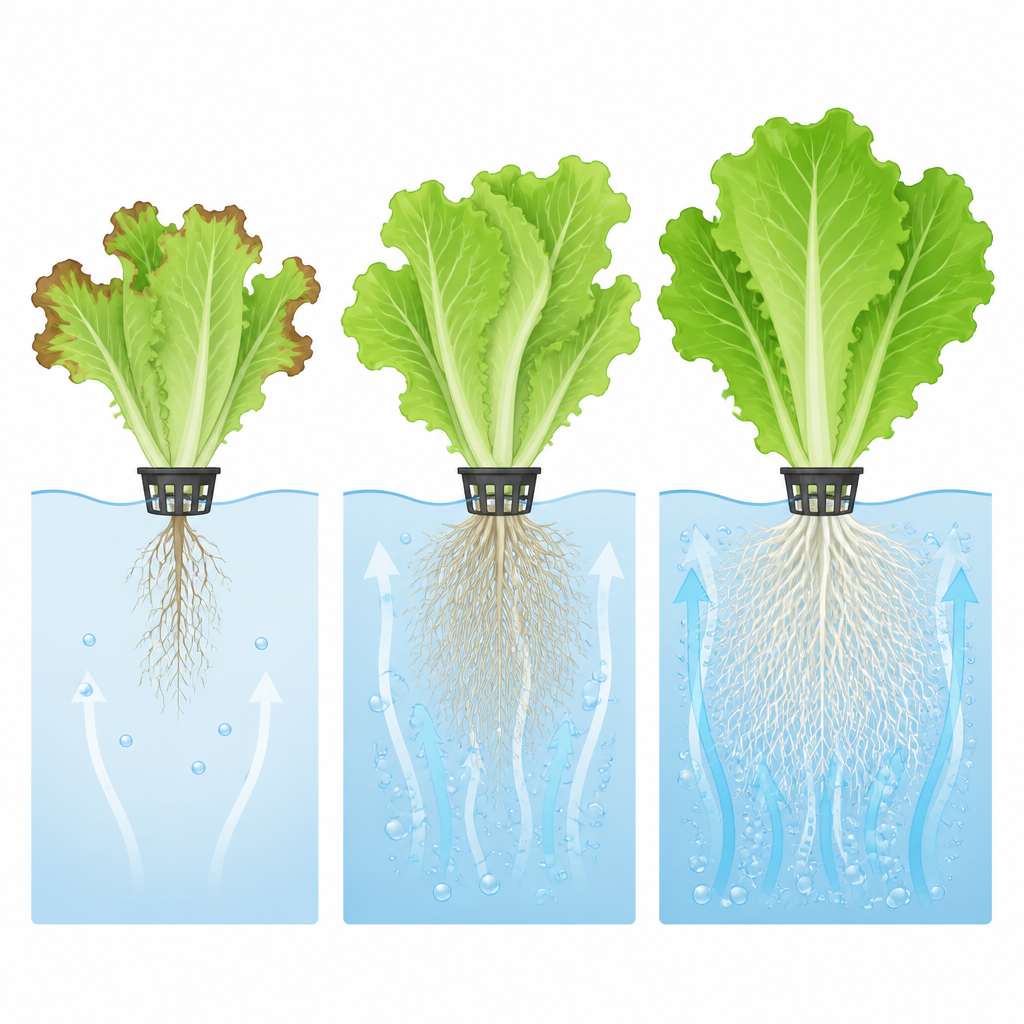
Raising the oxygen level in the nutrient solution from low to moderate and higher levels had a striking effect on plant size. By three to four weeks after transplanting, plants with more root-zone oxygen had nearly double or more fresh mass and noticeably wider heads, despite having similar or even slightly lower dry mass. In other words, the plants were not building far more solid material; instead, they were holding more water in their tissues. Moisture content rose by about 5 to 7 percent at higher oxygen levels, and visual images showed thicker, brighter root systems where air was supplied. This pattern suggests that modest boosts in aeration relieved root stress, improved water uptake, and allowed leaves to expand more fully, which in turn made the lettuce heavier, crisper, and more marketable.
Oxygen alone helped calm tipburn
The study also revealed that better root aeration reduced tipburn even without extra products. At early and later stages, plants grown with higher dissolved oxygen had fewer leaves showing burnt edges and a lower share of damaged leaves overall. This outcome is consistent with the idea that when roots are well supplied with oxygen, they move more water upward through the plant, carrying calcium into young, hidden leaves that are especially prone to shortage. Even though higher oxygen also sped up growth and could have raised calcium demand, the improved water flow appeared to balance that demand and protect the leaf margins from damage.
When the calcium helper mattered most
The calcium-mobilizing biostimulant did not boost overall growth but did influence tipburn in subtle, oxygen-dependent ways. Early in the experiment, the additive cut the number and share of burnt leaves mainly at medium oxygen, where plants were growing quickly yet still close to calcium limits. Later on, as plants became larger, the additive was most helpful under low oxygen, where roots likely struggled to move enough water and calcium. Under well-aerated conditions, the biostimulant made little difference because improved water flow already kept calcium movement adequate. These shifting patterns suggest the product works best in a narrow window where calcium supply is slightly, but not severely, limiting and where root oxygen levels do not already solve the problem.
Practical lessons for future leafy greens
For growers, the findings highlight root oxygen as a powerful but often overlooked lever for managing both yield and quality. Slight increases in dissolved oxygen, achieved through modest aeration, can make lettuce heads larger and more hydrated while also reducing tipburn. The calcium-mobilizing biostimulant offers extra help mainly when oxygen is modest or low and calcium movement is just short of what fast-growing plants require. This means that well-designed aeration can reduce the need for additives, and carefully timed use of the additive can, in some systems, let growers rely less on energy-intensive aeration. By tuning both air supply to the roots and use of calcium helpers, hydroponic farms can produce more attractive lettuce with fewer losses and lower operating costs.
Citation: Ries, J., Park, Y. & Meng, Q. Active aeration enhances tissue hydration and fresh mass in hydroponic lettuce and modulates calcium-mobilizing biostimulant efficacy. Sci Rep 16, 15789 (2026). https://doi.org/10.1038/s41598-026-46661-0
Keywords: hydroponic lettuce, tipburn, dissolved oxygen, greenhouse production, calcium biostimulant