Clear Sky Science · en
XGBoost-based ground motion model for constant-strength inelastic acceleration response spectra
Why shaking matters for real buildings
Earthquakes rarely leave buildings perfectly elastic; walls crack, beams yield, and structures bend more than design drawings suggest. Yet most tools engineers use to estimate shaking still assume buildings stay elastic. This study introduces a data-driven way to predict how hard real, slightly damaged buildings are likely to shake in future earthquakes, helping improve seismic design, safety checks, and risk estimates for cities.
From simple shaking charts to real behavior
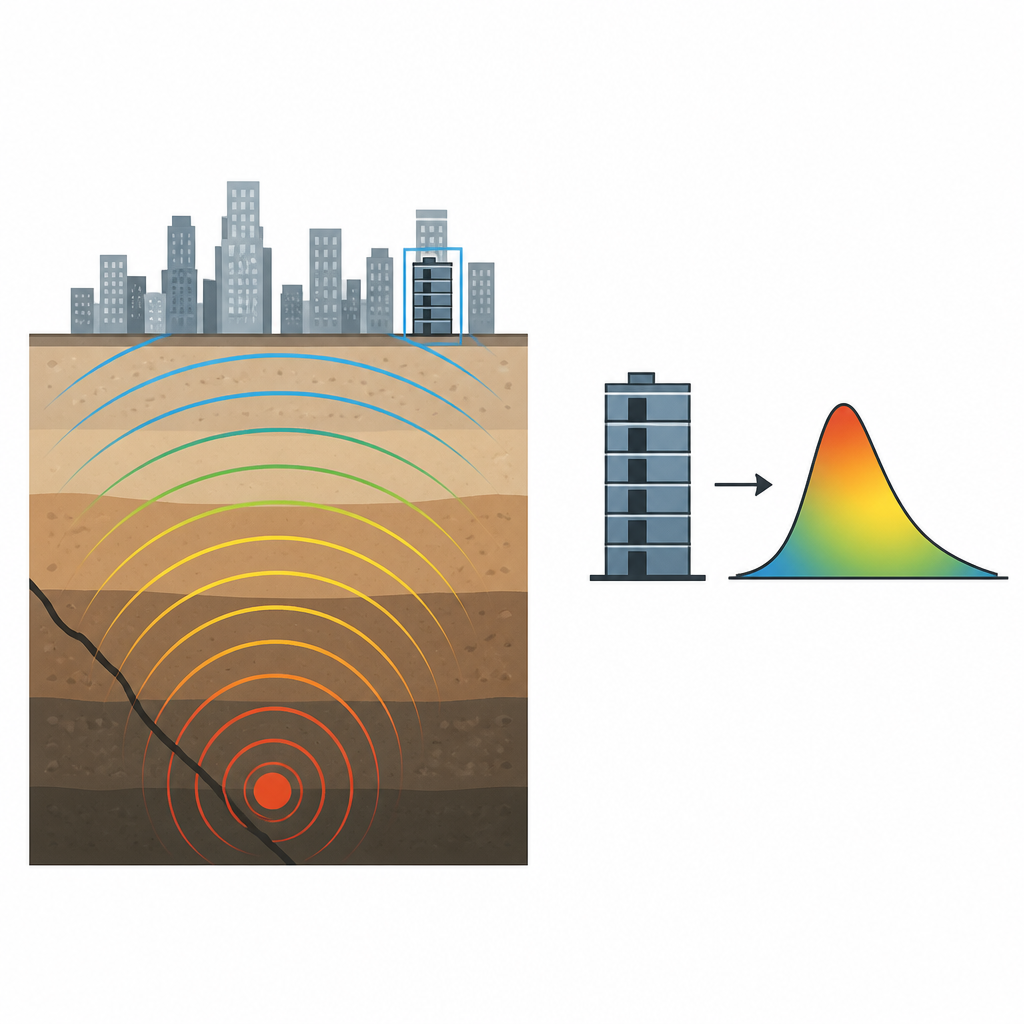
Traditionally, earthquake engineers rely on ground motion models that turn basic information about an earthquake and a site into measures of shaking such as peak acceleration. These models feed into response spectra, curves that show how much a perfectly elastic building would shake at different natural vibration periods. However, under moderate to strong earthquakes, most buildings go beyond this elastic range. Their real responses can differ sharply from elastic predictions, which makes it difficult to judge damage, plan retrofits, or set realistic design rules using elastic spectra alone.
A richer picture of shaking for yielding buildings
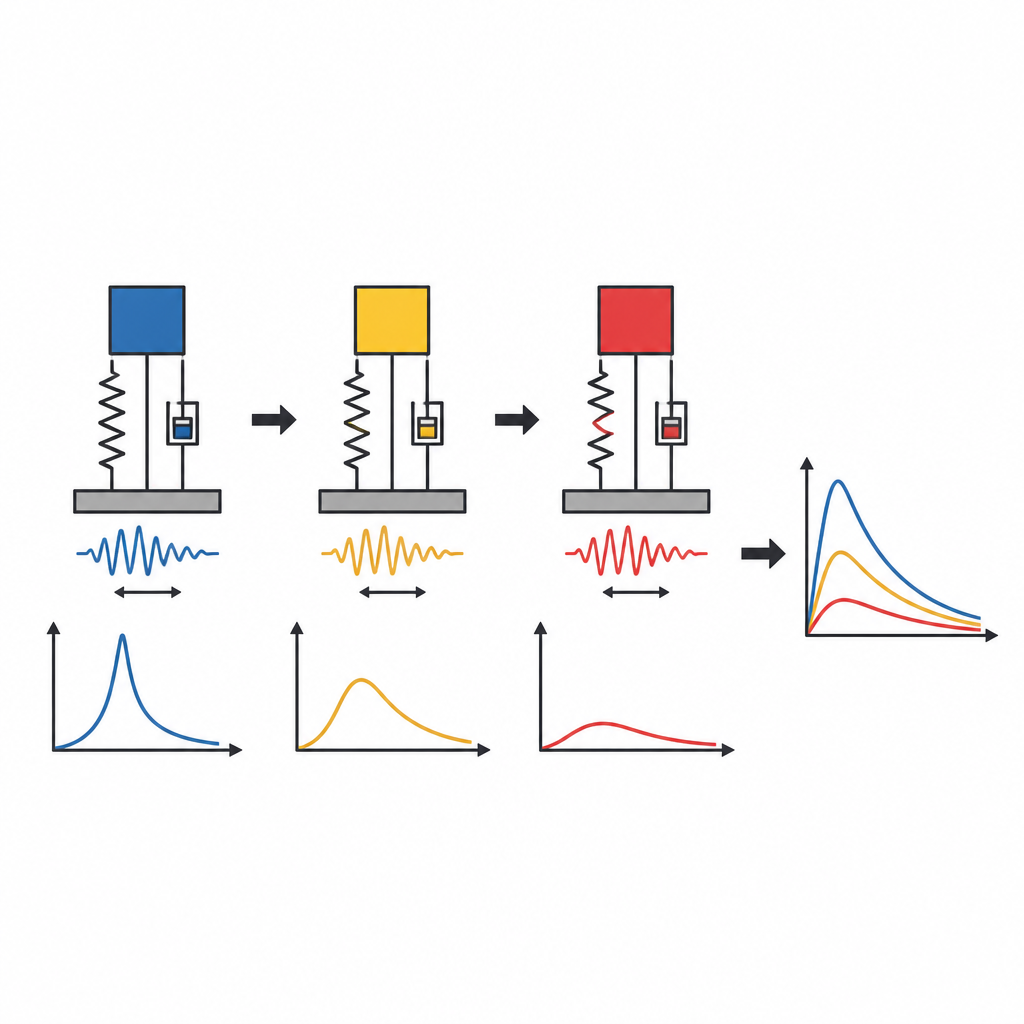
To bridge this gap, the authors focus on inelastic acceleration response spectra, which describe how much a building with limited strength will actually accelerate when it yields. They zero in on a version called constant strength inelastic spectral acceleration, which fixes a strength reduction factor to represent how much the structure can deform inelastically. Using more than fifteen thousand ground motion records from 171 earthquakes in a large international database, they simulate the response of many idealized one degree of freedom structures that mimic reinforced concrete behavior. These virtual buildings cover a wide range of vibration periods, site types, distances from the fault, magnitudes, and inelastic strength levels.
Teaching a model to learn from earthquakes
The heart of the work is a machine learning method called XGBoost, which combines many simple decision trees into a strong predictor. Instead of forcing the data to fit a fixed mathematical formula, the model learns complex relationships between earthquake size, distance, soil conditions, building period, and inelastic strength. The authors also embed the model in a mixed effects framework that separates differences between earthquakes from differences within a single event, mirroring how traditional seismic models treat variability. They use modern tools for interpreting machine learning, including permutation importance and SHAP values, to see which inputs matter most and how they push predictions up or down.
What controls shaking in this new view
Both interpretability tools paint a consistent picture: earthquake magnitude, building period, and distance to the fault dominate the predicted shaking, with the inelastic strength factor and near surface shear wave speed playing secondary but still meaningful roles. Larger earthquakes and closer sites lead to higher inelastic accelerations, while longer period buildings and softer soils show the expected changes in response. The model achieves high accuracy on unseen data, with over 92 percent of the variance in the simulated inelastic accelerations explained, and its residuals show little systematic bias across magnitude, distance, or site conditions.
Connecting to familiar design tools
To check physical realism, the authors compare their machine learning predictions, in the special case where the building remains elastic, with a widely used traditional ground motion equation. The shapes and trends of the curves agree closely, especially for typical design periods, while the new approach naturally extends into the inelastic range that the older model does not cover. This means engineers can use the new model to build hazard curves and spectra that directly reflect nonlinear building behavior, rather than adjusting elastic results with rough correction factors.
How this helps safer cities
In plain terms, the study shows that machine learning can provide accurate, transparent predictions of how much real, slightly damaged buildings will shake in future earthquakes, using information about the earthquake, the site, and the building itself. By working directly with inelastic response measures and clearly identifying which factors matter most, the model offers a more realistic basis for performance based design, code development, and rapid risk assessment, while still remaining consistent with familiar elastic design tools.
Citation: Gong, Y., Zhao, J. XGBoost-based ground motion model for constant-strength inelastic acceleration response spectra. Sci Rep 16, 15653 (2026). https://doi.org/10.1038/s41598-026-46656-x
Keywords: earthquake engineering, ground motion models, machine learning, inelastic response spectra, seismic design