Clear Sky Science · en
Differential effects of cognitive training and aerobic exercise on regional gray matter volume and inter-regional covariance in community-dwelling older adults
Why this study matters for healthy aging
As people live longer, many worry about staying mentally sharp and independent in later life. This study asks a practical question that interests many older adults and their families: when it comes to protecting the aging brain, how do brain games compare with simple aerobic exercise like brisk walking? Using brain scans collected over a year, the researchers explored how these two popular, drug free approaches may slow natural shrinkage in key brain areas linked to thinking and emotion.
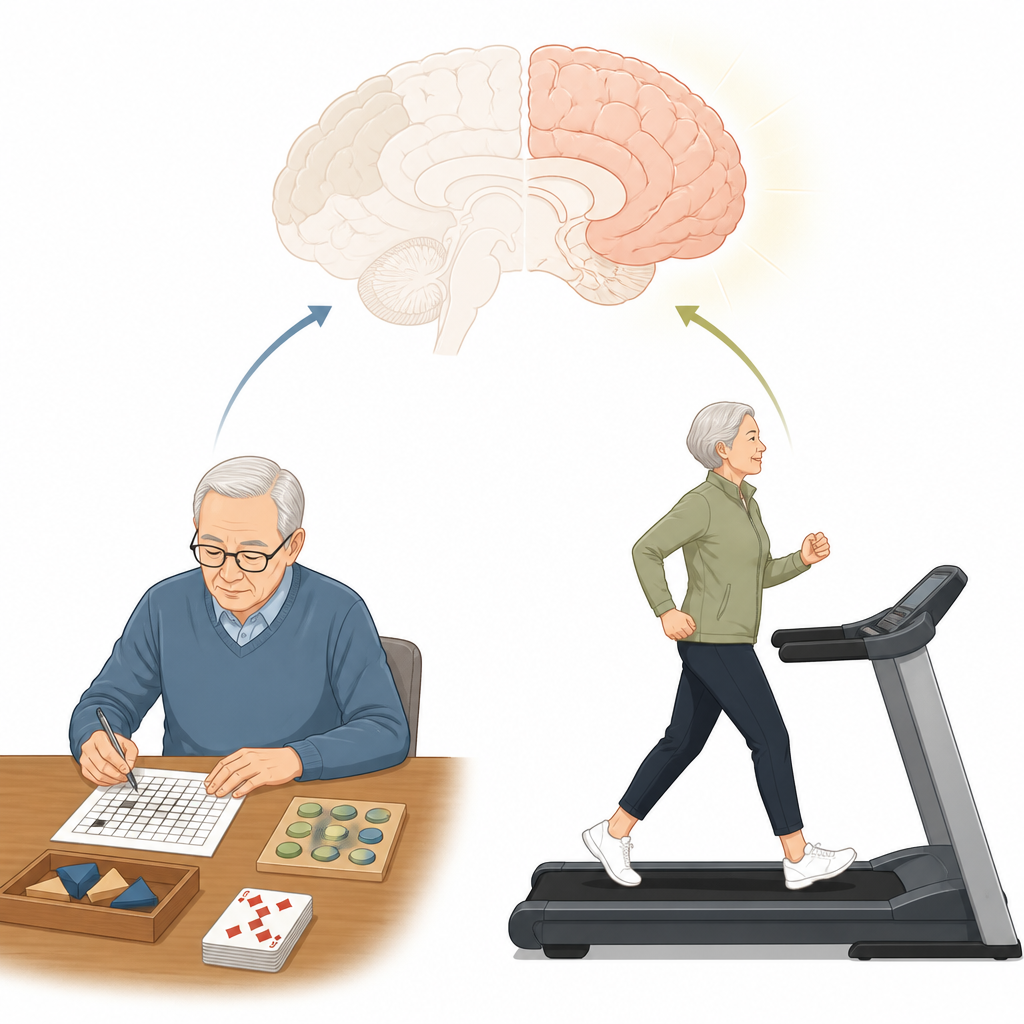
Two paths to support an aging brain
The research team worked with 100 community dwelling adults between 65 and 75 years old in Shanghai. All participants were living independently, had relatively high scores on standard memory and thinking tests, and had no major brain or psychiatric illnesses. They were randomly assigned to one of three groups: multi skill cognitive training, supervised aerobic exercise, or a control group that received only health education lectures. Cognitive training focused on memory, reasoning, problem solving, and map reading in small group sessions. The exercise program used treadmills for brisk walking at carefully monitored heart rate levels, twice a week for 12 weeks. The control group attended the same health talks but did not receive extra training or exercise from the study.
Looking inside the brain over time
To move beyond simple paper and pencil tests, the scientists used high resolution magnetic resonance imaging to measure brain structure before the interventions and again 12 months later. They focused on gray matter, the tissue that contains nerve cell bodies and supports thinking, feeling, and sensing. Rather than looking only at overall brain size, they examined 122 specific regions and also studied how changes in one area tended to go along with changes in another, a pattern known as structural covariance. This network view can hint at how brain regions age together or respond together to lifestyle changes.
Exercise helps preserve a key frontal region
The clearest difference between groups emerged in a small area on the underside of the frontal lobe called the posterior orbital gyrus. This region helps with decision making, emotional control, and evaluating rewards. Over the year, older adults in the aerobic exercise group showed a slight increase in volume in this region, while those in the control group showed a noticeable decrease. The cognitive training group showed almost no change, falling between the other two. The control group also lost tissue in two other nearby regions linked to emotion and internal body signals, while these losses were less marked in the training and exercise groups. Taken together, the patterns suggest that both activities may help slow natural age related thinning of gray matter, with aerobic exercise showing the strongest effect in this particular frontal area.
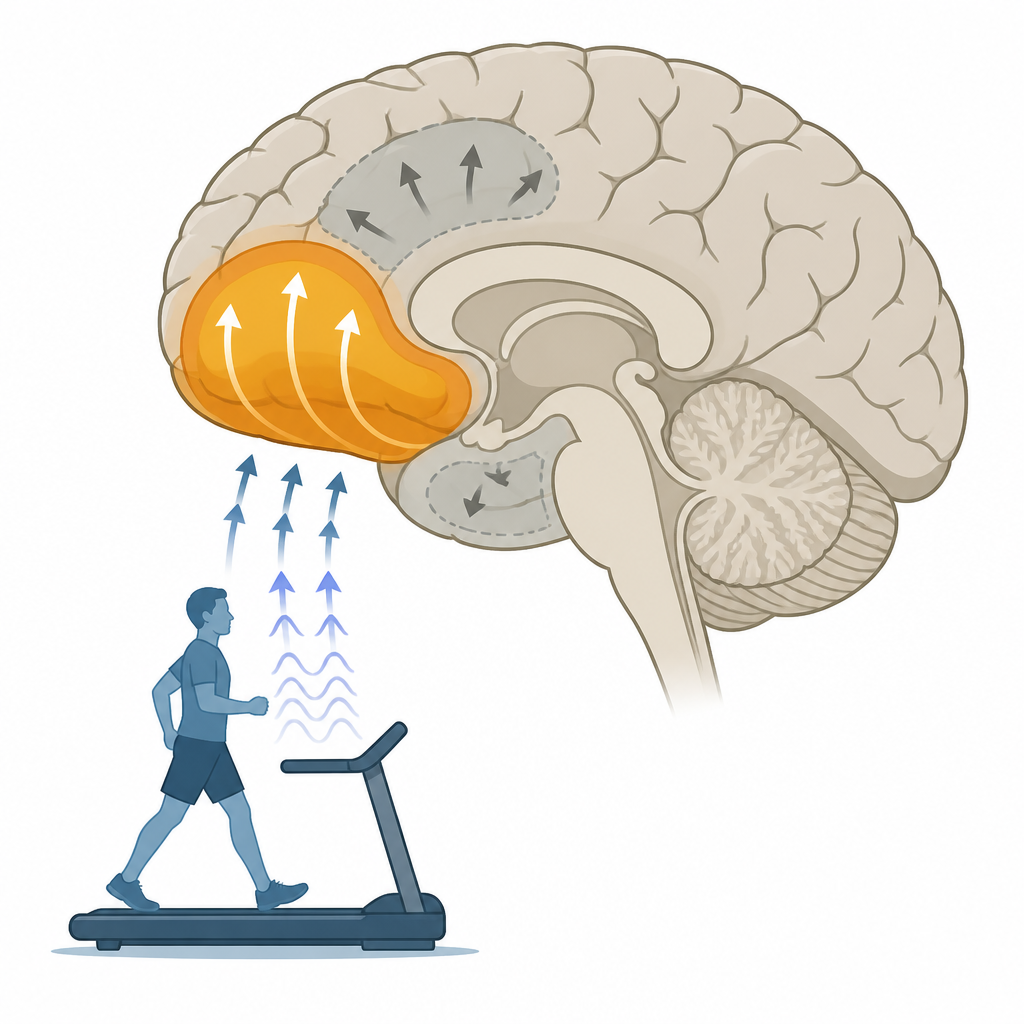
Subtle shifts in how regions change together
Beyond single regions, the researchers explored how changes in one area were coordinated with changes in others. In people who exercised, shifts in the frontal region tied to decision making showed a close partnership with a region involved in sound and speech processing, hinting that exercise may support broader communication across brain networks. At the same time, the exercise group showed weaker coordination between an emotion related region deep in the frontal lobe and the auditory region than the control group. These network findings were modest and did not all meet the strictest statistical tests, so they should be viewed as early clues rather than firm answers, but they point toward exercise influencing not only how much tissue is preserved, but also how different brain areas age together.
What this means for everyday life
Across the year, all three groups improved slightly on standard cognitive tests, likely reflecting practice effects and the generally healthy, educated nature of the participants. The brain scan results, however, suggest that what happens inside the skull may change even when everyday testing does not yet show clear differences. For older adults, the message is that both mental training and regular aerobic activity may help the brain resist some aspects of age related shrinkage, with brisk walking showing a particularly clear benefit for a decision making region in the frontal lobe. While the study cannot prove that these changes will prevent dementia, it supports the idea that staying both mentally and physically active is a sensible strategy to support brain health as we age.
Citation: Jiang, L., Cao, X., Li, T. et al. Differential effects of cognitive training and aerobic exercise on regional gray matter volume and inter-regional covariance in community-dwelling older adults. Sci Rep 16, 15282 (2026). https://doi.org/10.1038/s41598-026-46631-6
Keywords: aerobic exercise, cognitive training, brain aging, gray matter, older adults