Clear Sky Science · en
Comparative mechanical characterisation of 13–93 bioactive glass and hybrid scaffolds for bone regeneration
Why new bone repair materials matter
When a large section of bone is lost after an accident or disease, surgeons often struggle to restore both strength and flexibility. Traditional bone grafts taken from a patient’s own body are limited, and many artificial implants are either too brittle or do not encourage new bone to grow well. This study compares two types of tiny, sponge-like “scaffolds” that can be 3D printed and placed into bone defects, asking which design better balances strength, flexibility, and the ability to support healing bone.
Two kinds of tiny bone supports
The researchers focused on cylindrical scaffolds, each a few millimetres across, built from repeating networks of thin struts and pores. One type is made from a rigid bioactive glass known for bonding well to bone but prone to cracking. The other is a flexible hybrid that blends glass-like components with long-chain polymers, giving it a more rubbery character. Both scaffolds were created using the same 3D printing method so that differences in performance could be traced mainly to the material rather than to the printing process itself. 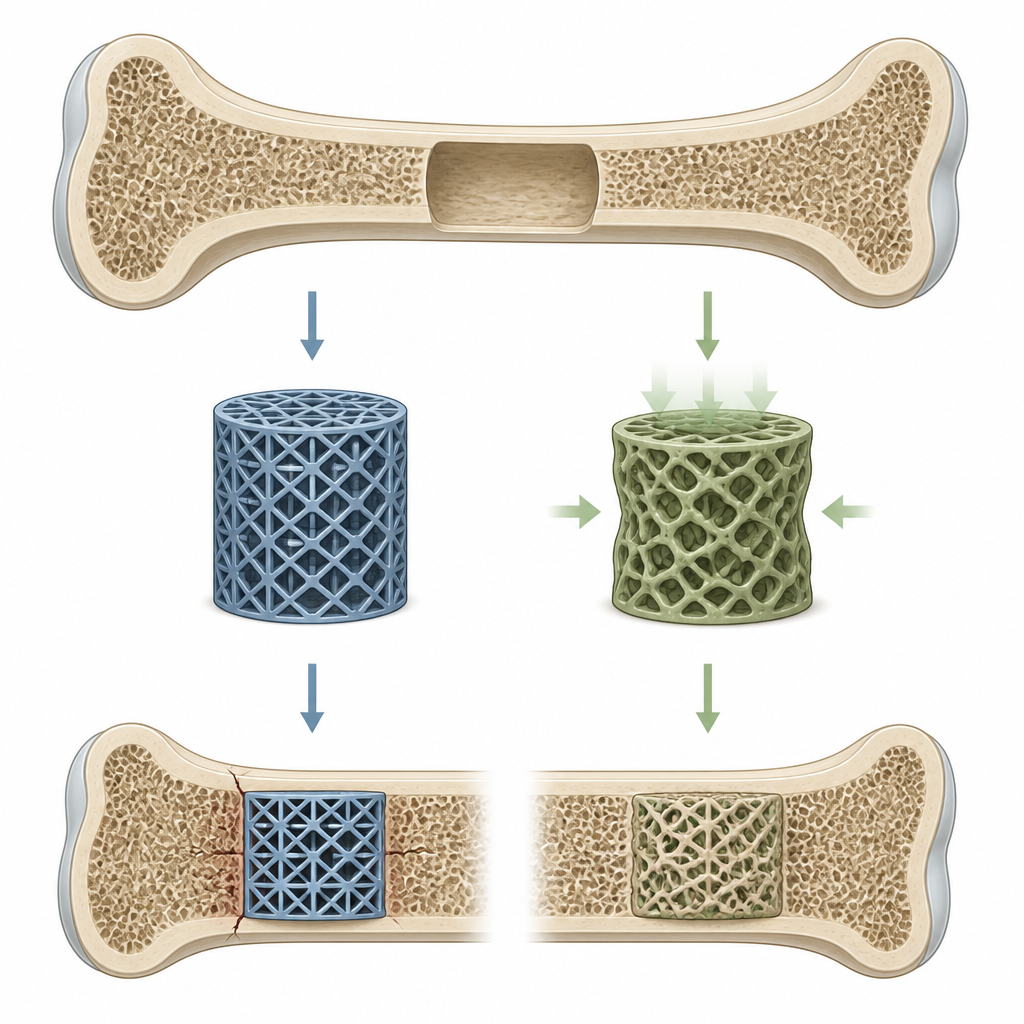
Peeking inside the scaffold structure
Using high-resolution X-ray micro-computed tomography, the team reconstructed the internal architecture of the printed pieces in three dimensions. The glass scaffold showed a highly ordered, grid-like pattern with relatively large, evenly spaced channels. In contrast, the hybrid scaffold had thicker, less regular struts and a more tangled pore network that resembled natural spongy bone. Both designs had plenty of open, interconnected space for cells and blood vessels to move through, with pore sizes comfortably above the threshold usually considered necessary for bone ingrowth.
How they behave under pressure
The scaffolds were then squeezed in a mechanical testing machine to mimic the loads they would face in the body. The glass version resisted higher forces before failing and was noticeably stiffer, but it fractured at only about 2 percent strain, behaving much like a brittle ceramic. The hybrid scaffold carried slightly lower peak loads yet could stretch to around 7 percent strain, absorbing roughly three times more energy before failing. In repeated loading tests, the hybrid pieces settled into a more stable response over ten cycles, suggesting they can adapt to ongoing stresses more like living bone.
Following the forces inside
To understand how internal stresses build up, the researchers converted their 3D X-ray data into computer models and ran virtual compression experiments. These simulations showed that in the glass scaffold, stress and strain concentrate sharply at the junctions where struts meet, highlighting likely starting points for cracks. In the hybrid scaffold, the forces spread more evenly through the irregular network, with higher local stretching but much lower peak stress. This pattern points to a structure that deforms more gently and is less likely to suffer sudden, catastrophic failure. 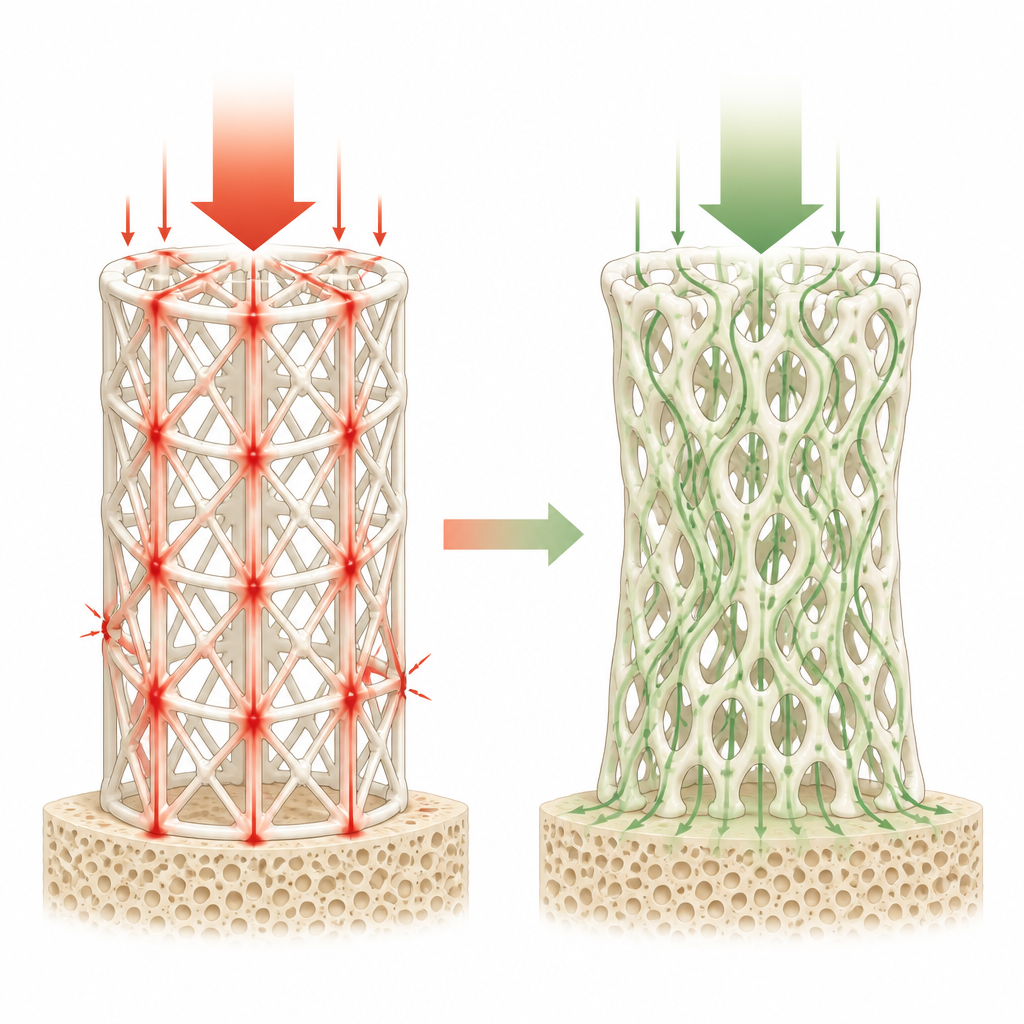
What this means for future bone repair
For patients, the key result is that different scaffold materials may suit different clinical needs. The glass scaffold offers higher initial stiffness, which could help in very demanding load-bearing situations, but its brittleness limits how much movement it can safely tolerate. The hybrid scaffold is softer but tougher and more bone-like in its ability to bend and recover, making it a strong candidate where repeated loading and gradual healing are important. By combining detailed imaging, mechanical testing, and computer modelling, this study provides a roadmap for tuning scaffold designs so that future implants can better match the complex mechanical behaviour of real bone.
Citation: Liu, J., Chen, J., Heyraud, A. et al. Comparative mechanical characterisation of 13–93 bioactive glass and hybrid scaffolds for bone regeneration. Sci Rep 16, 15905 (2026). https://doi.org/10.1038/s41598-026-46620-9
Keywords: bone scaffolds, bioactive glass, 3D printing, hybrid biomaterials, bone regeneration