Clear Sky Science · en
Data-driven prediction of microhardness and tensile strength in microwave-sintered ZrC reinforced AA7075/SiC hybrid composites using machine learning
Why stronger light metals matter
Airplanes, electric cars, and wind turbines all need parts that are light but tough enough to survive years of stress. Aluminium alloys are a popular choice, but engineers want them to be even harder and stronger without adding weight or spending months on trial-and-error testing. This study shows how mixing aluminium with tiny ceramic particles and using artificial intelligence can help predict and fine-tune those properties far more efficiently.
Building a smarter metal recipe
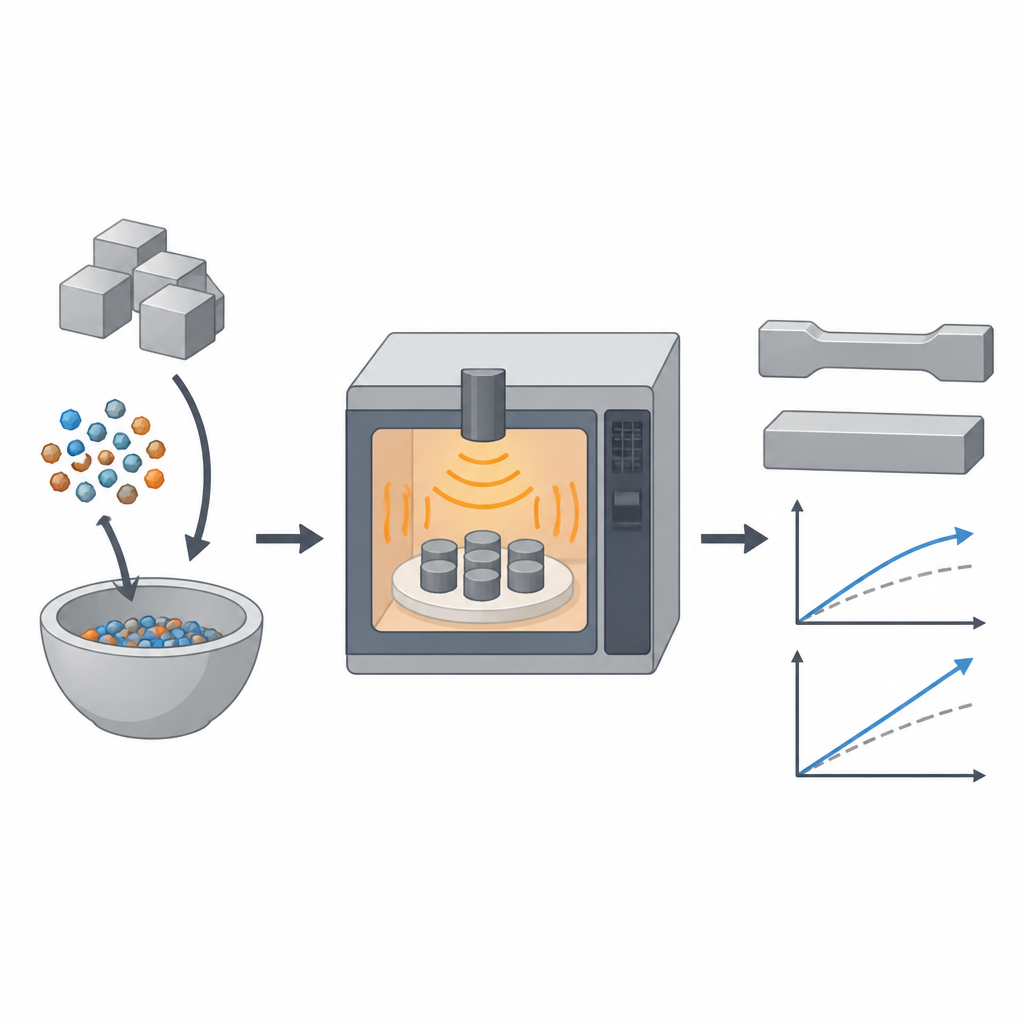
The researchers worked with a high-strength aluminium alloy called AA7075 and added two kinds of ceramic particles: silicon carbide (SiC) and zirconium carbide (ZrC). These particles act like gravel in concrete, helping the soft metal carry more load and resist wear. Instead of melting everything, the team used a powder route: they blended metal and ceramic powders, pressed them into small pellets at different pressures, and then heated them in a microwave furnace. By carefully varying how much SiC and ZrC they used, how hard they pressed the powders, and how long and how hot they heated them, they created 172 different samples and measured their hardness and tensile strength.
What the microscope reveals
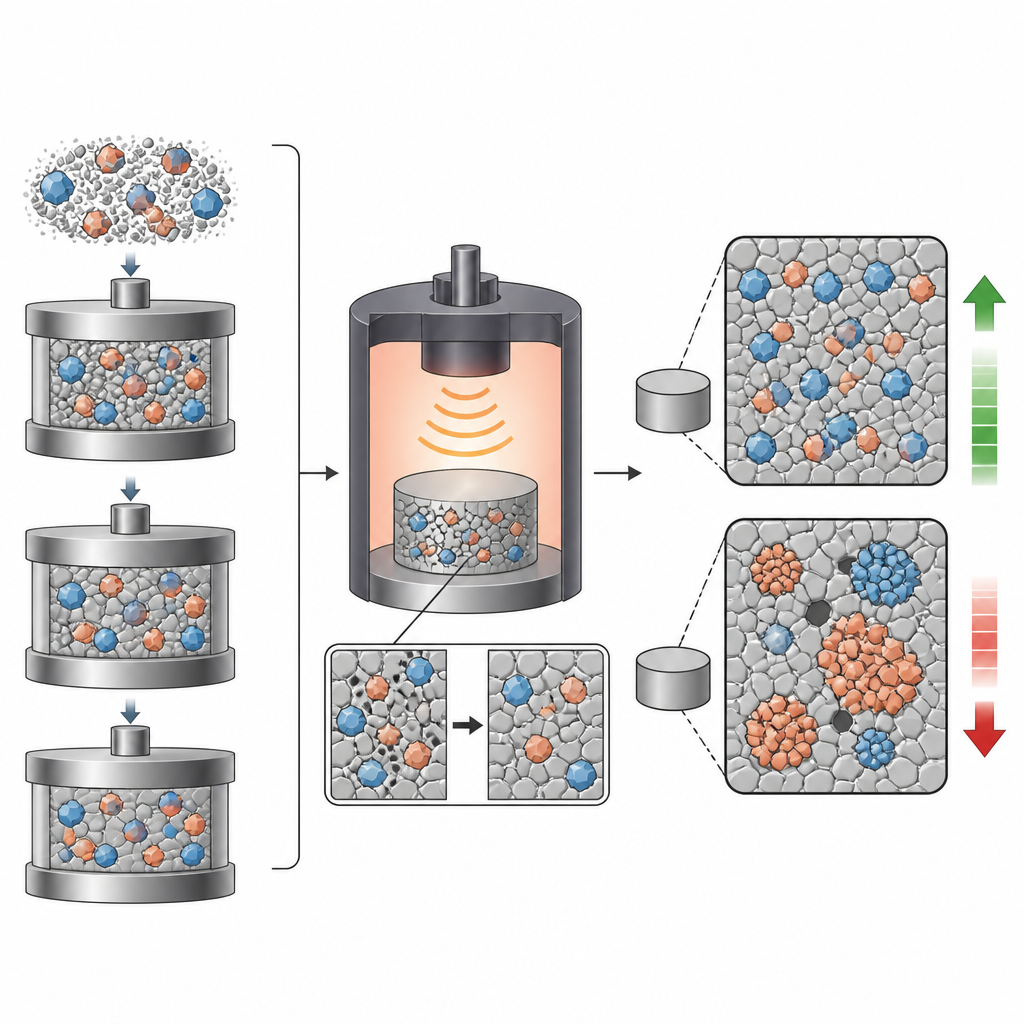
Microscope images showed that the way the particles spread through the aluminium is crucial. When SiC and ZrC were present in moderate amounts and well dispersed, the particles were evenly scattered and tightly bonded to the metal. This helped block the motion of defects inside the metal, refine the grain size, and pass load from the soft aluminium to the hard particles, all of which improved hardness and strength. But when the team pushed the ZrC content too high, the particles began to clump together, leaving pores and weak spots in the microstructure. These clumps act like tiny cracks waiting to grow, so strength and ductility drop even though more hard material has been added.
How processing knobs change strength
The study also mapped how processing conditions shape performance. Higher compaction pressures squeezed the powder together more effectively, reducing empty spaces and giving the microwave heating a better starting point, which boosted both strength and hardness. Heating to the right temperature and holding for the right time helped the particles fuse and bond to the metal, but going too hot or too long allowed grains to grow and interfaces to weaken, erasing some of the gains. SiC content strongly raised hardness and strength up to an optimum level, while modest ZrC additions improved stability and bonding; beyond about three to four percent ZrC, however, particle clumping began to hurt properties. These patterns confirmed that there is a sweet spot where composition and processing come together to give the best performance.
Teaching machines to predict metal behavior
To avoid repeating long test campaigns each time they tried a new recipe, the authors trained several machine learning models to predict hardness and tensile strength from the processing settings and particle contents. They used methods such as neural networks, random forests, boosted trees, support vector machines, and nearest neighbours, and checked them using strict cross-validation so that no model was only memorizing the data. The best models, especially a neural network and a boosted tree approach, could predict tensile strength and microhardness with accuracy above 95 percent. Just as important, the team probed how the models made their predictions and found that the most influential inputs matched what the metallurgy suggested: compaction pressure and reinforcement balance dominated strength, while SiC content and heating conditions were most critical for hardness.
What this means for future materials
For non-specialists, the key message is that computers can now help design lighter, stronger aluminium composites by learning from a focused but carefully planned set of experiments. Instead of fabricating and testing hundreds of extra samples, engineers can use these trained models to explore virtual recipes, narrow down the most promising combinations of particle content and processing, and then confirm only the best ones in the lab. By tying machine learning back to what is seen under the microscope, the work shows that these predictions are not just number tricks but reflect real physical behavior inside the metal. This blend of data and materials science may speed up the arrival of more efficient, durable components in planes, cars, and energy systems.
Citation: Srinath, E., Venkateswara Reddy, K., Manohar, G. et al. Data-driven prediction of microhardness and tensile strength in microwave-sintered ZrC reinforced AA7075/SiC hybrid composites using machine learning. Sci Rep 16, 15971 (2026). https://doi.org/10.1038/s41598-026-46609-4
Keywords: aluminum composites, microwave sintering, machine learning, tensile strength, microhardness