Clear Sky Science · en
Genome-wide identification and expression analysis of the expansin gene family in Brassica napus L
Why this matters for everyday crops
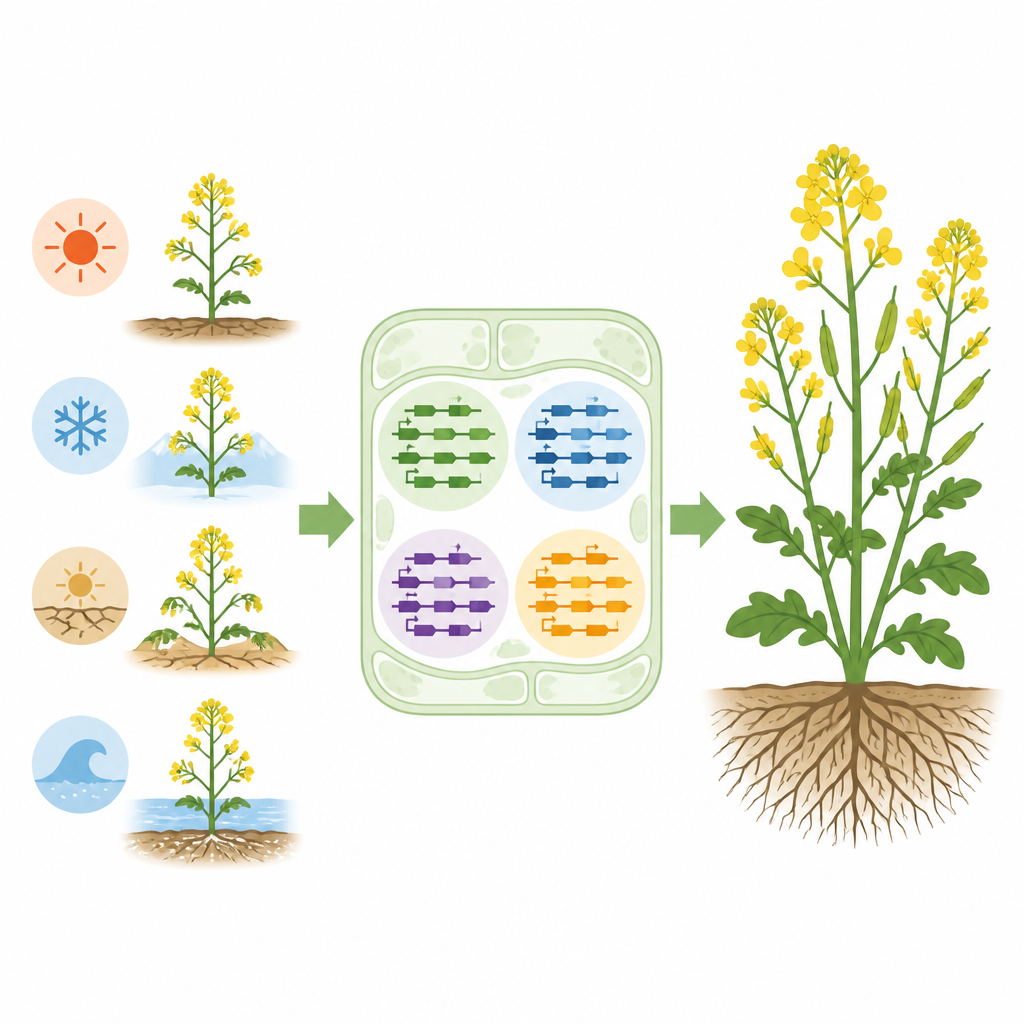
Rapeseed, also known as canola, is one of the world’s most important oilseed crops, supplying cooking oil and animal feed. Its yields, however, are threatened by stresses such as heat, cold, drought, and waterlogging. This study takes a deep look at a large group of plant proteins that help cells loosen and grow, asking how they are organized in rapeseed and how they respond when the plant is under stress. Understanding these growth helpers could ultimately guide breeders toward hardier, higher yielding varieties.
The plant “wall softeners” that let cells grow
Plant cells are surrounded by rigid walls that must loosen for the plant to grow. Expansin proteins act like tiny wedges in these walls, helping cells stretch as internal pressure pushes outward. They are also involved in seed sprouting, root elongation, fruit softening, and responses to harsh conditions. Previous work in model plants such as Arabidopsis and in crops like rice and soybean showed that altering expansin activity can change plant height, root systems, and tolerance to salt and drought. Yet until now, the full expansin toolkit in rapeseed had not been mapped.
Cataloging the expansin toolkit in rapeseed
The researchers scanned the reference genome of a widely used rapeseed variety and identified 127 expansin genes. These genes fall into four groups, or subfamilies, that have also been seen in other plants. Most belong to the largest group, EXPA, with smaller sets in EXPB and two “expansin like” groups. The team examined the basic properties of the proteins, their shared building blocks, and how the genes are arranged on the 19 rapeseed chromosomes. Many genes share similar structures and conserved sequence motifs, pointing to a high degree of preservation across evolution.
How evolution copied and conserved these genes
By comparing corresponding regions within the rapeseed genome, and between rapeseed, Arabidopsis, and tobacco, the authors traced how the expansin family expanded. They found that most related gene pairs arose through large scale segmental duplication events, a common outcome of ancient genome doubling in flowering plants. Measures of DNA change suggest these duplicated genes have been kept under purifying selection, meaning harmful changes are weeded out. Many rapeseed expansins still match partner genes in Arabidopsis and tobacco, implying that they likely help control similar traits across species.
Where and when expansin genes switch on
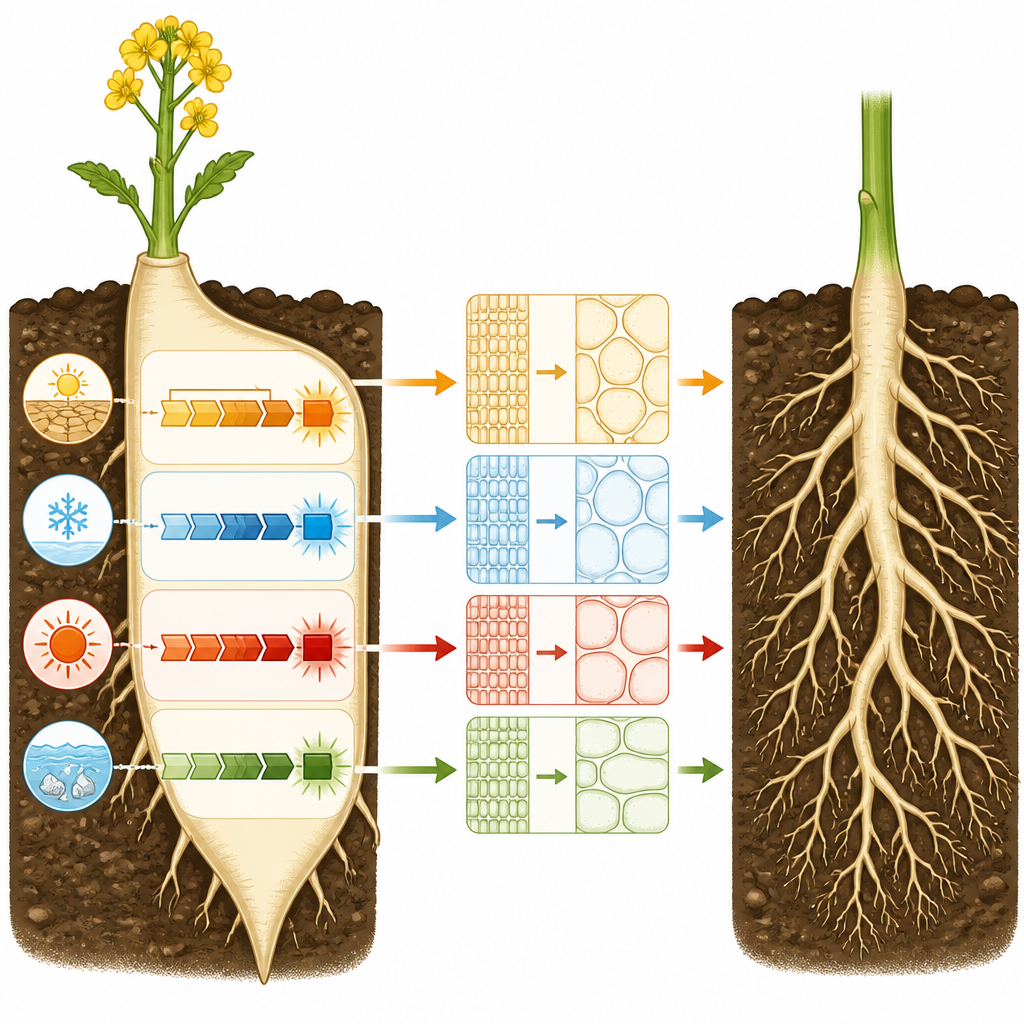
To see what these genes might be doing, the team mined public RNA data that track gene activity in many rapeseed tissues and under several stress treatments. Most expansin genes were switched on in at least one tissue, but each subfamily showed its own pattern. EXPA genes dominated in nearly all organs, from roots and stems to flowers, pods, and seeds. One small group, EXLA, was especially active in seeds, hinting at roles in preparing seeds to germinate. Another group, EXLB, stood out mainly in roots facing salt and osmotic stress, suggesting a role in helping roots adjust to challenging soil conditions.
Zooming in on stress responsive genes
The authors then selected eight expansin genes whose control regions contained many stress related switches, and measured their activity in roots, stems, and leaves after cold, heat, or drought treatment. Some genes, such as BnaEXPA7, BnaEXPA73, and BnaEXPA81, increased activity under particular stresses, often in roots or leaves, consistent with their having multiple stress responsive control elements. Others, like BnaEXPA34, BnaEXPA41, BnaEXPA72, BnaEXPA77, and BnaEXPA84, were strongly active under normal conditions but dropped under stress. Together, these patterns suggest that different expansins either help plants mount a response or dial back growth when conditions become harsh.
What this means for future rapeseed breeding
This work builds a detailed map of all expansin genes in rapeseed, how they are organized, and how they behave across tissues and stress conditions. For non specialists, the key takeaway is that rapeseed carries a large, finely tuned set of wall loosening proteins that can either support growth or help the plant cope when the environment turns hostile. By pinpointing which genes respond to cold, heat, drought, or salty soils, this study lays the groundwork for future breeding or genetic work aimed at producing rapeseed varieties that grow well and yield reliably even under difficult weather and soil conditions.
Citation: Luo, W., Zhang, J., Zhang, H. et al. Genome-wide identification and expression analysis of the expansin gene family in Brassica napus L. Sci Rep 16, 15918 (2026). https://doi.org/10.1038/s41598-026-46606-7
Keywords: rapeseed, expansin genes, plant stress, root growth, oilseed crops