Clear Sky Science · en
YOLO-DCF: dual distillation and context-aware fusion for defect detection
Sharper eyes for factory flaws
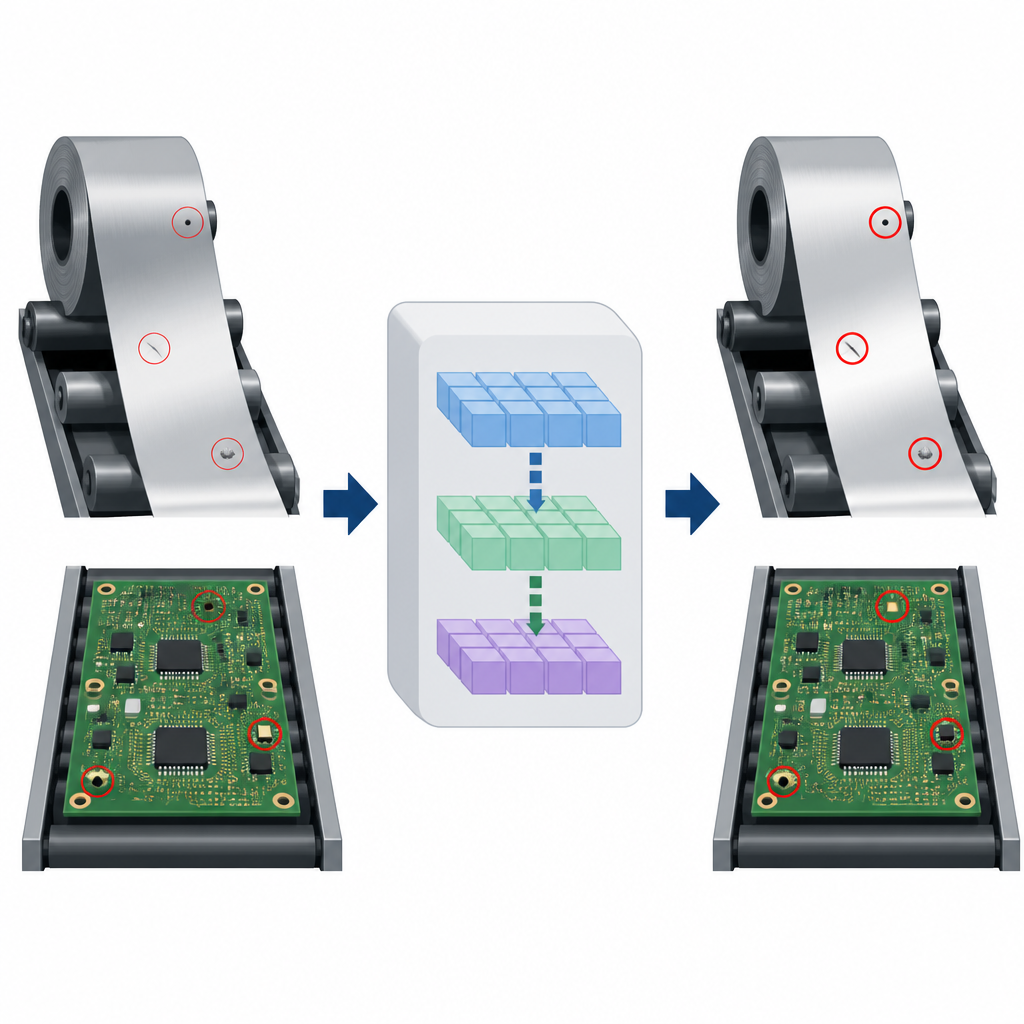
From smartphones to cars, modern products rely on flawless metal and circuit boards. Yet tiny cracks or specks on these surfaces can slip past human inspectors and even fool many computer systems. This study introduces a new artificial intelligence tool called YOLO-DCF that is designed to spot these small, hard-to-see defects quickly and reliably on real manufacturing lines.
Why tiny defects are such a big problem
Industrial surfaces rarely look clean and simple. Steel strips show streaks and textures, and printed circuit boards are crowded with fine lines and components. Defects come in many shapes and sizes, from faint scratches to missing holes, often blending into busy or noisy backgrounds. Traditional image processing can miss subtle flaws, while many deep learning models need huge labeled datasets and can struggle when lighting, materials, or defect patterns change on the factory floor.
A smarter way to read the whole picture
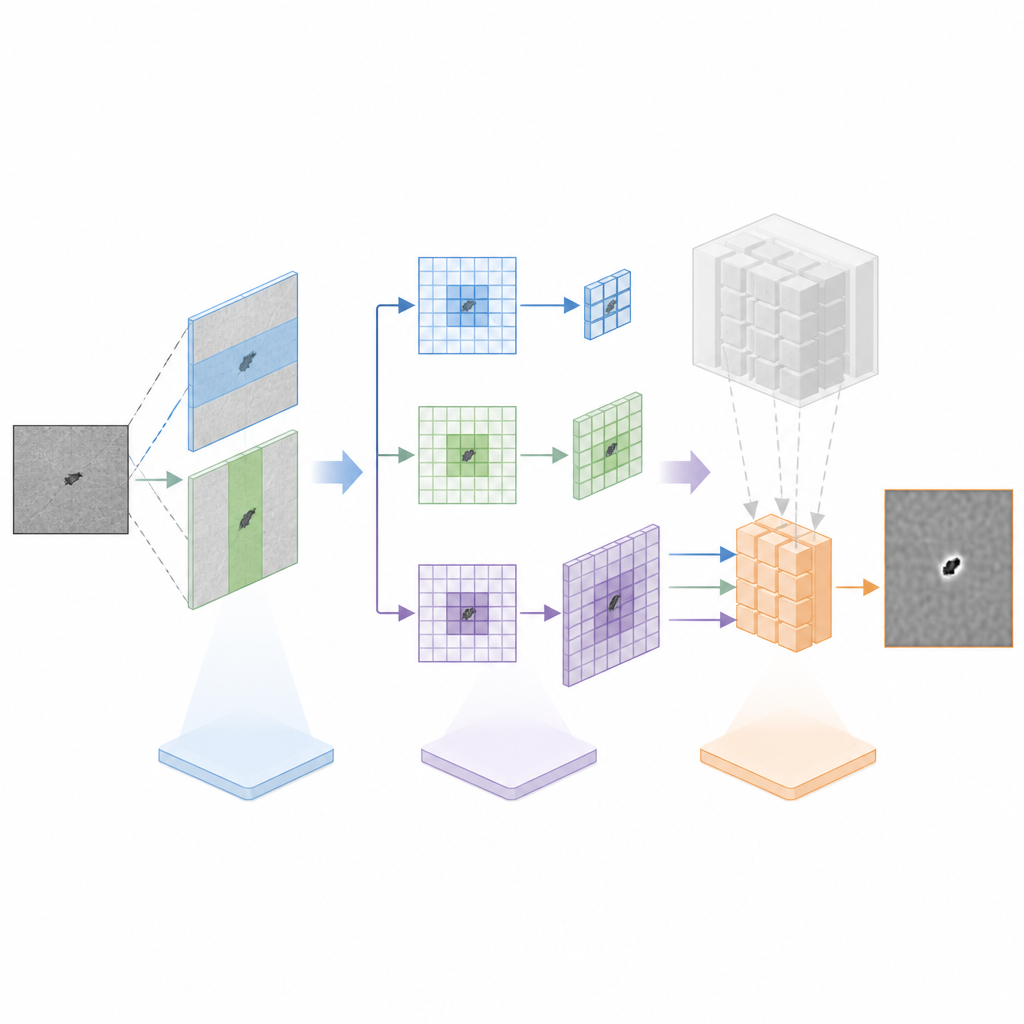
YOLO-DCF builds on a popular real-time detector family and reshapes how the model understands context in an image. One new part, called a context-guided fusion module, first looks along horizontal and vertical directions to capture the broader layout of lines and regions that are common in steel strips and circuit boards. It then blends fine local details with this wider view so that small marks are interpreted in relation to their surroundings, reducing confusion from background patterns and improving the chances of catching low-contrast defects.
Zooming in at several scales at once
Another key innovation is a multiscale residual block that lets the network examine each area through several virtual lenses at the same time. Parallel paths in the model focus on dense local textures, medium-sized shapes, and larger structures, while a reconfiguration step later folds these paths into a simpler form for fast use. This design helps the system recognize both thin cracks and larger blotches without becoming too heavy to run in real time, keeping the model compact enough for deployment on typical industrial hardware.
Teaching a small model to think like a big one
To keep the system efficient, the authors use a dual distillation strategy, where a stronger version of the same network guides a lighter one. Instead of copying only final predictions, the student model learns how the teacher relates different regions of the image to each other and how it distributes attention across feature channels. By matching both the spatial relationships between blocks and the emphasis within each channel, the smaller model preserves much of the teacher’s ability to spotlight tiny, localized defects while remaining faster and more economical to run.
Putting the method to the test
The researchers evaluated YOLO-DCF on two widely used benchmark datasets: steel surface images with six types of defects and a set of synthetic circuit board images with six fault categories. On both, the new system achieved higher detection scores than a strong baseline while adding only a modest number of parameters. It showed particular gains for fine, low-contrast flaws such as crazing in steel and short circuits on boards. Tests with motion blur and noise further suggested that the method is more robust to common industrial imaging issues, maintaining accurate detection when pictures become smeared or grainy.
What this means for real factories
For a non-specialist, the takeaway is that YOLO-DCF offers a more careful and context-aware set of eyes for automated inspection. By combining wider scene understanding, multiscale focus, and efficient knowledge transfer, it can better distinguish true defects from harmless texture while still operating at real-time speeds. This balance of accuracy, speed, and model size makes it a promising candidate for deployment on production lines where missed faults and false alarms both carry high costs.
Citation: Xing, H., Yang, Z. YOLO-DCF: dual distillation and context-aware fusion for defect detection. Sci Rep 16, 15897 (2026). https://doi.org/10.1038/s41598-026-46602-x
Keywords: industrial defect detection, surface inspection, computer vision, deep learning, quality control