Clear Sky Science · en
An efficient method for monitoring small bird targets in wetland environments based on object detection
Watching Wetlands Without Disturbing Them
Wetlands are nurseries of life, and birds are among their most visible residents. Counting and tracking these birds helps scientists judge how healthy a wetland is, but doing this by eye is slow, costly, and can even scare the animals away. This study introduces a smarter computer vision method that can spot very small birds in messy, real-world wetland scenes, helping conservationists monitor wildlife more quietly and more often.
Why Small Birds Are Hard to See
From a distance, a duck or sandpiper can shrink to just a few pixels in a photograph. In wetlands, these faint specks are surrounded by reeds, water reflections, and shifting light that make them blend into the background. Traditional surveys rely on people with binoculars or cameras, and even modern drones and radar struggle to pick out individual birds in such cluttered scenes. The challenge is to automatically find many tiny birds at once, in images where they may be half hidden by plants, bathed in sunset glare, or scattered across shimmering water.
Building a Tough Test for the Computer
To tackle this problem, the researchers first created their own image collection at Sun Island National Wetland Park in China. They gathered photos and video frames across several seasons using phones, telephoto lenses, and fixed surveillance cameras. Only the most difficult examples were kept: birds taking up less than a tenth of the picture, heavy background clutter, camouflage, and partial hiding behind reeds or branches. They then expanded the training set by rotating images, adding noise, and changing brightness so that the model would learn to cope with shaky cameras, glare, and dim or harsh light. The final dataset contained thousands of challenging bird scenes designed to mimic real monitoring conditions. 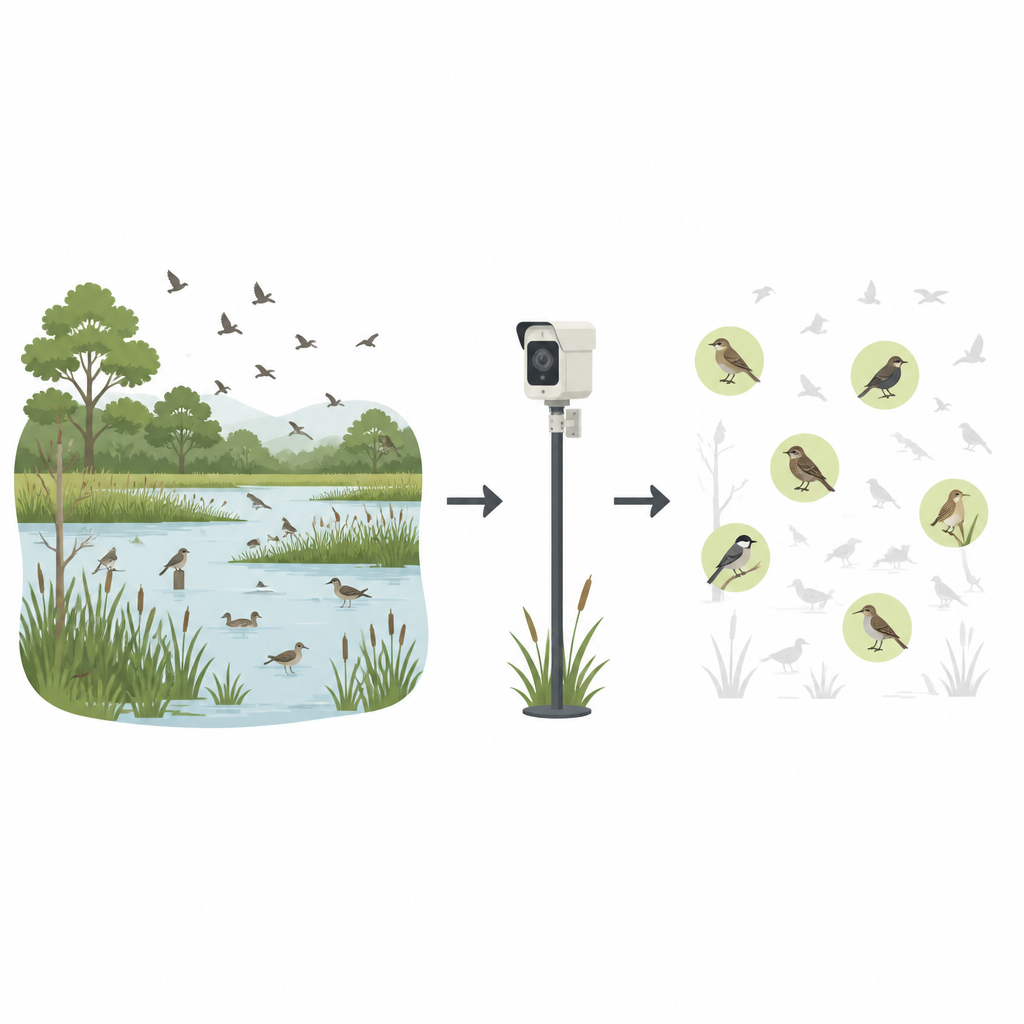
A Leaner Digital Birdwatcher
The team built on a popular fast object detector called YOLO and redesigned it for this wetland task, creating a version they call RLCB-YOLO. Instead of treating every part of the image the same, their model pays extra attention to tiny texture differences that separate a bird from lookalike reeds or ripples. New modules help the network combine close-up detail with broader scene context, so it can tell whether a small dark shape is a bird or just a patch of shadow. Other changes improve how information from different scales is blended and how low-resolution maps are enlarged again, preserving sharp outlines instead of smearing them. Together, these steps make the system better at locking onto small, distant birds without bloating its size.
Testing Speed and Accuracy
The researchers carefully compared different design choices, such as several attention schemes and feature fusion layouts, to see which gave the biggest boost for the least extra computing. They also checked how well the system held up when the image size or learning rate changed, showing that its gains were not tied to one narrow setting. On their wetland bird dataset, RLCB-YOLO detected birds more accurately than the original YOLO model, reaching higher scores on standard measures while using fewer trainable parameters. It even matched or beat larger, more complex detectors, all while still running fast enough to analyze more than one hundred images per second on modern graphics hardware. Visual tests showed fewer missed birds and fewer false alarms in scenes with dense flocks, camouflage, or partial hiding. 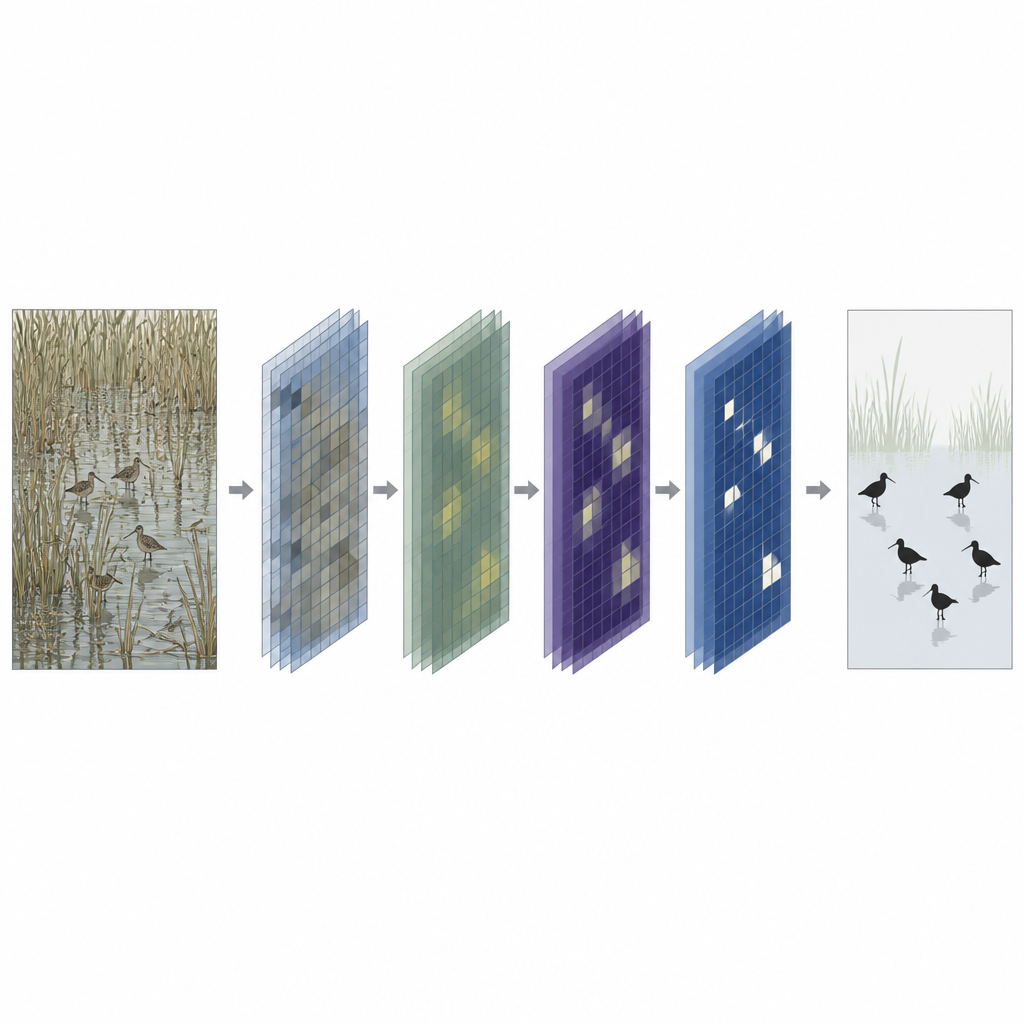
What This Means for Wetland Care
For conservationists, the main message is that it is becoming practical to monitor small birds in large, hard-to-reach wetlands using fixed cameras and smart software rather than constant field visits. RLCB-YOLO offers a way to count and locate birds more precisely in real time, even under tricky lighting and background conditions, while keeping the computer model light enough to run on modest equipment. Although the current work focuses on one type of bird and a single park, the same ideas could be extended to many species and habitats, helping scientists track wildlife trends and protect fragile ecosystems with less disturbance and more detail.
Citation: Xing, C., Qu, C., Zhang, P. et al. An efficient method for monitoring small bird targets in wetland environments based on object detection. Sci Rep 16, 15828 (2026). https://doi.org/10.1038/s41598-026-46593-9
Keywords: wetland birds, small object detection, computer vision, ecological monitoring, YOLO model