Clear Sky Science · en
Experimental study of mRNA from human dental pulp tissue for late postmortem interval estimation
Reading Clues from the Last Silent Tissues
When investigators are faced with a body that has been dead for weeks, even seasoned forensic experts struggle to tell how long ago death occurred. The usual signs—body temperature, stiffening of muscles, and visible changes to the skin—lose their usefulness over time. This study explores a surprising new source of timing clues: tiny genetic messages preserved inside the soft tissue at the center of our teeth. By tracking how these messages fade, the work aims to give forensic science a more reliable way to narrow down the time of death in difficult cases.
Why Teeth Can Hold Long-Lasting Clues
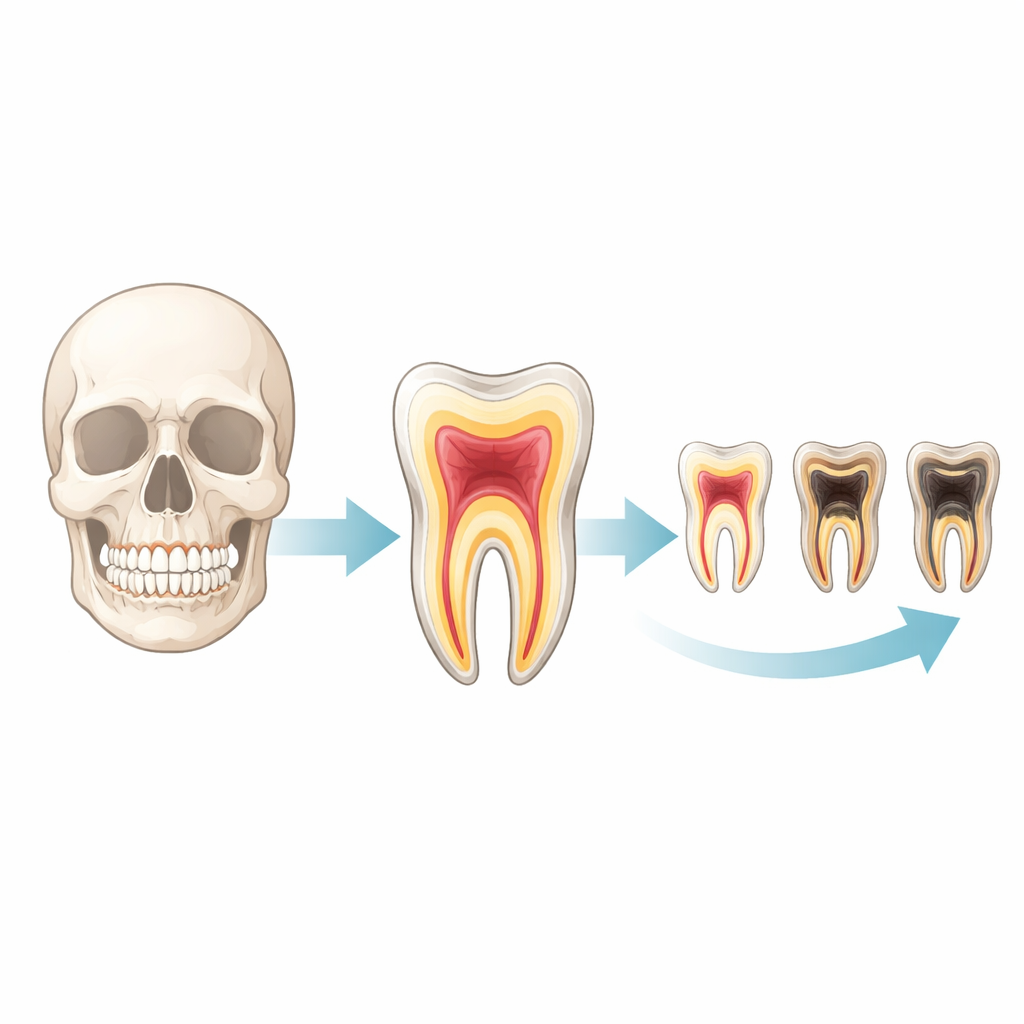
Teeth are some of the toughest structures in the human body. Their hard outer layers of enamel and dentin form a natural shell around the inner pulp, a soft core rich in living cells and blood vessels. Unlike organs that quickly decompose in open air, the pulp is shielded from temperature swings, insects, and microbes. Earlier research suggested that genetic material inside the pulp can remain surprisingly stable after death. This makes teeth especially valuable in cases where the body is badly decomposed, skeletonized, or has been exposed to harsh environments in which other tissues—and more traditional clues to time of death—have already vanished.
Watching Pulp Tissue Break Down Over Time
To see how dental pulp changes after removal, the researchers collected 264 teeth from adults with proper ethical consent. The teeth were kept at room-like temperatures and then frozen at different time points. At several intervals up to 28 days, they examined pulp slices under the microscope. Early on, the pulp structure was mostly intact: cells were packed together, nuclei were clear, and blood vessels were visible. By one to two weeks, cell membranes began to rupture, the tissue loosened, and cell nuclei faded or dissolved. After three to four weeks, only scattered fragments of tissue remained, with the fine collagen network largely broken down. This orderly progression of damage suggested that pulp morphology carries a time pattern that could help estimate how long a tooth has been isolated.
Measuring Fading Genetic Messages
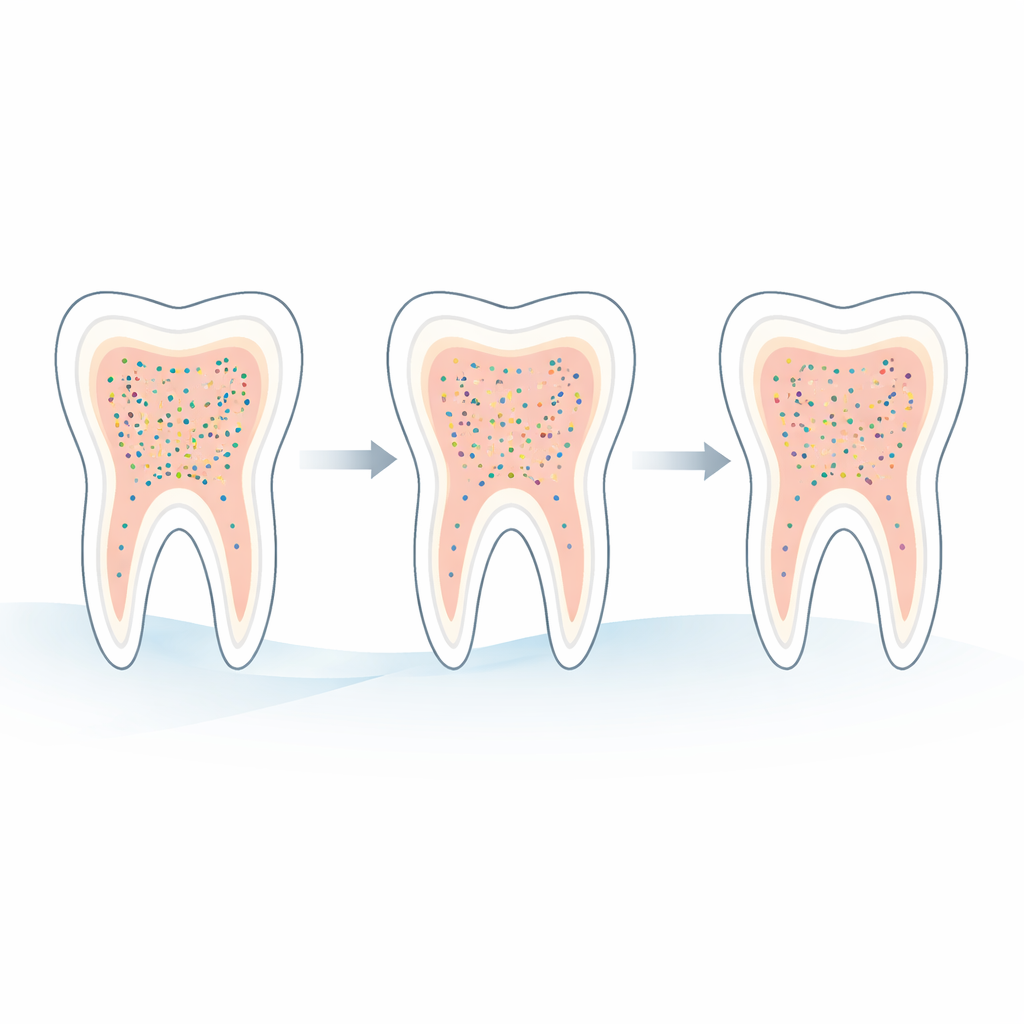
Beyond visible damage, the team focused on messenger RNA (mRNA)—short-lived molecules cells use to carry genetic instructions. Because mRNA naturally breaks down after death, its decline can act like a biological countdown. Using high-throughput sequencing on teeth stored for 0, 7, and 21 days, the researchers identified thousands of mRNAs whose levels changed over time. From these, they selected eight promising candidates and then concentrated on five that gave the most reliable measurements: SRSF5, FGFR1, ACADVL, FOS, and LRP1. With a sensitive technique called RT–qPCR, they quantified how strongly each of these five mRNAs remained in pulp samples collected at seven different time points up to 28 days. All five showed a steady, predictable decrease as time went on.
Turning Molecular Decay into a Time Ruler
To turn these molecular patterns into a practical timing tool, the researchers built mathematical models that link mRNA levels to the late postmortem interval—the time span from roughly several days to several weeks after death. First, they created simple models that used just one mRNA at a time. These single-marker models showed clear linear relationships with time, but their error rates were still relatively high. Next, they built multi-marker models that combined several mRNAs at once. These joint models captured more of the underlying pattern and, when tested on separate teeth stored for 10, 18, and 25 days, consistently outperformed the single-marker versions. The best multi-marker model reduced the average timing error to about 5 days, with a lower overall percentage error.
What This Means for Real Forensic Cases
The authors stress that their work is an early but important step. The teeth in this study were stored at a single, controlled temperature, and factors like age, sex, tooth type, disease, soil conditions, and climate were not fully explored. In real investigations, such variables can alter how quickly mRNA decays. Even so, the findings show that specific genetic signals inside dental pulp fade in a regular, measurable way over several weeks. While the method is not yet accurate enough to pinpoint the exact day of death, it can help narrow down broad time windows when traditional signs have disappeared. Combined with other tools, and eventually with rapid on-site testing devices, pulp mRNA patterns could become a valuable backup clock for forensic experts working on complex, late-stage cases.
Citation: Yin, M., Gao, H., Chen, J. et al. Experimental study of mRNA from human dental pulp tissue for late postmortem interval estimation. Sci Rep 16, 14398 (2026). https://doi.org/10.1038/s41598-026-46591-x
Keywords: time of death, forensic dentistry, dental pulp, mRNA degradation, postmortem interval