Clear Sky Science · en
Quantitative mapping of meniscus morphology using advanced imaging analysis in young patients
Why knee cushions matter
Every time you walk, run, or jump, soft crescent shaped pads in your knees help spread out the impact. These pads, called menisci, protect the smooth cartilage that lets your knee bend without pain. Women are more likely than men to develop certain knee problems, including arthritis after injury, so scientists want to know whether small differences in these pads might help explain why. This study used advanced MRI analysis to look very closely at meniscus shape and internal structure in young women and men with otherwise healthy knees.
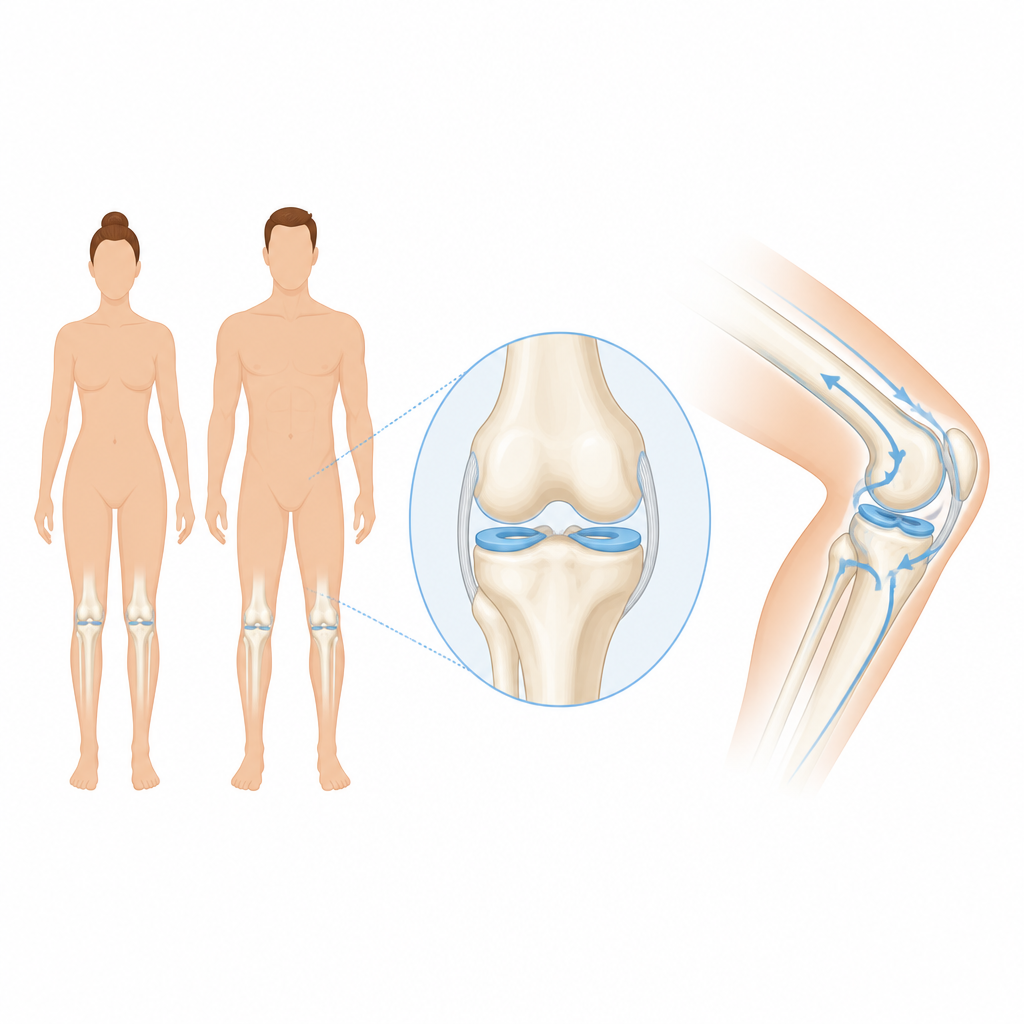
Taking a closer look inside healthy knees
The researchers studied MRI scans from 105 people between 13 and 35 years old who had surgery for a torn ACL in one knee. Instead of looking at the injured side, they focused on the opposite, uninjured knee to see what “normal” menisci looked like in each sex. Using a computer based method, they turned each scan into a three dimensional model of the two menisci in the knee. They then measured the cross sectional area, or thickness and height, of the tissue in narrow slices taken all along the curved length of each meniscus, from the front to the back. They also measured how bright the tissue appeared on MRI, a signal that can reflect water content and microstructure and that often rises when the tissue is damaged.
Making fair size comparisons between women and men
Because men usually have larger bones and joints than women, the team first confirmed that male knees in this group were wider on average. As expected, the raw meniscus size measurements were larger in men all along both the inner and outer menisci. To make a fair comparison, the researchers adjusted each person’s meniscus measurements by their knee width. This allowed them to ask whether, after accounting for overall knee size, menisci in women were still relatively smaller or shaped differently in specific regions.
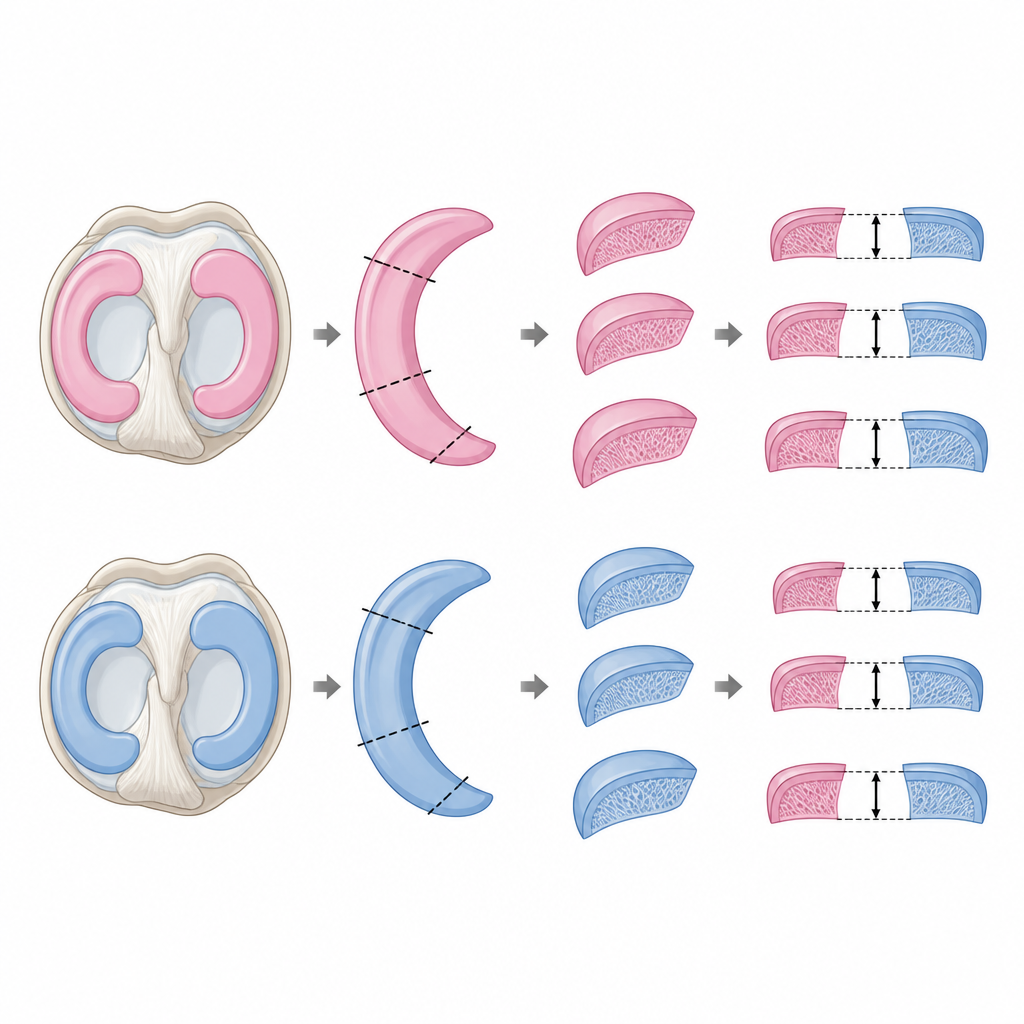
Where the real differences show up
After this size adjustment, the outer meniscus showed no meaningful sex based differences anywhere along its length. The inner meniscus told a more nuanced story. Overall patterns of shape along the curve were similar for women and men, with both sexes having thicker tissue toward the back of the knee where pressures are highest during movement. However, in the front portion of the inner meniscus, women had a modest but consistent reduction in cross sectional area compared with men. This difference was limited to that front region rather than being spread evenly across the structure.
What MRI brightness says about tissue quality
The team also examined MRI signal intensity, a measure tied to tissue composition and early wear. In damaged or arthritic knees, this signal tends to rise, especially in the inner meniscus. In this study of uninjured knees, signal patterns shifted from front to back in both menisci, hinting at natural variation in blood supply and fiber arrangement. Yet once the values were normalized, women and men showed very similar signal profiles in both the inner and outer menisci. This suggests that, at least in this young and otherwise healthy group, the internal material quality of the meniscal tissue is comparable between sexes.
What this means for knee health
To a layperson, the main takeaway is that women’s and men’s knee cushions are built much the same, once overall knee size is taken into account, with one notable exception in the front part of the inner pad. That local shape difference might change how force is spread in that region, but by itself it probably does not fully explain why women face higher rates of knee arthritis after injury. The study also shows that careful, region by region mapping of meniscus size and MRI signal is crucial, since looking only at averages can hide important local changes. This approach may help doctors and researchers better track how knee tissue responds to injury and treatment over time.
Citation: Barnes, D.A., Murray, C.J., Movahhedi, M. et al. Quantitative mapping of meniscus morphology using advanced imaging analysis in young patients. Sci Rep 16, 15534 (2026). https://doi.org/10.1038/s41598-026-46590-y
Keywords: knee meniscus, MRI analysis, sex differences, knee osteoarthritis risk, ACL surgery