Clear Sky Science · en
Sequential extraction and organosolv pretreatment of halophytes: unlocking biomass recalcitrance for bio-based production
Turning Salt-Loving Plants into Useful Resources
As the world searches for alternatives to fossil fuels, scientists are looking for plants that do not compete with food crops or precious freshwater. This study focuses on Salicornia, a salt-loving plant that thrives in coastal marshes and salty soils where little else grows. The researchers show how late-harvested, woody Salicornia stems can be processed in a stepwise way to recover valuable chemicals and produce renewable methane gas, turning an underused coastal plant into a flexible raw material for a future circular economy.
Why a Coastal Weed Matters
Salicornia, sometimes called sea asparagus or glasswort, is already known for its edible shoots and oil-rich seeds. What usually remains after seed and food use is a dry, woody residue rich in tough fibers that are hard to break down. Instead of viewing this as waste, the authors investigated whether these lignified stems could become a feedstock for a “biorefinery” – a facility that, much like a petroleum refinery, splits raw material into several useful streams. Because Salicornia can be grown on salty, marginal land with limited freshwater, proving its value as a multi-purpose crop could reduce pressure on good farmland while still supplying ingredients for food, chemicals, and energy.
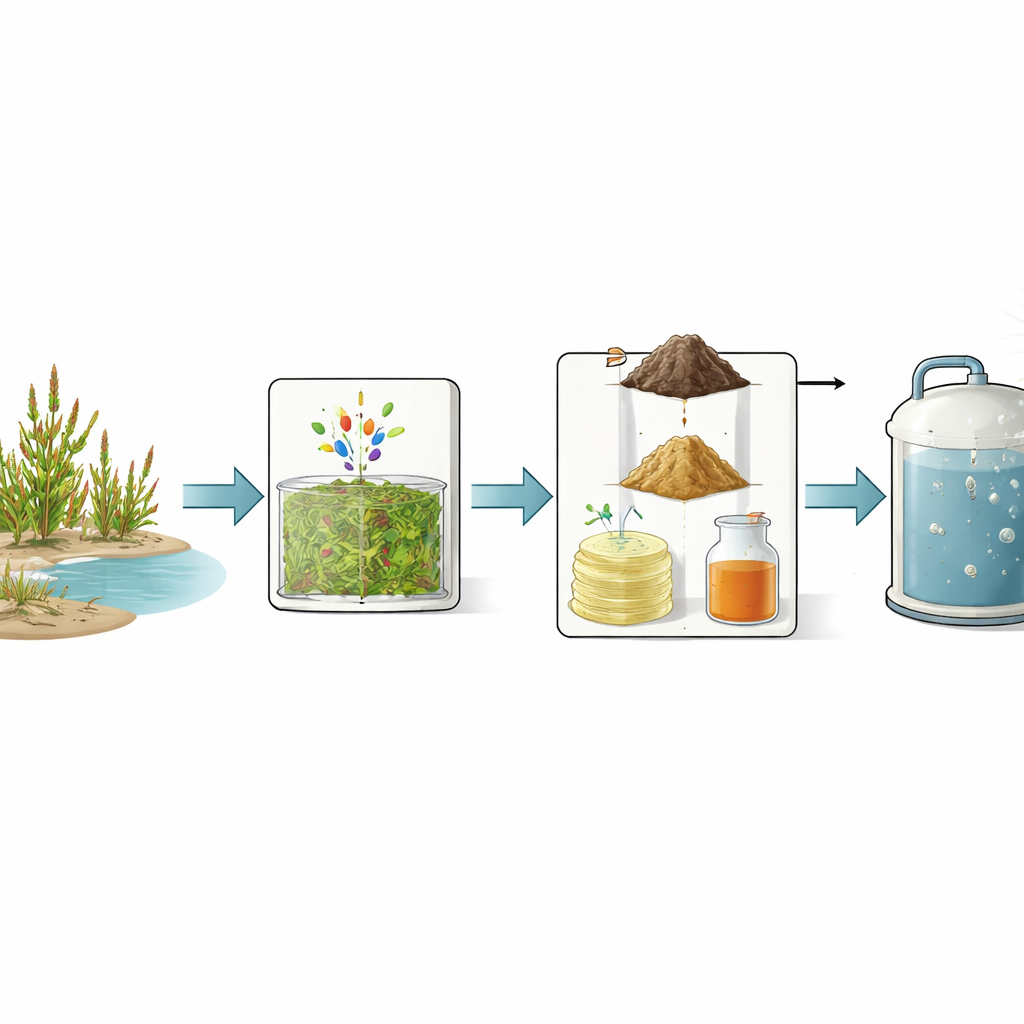
Stepwise Processing to Unlock Tough Fibers
The team designed a chain of treatments to gently take apart the complex mixture of compounds in Salicornia stems. First, they removed bioactive molecules using either a classic hot-water cycle called Soxhlet extraction (SLE) or a high-pressure hot-water method known as subcritical water extraction (SWE). These steps pull out a range of useful small molecules, including antioxidants and other specialty compounds, while leaving behind a fibrous residue. Next, they subjected this residue to an organosolv step, where a hot mixture of water and ethanol separates the main building blocks of the plant cell wall: cellulose, hemicellulose, and lignin. By adjusting temperature, treatment time, and solvent strength, they tested which conditions best freed each fraction without destroying it.
Separating the Plant into Building Blocks
Organosolv treatment proved highly effective in splitting the fibers into cleaner streams. In most cases, more than 88–96% of the original cellulose was preserved in the solid pulp, while large portions of hemicellulose and lignin were dissolved and collected separately. Soxhlet-pretreated fibers tended to lose hemicellulose more completely, reaching over 96% removal in many runs, while SWE-pretreated fibers retained more hemicellulose in the pulp. Higher ethanol content generally encouraged lignin removal, but very harsh conditions also led to unwanted breakdown of sugars into smaller acids and byproducts. The researchers were able to recover lignin fractions with low contamination by sugars and minerals, which could later serve as raw material for coatings, adhesives, or other advanced products.
From Clean Fibers to Sugar and Methane
Once the pulp was enriched in cellulose and partially freed from lignin and salts, enzymes could attack it more easily. In lab tests, many of the treated pulps released nearly all of their potential glucose, especially those obtained from SWE, which achieved full conversion in most of the conditions tried. The team then fed these pretreated fibers to anaerobic microbes to measure how much biomethane could be produced. Here, too, the integrated treatment paid off: methane yields exceeded 300 milliliters of methane per gram of volatile solids for both extraction routes, with the best SWE condition reaching roughly 336 milliliters. These values were up to three-quarters higher than for fibers that had only been extracted but not further fractionated, and the digestion ran faster as well.
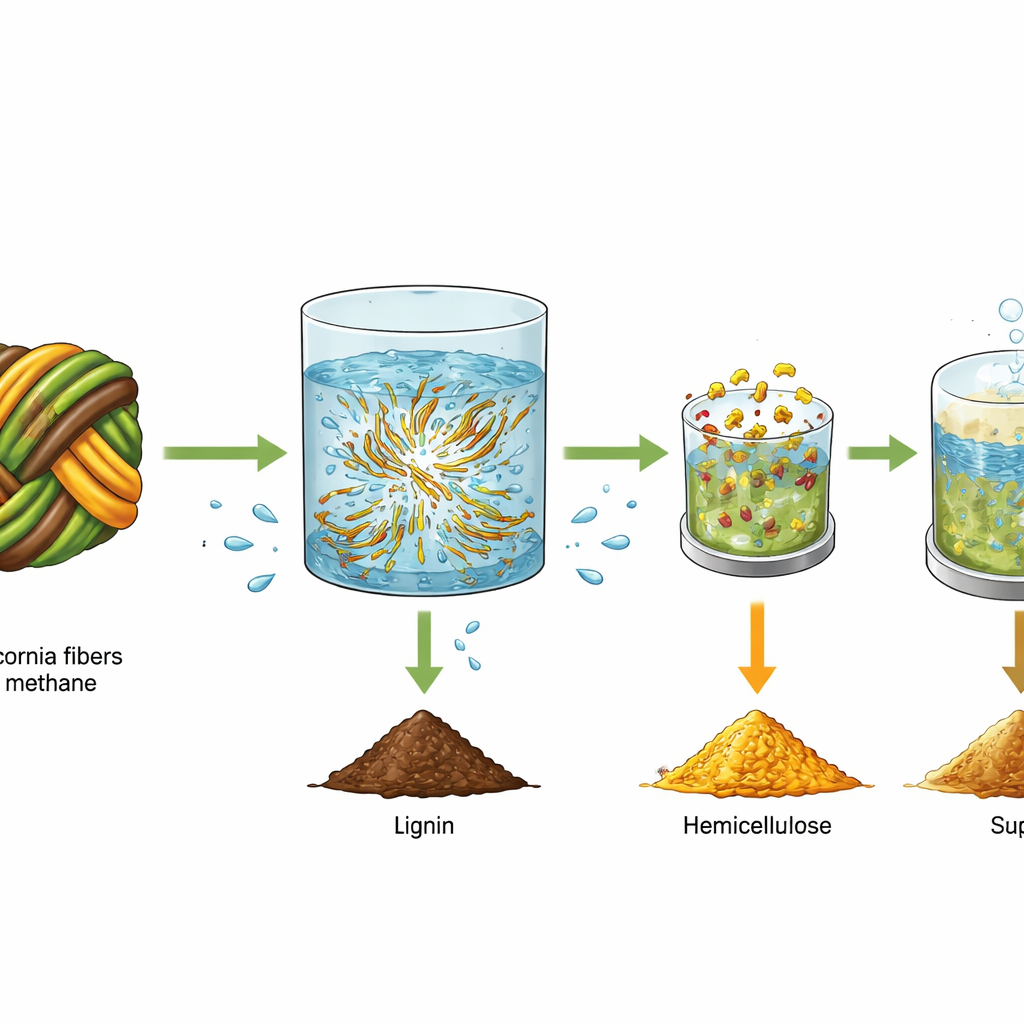
Finding the Sweet Spot in Treatment Conditions
The study systematically compared dozens of combinations of temperature, time, and solvent strength. A clear pattern emerged: moderately high temperatures (around 180 °C), longer treatment times (about one hour), and a richer ethanol mixture (60% by volume) offered the best balance between loosening up the plant structure and avoiding excessive sugar damage. Under these conditions, cellulose losses were low, lignin removal was high, salts were greatly reduced, and both saccharification and methane production were maximized. Importantly, these benefits were realized after valuable bioactive compounds had already been captured in the first extraction step, boosting the overall value drawn from each kilogram of biomass.
What This Means for Future Green Industries
To a non-specialist, the takeaway is that a salt-marsh plant often treated as a niche crop or even a weed can be transformed into a versatile resource when processed wisely. By chaining together gentle extraction, smart solvent treatment, and microbial digestion, the researchers show that Salicornia can provide specialty chemicals, clean polymer building blocks, and renewable methane from the same batch of plants. This kind of integrated approach makes better use of land that cannot support conventional crops, reduces waste, and creates multiple revenue streams from a single harvest. As such strategies are scaled up, they could help shift energy and materials production toward a more sustainable, circular model.
Citation: Monção, M., Al-Dubai, A., Cayenne, A. et al. Sequential extraction and organosolv pretreatment of halophytes: unlocking biomass recalcitrance for bio-based production. Sci Rep 16, 12201 (2026). https://doi.org/10.1038/s41598-026-46584-w
Keywords: Salicornia, halophyte biorefinery, organosolv pretreatment, biomethane, lignocellulosic biomass