Clear Sky Science · en
Controlling memorability of face images with generative models
Why some faces stick in our minds
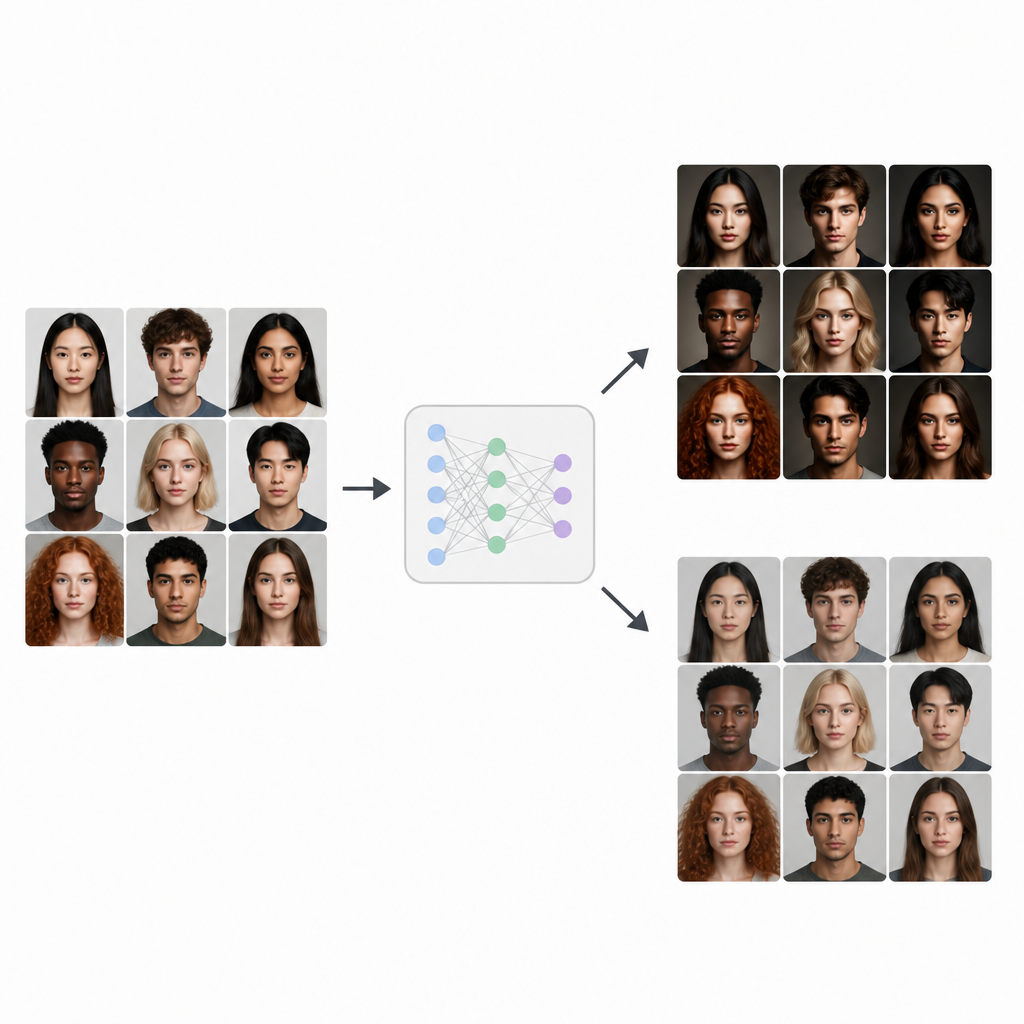
Every day we scroll past countless faces on our screens, yet only a few stay with us. Advertisers, teachers, artists, and even law enforcement all care about which images people remember and which ones they forget. This study asks a striking question: can we deliberately dial a face photograph up to be more memorable or down to be less memorable, while still keeping the same person and a natural look? Using powerful image generators, the authors show that the answer is largely yes, and that memorability can be steered in a controlled way.
A new way to tune how memorable a face is
The researchers build on recent progress in generative artificial intelligence, especially a system called StyleGAN that can create highly realistic face images from abstract numerical codes. Each code corresponds to one face. By generating a large collection of synthetic faces and scoring how likely each one is to be remembered using deep learning “memorability assessor” networks, the team creates a map between these hidden codes and human memory. They then use a simple statistical tool to find a dividing surface in this hidden space that separates more memorable faces from less memorable ones. Moving a face’s code in one direction across this surface increases its predicted memorability, while moving it the other way lowers it.
Changing looks without changing who it is
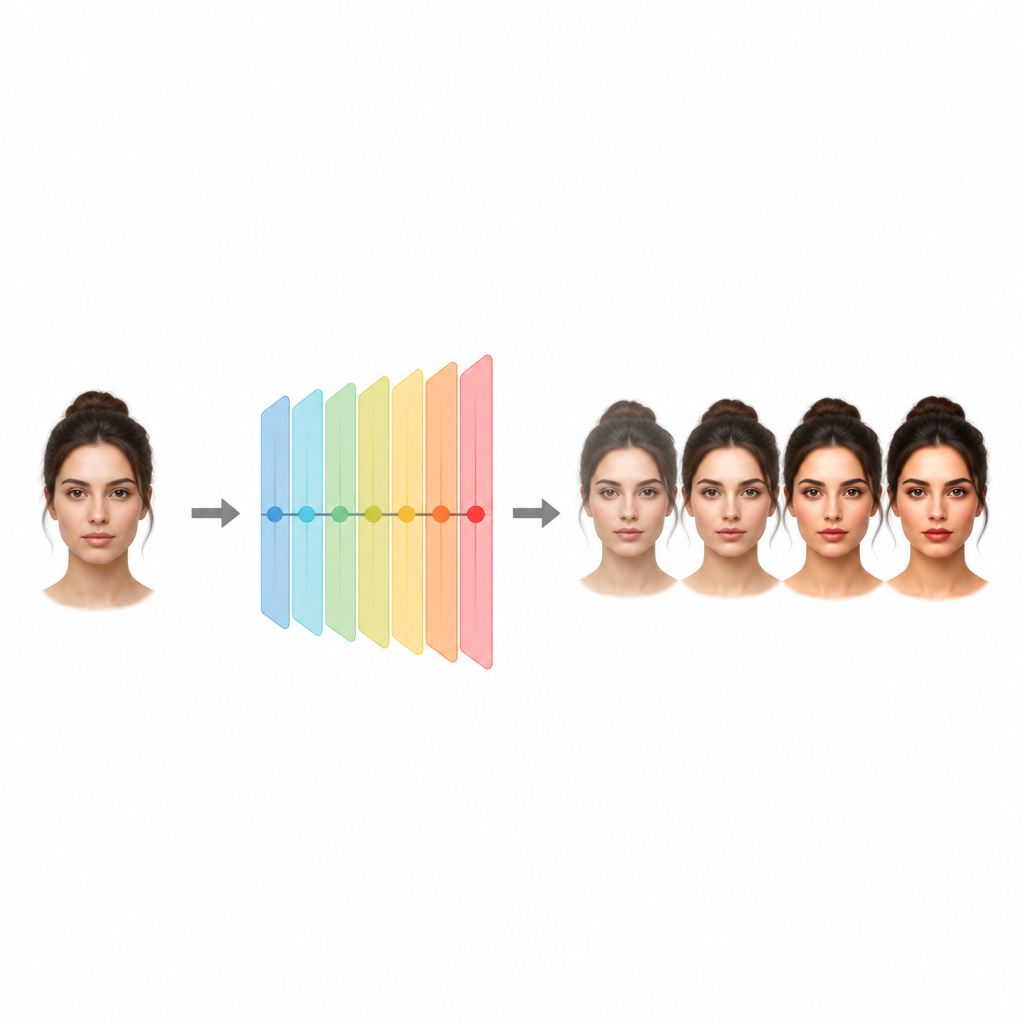
To make this useful for real photographs, the authors first “invert” a real image into StyleGAN’s hidden space, finding a code that recreates the original face. Once this code is found, they nudge it along the memorability direction and regenerate the image. The resulting faces belong to the same individual but now look more or less likely to stick in memory. Careful tests show that people’s identities are preserved and that the realism of the images remains close to that of the unedited outputs. The team also develops a finer, multi-level version of the method that adjusts memorability in several small steps rather than a single jump; this gentler control keeps identity even more stable.
What actually changes when a face becomes memorable
By inspecting thousands of edited faces, the study uncovers which visual details tend to shift when memorability rises. More memorable faces often look slightly younger, with slimmer facial structure, brighter skin, more pronounced makeup or facial hair, and more serious expressions. The researchers measure local image properties around the eyes and mouth, finding small but reliable boosts in eye-region contrast and lip color richness when memorability is increased. They also rule out a simple explanation based on overall brightness: uniformly lightening or darkening faces barely alters memorability scores compared with the stronger, more localized edits produced by their method.
Beyond faces to everyday objects
The approach is not limited to people. The authors apply the same idea to images of cats, horses, cars, and churches created by other generative models. Again, they find a direction in the hidden code space that raises or lowers predicted memorability. For objects, the visible changes often involve zooming in, shifting viewpoint, or changing background and color in ways that make the subject stand out. This suggests that while the visual cues differ between faces and objects, the underlying principle is similar: there are consistent directions in the space of possible images that make them more or less likely to be remembered.
Why controlled memorability matters
In simple terms, the paper shows that memorability is not just a mysterious byproduct of an image; it is something that can be adjusted with intent. By learning how to nudge images along subtle visual dimensions, computers can make faces and objects that our minds are more or less likely to store. This has potential uses in education, where diagrams or illustrations could be tuned for better recall, and in communication and design, where important messages might be paired with images crafted to linger in memory. At the same time, the authors stress the need for ethical safeguards, since the same tools that make educational images more effective could also be used to shape attention and memory in ways that deserve careful oversight.
Citation: Younesi, M., Mohsenzadeh, Y. Controlling memorability of face images with generative models. Sci Rep 16, 15759 (2026). https://doi.org/10.1038/s41598-026-46581-z
Keywords: image memorability, face images, generative models, StyleGAN, latent space editing