Clear Sky Science · en
Fault-tolerant control of quadrotor unmanned aerial vehicle by using adaptive fuzzy T-S and linear matrix inversion approach
Keeping Drones Steady in a Messy World
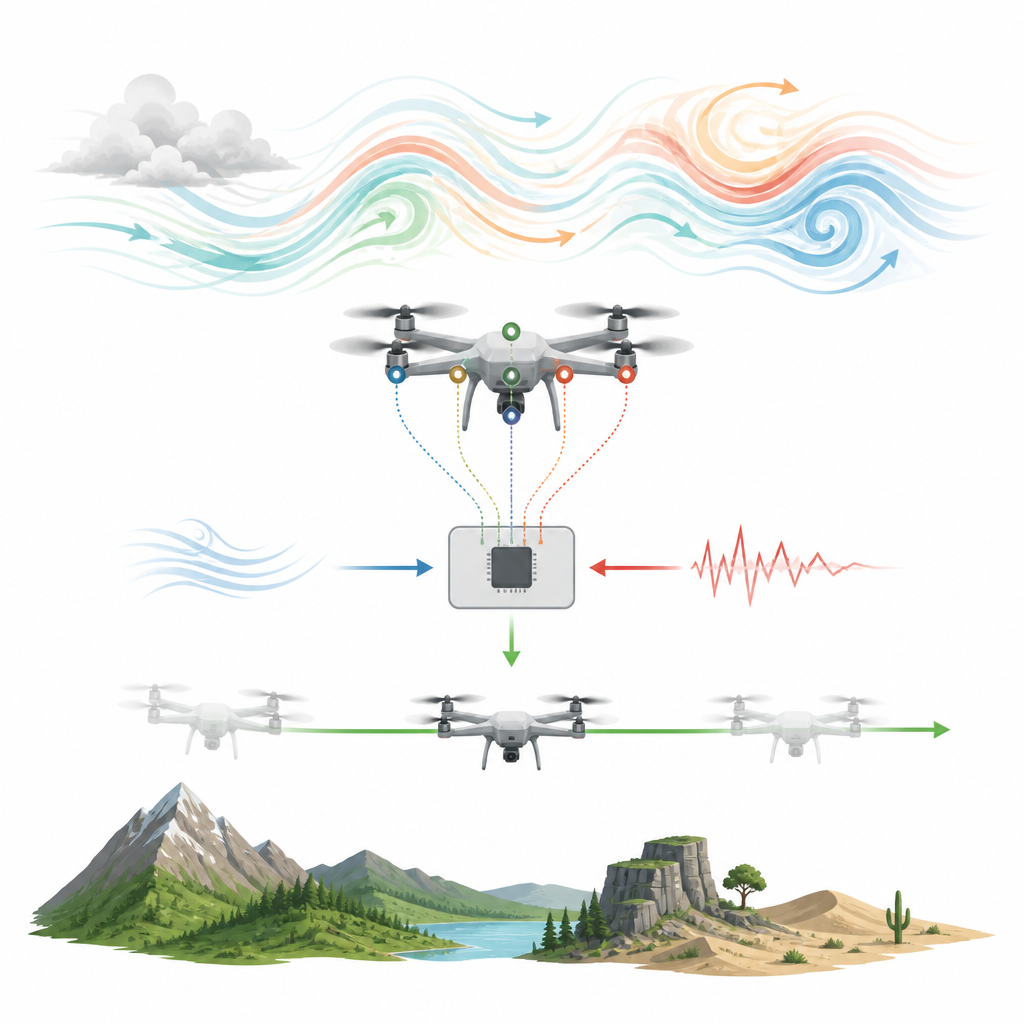
Small four-rotor drones are becoming everyday tools for jobs like crop inspection, rescue searches, and filming. But in the real world their sensors can misbehave and winds can shove them off course, risking shaky flight or even crashes. This paper explores a new way to keep a quadrotor drone stable and responsive, even when its sensors are lying and the air around it is unpredictable.
Why Drone Control Is Hard
A quadrotor looks simple, yet its motion is governed by tightly coupled spinning rotors, body tilts, and position changes. Traditional control methods often rely on simplified linear models that work well only in calm, predictable conditions. When real life adds gusty winds, vibrations, and sensor faults, these methods can struggle, leading to growing oscillations or slow corrections. At the same time, more advanced nonlinear methods can demand heavy computation or very accurate models, which are not always practical on lightweight flying robots.
Blending Simple Rules With Smart Math
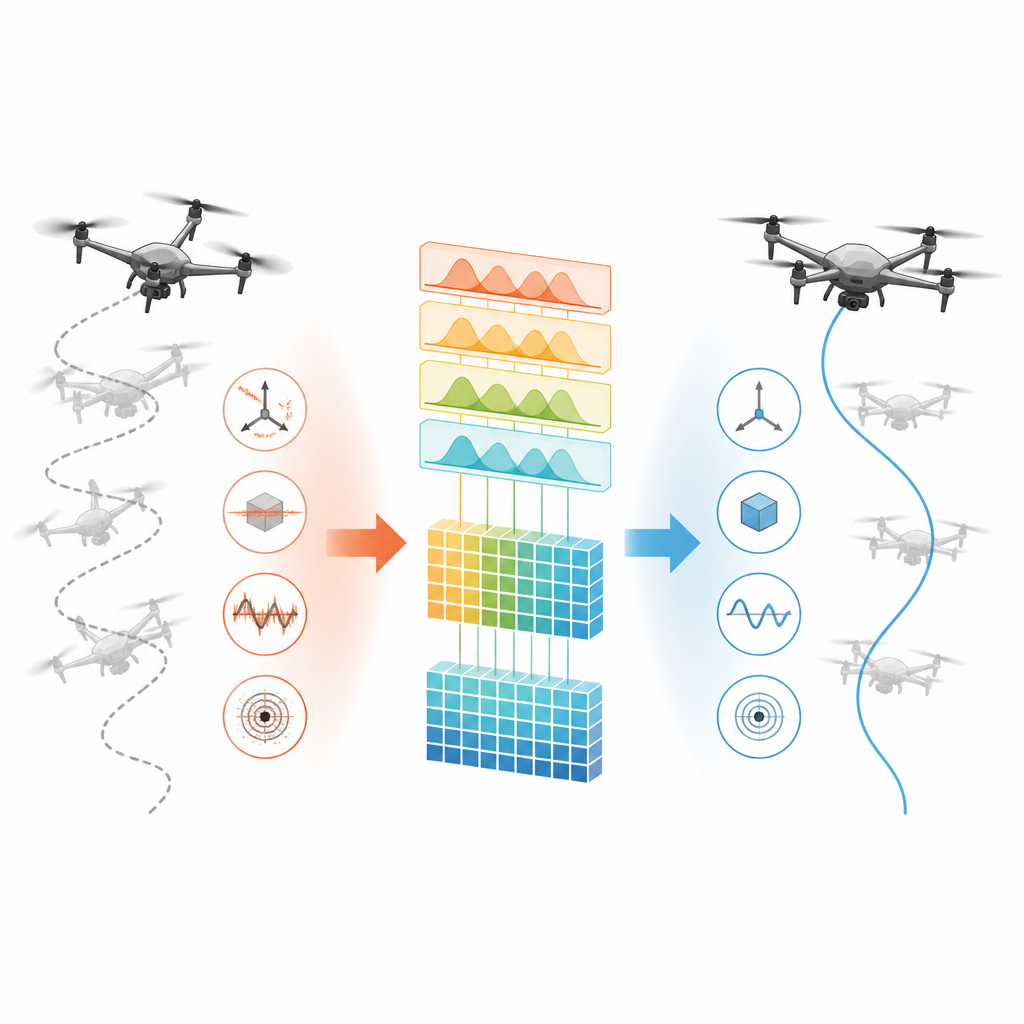
The authors propose a hybrid control strategy that combines two ideas. The first is a fuzzy rule system, which breaks the drone’s complex behavior into several simpler operating zones, such as small or large tilts. Each zone is described by an easy-to-handle linear model, and fuzzy logic blends them smoothly as the drone moves. The second idea is a mathematical tool known as linear matrix inversion, which is used here to calculate feedback gains that keep the combined fuzzy model stable. By adapting these gains in real time, the controller can respond to changing conditions without needing to explicitly detect and classify every fault.
How the New Strategy Was Tested
To test their approach, the researchers built a detailed computer model of a quadrotor, including both body motion and motor behavior. They then injected artificial faults and disturbances into the sensor readings. Two types of problems were considered: smoothly varying “cosine” faults that change over time and sharp “rectangular” faults that appear suddenly in short bursts. The new adaptive controller was compared against a standard fuzzy controller and a standard linear matrix inversion controller, as well as approaches reported in earlier work, all using the same simulated drone and disturbance patterns.
What Happened When Things Went Wrong
In quiet conditions, before any faults were applied, all three controllers guided the drone’s tilt angles to the desired values with similar accuracy, except that the purely linear controller showed more oscillations. The real differences appeared once faults and disturbances were switched on. Under smoothly varying sensor faults, the conventional methods exhibited growing oscillations in roll, pitch, and yaw; in some cases the linear approach could no longer stabilize the drone. The fuzzy-only controller eventually calmed down but required more time. In contrast, the adaptive hybrid controller showed only small, brief deviations and restored stable flight in about one second. Under sudden rectangular faults, the pattern was similar: the new controller kept the drone’s attitude very close to the desired path while the others wandered further and took longer to recover.
Why This Matters for Everyday Flight
For a non-specialist, the takeaway is that this adaptive hybrid controller lets a quadrotor keep flying safely even when its sensors are unreliable and the air is turbulent. Instead of trying to first diagnose each specific fault, the method treats faults and disturbances as things to be rejected automatically, adjusting its behavior on the fly. In simulations, this made the drone’s tilt angles stay much closer to their targets than with standard approaches, with smaller errors and faster settling times. The authors argue that such strategies could raise the safety and reliability of drones and other nonlinear machines, making them better suited for demanding real-world tasks where quick, stable reactions are crucial.
Citation: Taimoor, M., Wang, H., Bibi, S. et al. Fault-tolerant control of quadrotor unmanned aerial vehicle by using adaptive fuzzy T-S and linear matrix inversion approach. Sci Rep 16, 16181 (2026). https://doi.org/10.1038/s41598-026-46576-w
Keywords: quadrotor drones, fault tolerant control, adaptive control, fuzzy systems, sensor faults