Clear Sky Science · en
Developing antibacterial Zn-Cu-Mg alloys with high strength and osteogenic stimulation for osteomyelitis
Why smarter metal implants matter for bone infections
Bone infections are notoriously hard to cure, often demanding repeated surgeries and long courses of antibiotics. This study explores a new class of “disappearing” metal implants made from zinc mixed with copper and magnesium that are designed not only to hold broken or diseased bone together, but also to slowly dissolve, fight bacteria, and encourage fresh bone to grow. Such materials could one day simplify treatment for people with severe bone infections by combining several therapies into a single device.
A stubborn problem inside damaged bone
Osteomyelitis, a serious infection inside bone, is difficult to treat because bacteria can hide deep within bone tissue and on implant surfaces, where they form slimy biofilms that resist antibiotics. Current metal plates, screws, and rods give the skeleton much needed support but are passive bystanders in the battle against bacteria. They usually must be removed once healing is complete, which means an extra operation. The researchers aimed to design a metal that could support the bone, help control infection, and then gradually vanish as healthy tissue takes its place.
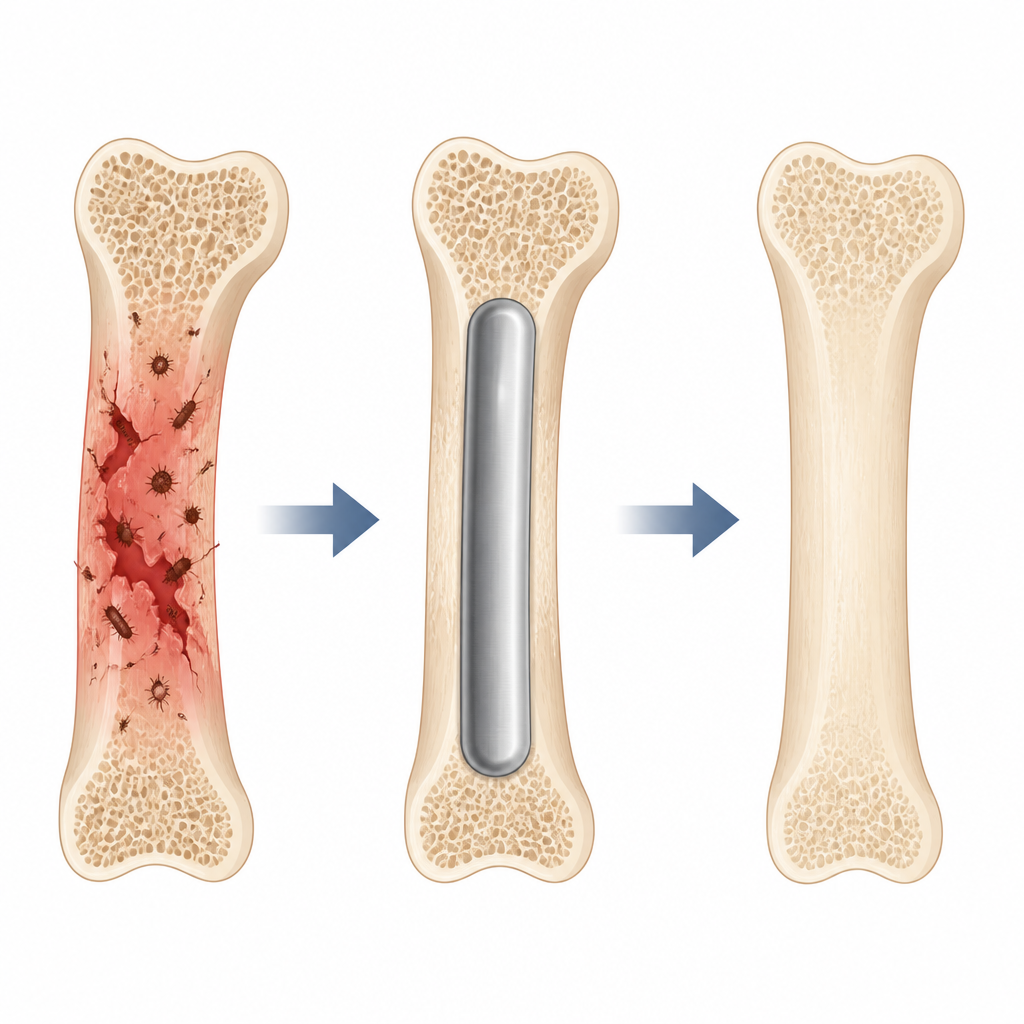
Designing a “helper” metal that melts away
Zinc was chosen as the base metal because it corrodes at a moderate rate in the body and releases ions that the body can use. However, pure zinc is too soft and does not kill germs strongly enough. To overcome this, the team blended zinc with small amounts of copper, which has natural antibacterial power, and magnesium, which is known to aid bone formation. They then pushed the alloys through a special die in a process that heavily deforms the metal and chops its internal grains down to submicron size. This fine internal structure, along with tiny zinc–copper and zinc–magnesium particles, was expected to strengthen the metal and tailor how it dissolves in body-like fluids.
Stronger support and gentler, more controlled fading
Mechanical tests showed that the combined zinc–copper–magnesium alloy, labeled Zn-1Cu-1Mg, had the highest hardness and tensile strength of all the compositions tested, while still stretching enough before breaking to be practical for bone fixation. Compared with zinc mixed only with magnesium, the three-metal blend was both stronger and more ductile, thanks to its tiny grains and well-dispersed nanoscale particles. Corrosion experiments in a salty, body-like liquid revealed that adding magnesium sped up the overall dissolution of zinc, while adding a modest amount of copper slightly slowed and smoothed this process. Over a month of soaking, all the alloys developed compact surface layers rich in zinc, oxygen, carbon, calcium, phosphorus, and chlorine, but the copper-bearing alloys showed fewer deep pits, pointing to a more even and predictable fade that could better match the pace of bone healing.
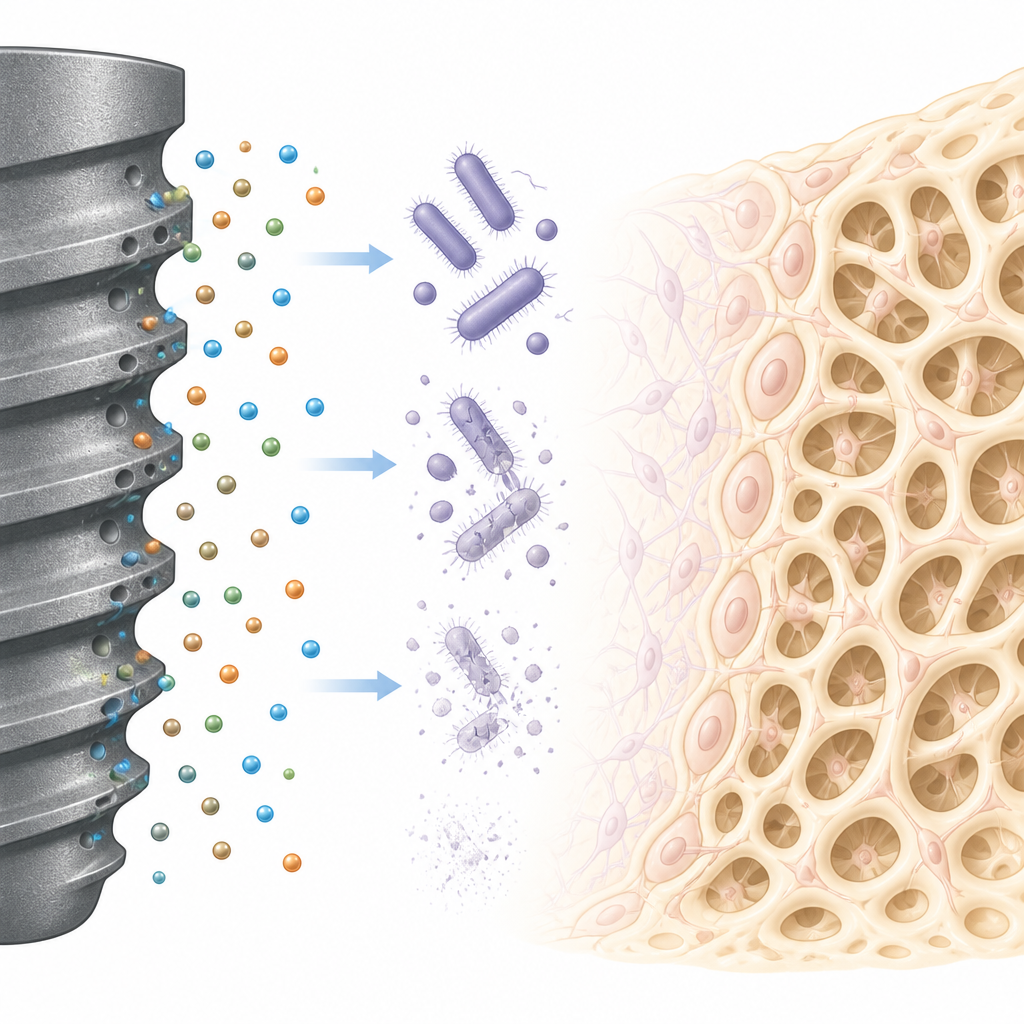
Helping cells grow bone while keeping microbes at bay
To see how living cells respond, the team exposed bone-forming stem cells from rat bone marrow to liquids that had been in contact with the alloys. At appropriate dilutions, the cells remained healthy and even showed higher markers of bone-building activity than on a standard titanium control, particularly with alloys that contained magnesium. These cells produced more alkaline phosphatase, laid down more mineralized nodules, and turned on key bone genes. At the same time, all of the zinc-based alloys sharply reduced the growth of two common infection culprits, Staphylococcus aureus and Escherichia coli, with copper-containing versions generally showing the strongest early antibacterial effect. The balance between zinc, copper, and magnesium ions proved crucial: high levels of zinc and copper could stress mammalian cells, but when moderated and paired with magnesium, they supported both cell survival and bone formation.
What this could mean for treating bone infections
Altogether, the results suggest that the Zn-1Cu-1Mg alloy can act as a temporary internal scaffold that is strong enough for load-bearing use, degrades at a useful pace, kills bacteria around the implant, and encourages stem cells to build new bone. While these findings come from laboratory tests rather than human trials, they point toward a future in which a single metallic device could help stabilize infected bone, combat germs, and then quietly disappear as natural bone structure is restored, reducing the need for additional surgeries.
Citation: He, J., Song, Y., Xiao, Y. et al. Developing antibacterial Zn-Cu-Mg alloys with high strength and osteogenic stimulation for osteomyelitis. Sci Rep 16, 15654 (2026). https://doi.org/10.1038/s41598-026-46548-0
Keywords: osteomyelitis, biodegradable implants, zinc alloy, antibacterial materials, bone regeneration