Clear Sky Science · en
Numerical analysis and optimization of the impact of complex foundation pit construction on the deformation of adjacent subway structures
Why nearby digging matters for city subways
As cities grow, new underground roads and utilities often have to be built right next to working subway tunnels. Digging deep pits for these projects can subtly bend and settle the nearby tunnels, which may threaten long term safety and comfort for passengers. This study explores how carefully planning the order of excavation and internal structure building can keep tunnel movements as small as possible, offering guidance for busy urban areas that must build under tight space constraints.
The challenge of sharing crowded underground space
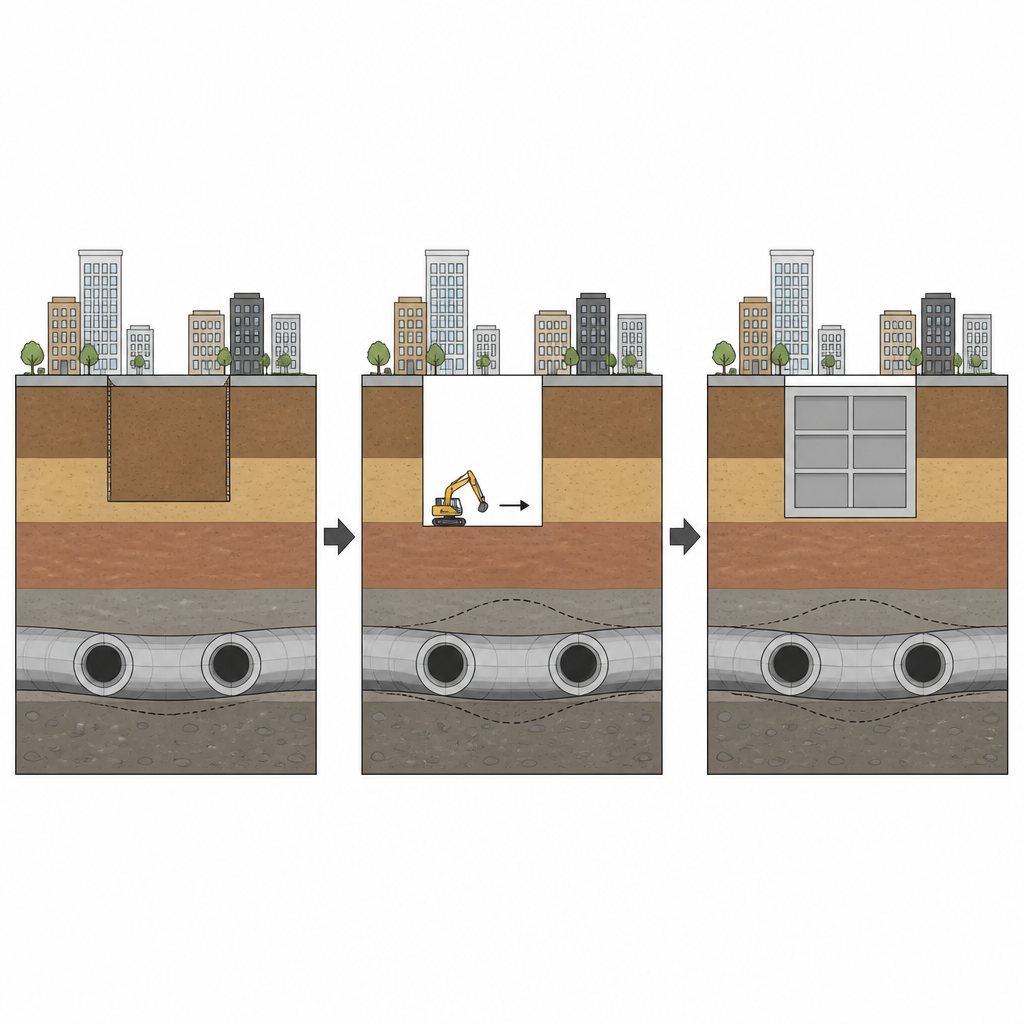
When engineers dig a deep pit next to an existing subway line, the soil around the pit relaxes and moves toward the open space. At the same time, the tunnel acts like a stiff ring buried in the ground, changing how that soil can move. Earlier research showed that the distance between pit and tunnel, the depth of digging, and the local geology all matter, but it often treated the excavation as a simple, one way process. In reality, modern projects are more complex: large concrete culverts or road boxes are cast inside the pit while digging continues, and their growing stiffness feeds back into how the soil and tunnel respond.
A virtual test bed beneath Beijing
The authors built a detailed three dimensional computer model of a real project in Beijing’s Fengtai District, where a long road tunnel and a large underground culvert are constructed close to Metro Line 10. The model includes layered soils, a deep rectangular pit, retaining walls, the subway tunnel, and the box shaped culvert that will eventually sit in the pit. Using widely accepted soil behavior rules, they simulated how the ground and tunnel would move as soil is removed step by step and as concrete structures inside the pit harden. This virtual test bed allowed them to compare different construction plans that would be impractical or risky to try in the field.
Ten ways to dig and build
The key question was how the sequence of work affects tunnel movement. The team combined two main choices: whether the culvert is cast in a forward direction or in reverse, and how the excavation itself advances. They tested ten scenarios that included digging from one side only, digging symmetrically from both sides, splitting the pit into zones, and using a staggered, step like progression. In each case they tracked the vertical settlement of the tunnel and the sideways movement of the retaining walls. While all scenarios kept tunnel movements small, the differences were clear enough to matter for strict subway safety standards.
What the simulations revealed
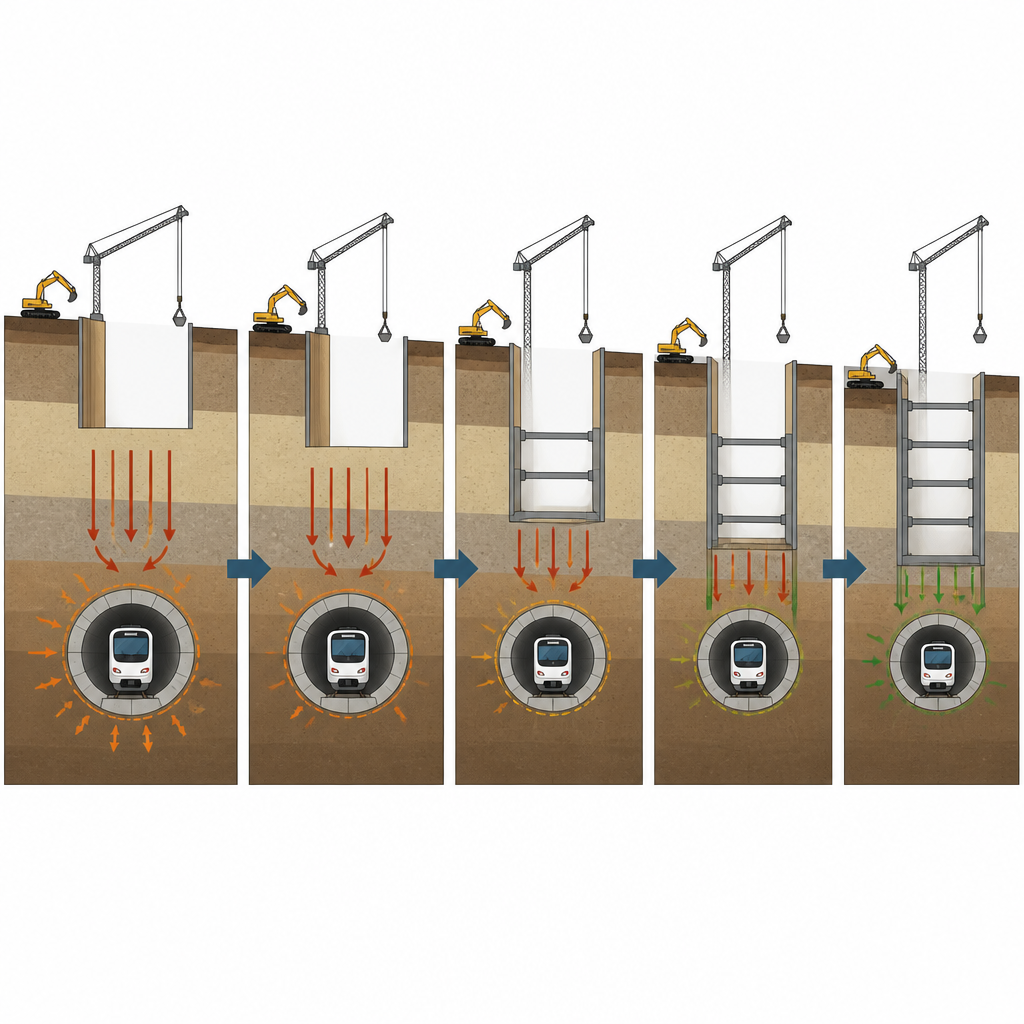
The most favorable plan paired forward culvert construction with a “far to near” unidirectional excavation, meaning soil was removed first on the side farther from the sensitive tunnel and only later near the tunnel. This approach allowed the remaining soil near the tunnel to act as a temporary brace, while the earlier culvert segments had time to gain strength and help carry loads before digging reached the critical zone. In contrast, one of the least favorable plans used reverse culvert building together with symmetric excavation from both ends. That combination caused the soil beneath the tunnel to unload from two directions at once, creating a double peak pattern of settlement and slightly higher tunnel bending, even though the absolute values stayed under about two millimeters.
Practical guidance for safer city digging
For non specialists, the main message is that the order in which underground structures are dug and cast is not a minor detail but a meaningful design choice. By favoring sequences where excavation approaches sensitive tunnels gradually from afar, and where new concrete structures are in place early to replace the strength of removed soil, engineers can reduce tunnel settlement by several percent without adding new hardware or materials. Although the model uses some simplifications and focuses on relative differences rather than exact numbers, it gives city planners and designers a rational way to choose safer construction plans when deep pits and operating subways must coexist.
Citation: Sun, J., Dun, H., Chen, S. et al. Numerical analysis and optimization of the impact of complex foundation pit construction on the deformation of adjacent subway structures. Sci Rep 16, 15436 (2026). https://doi.org/10.1038/s41598-026-46547-1
Keywords: subway tunnel, deep foundation pit, excavation sequence, tunnel deformation, finite element analysis