Clear Sky Science · en
Efficient deep learning framework for arecanut disease detection using graph neural network and Bat algorithm
Why smart crop care matters
Arecanut, also known as betel nut, supports millions of farmers in tropical regions, but invisible infections can quietly cut yields in half before anyone notices. This study explores how a new type of artificial intelligence can spot disease on arecanut leaves from simple photographs taken in real farm settings. By turning leaf images into networks of small regions and then letting a nature-inspired computer method fine-tune the system, the researchers show a faster, more accurate way to warn farmers early, protect trees, and reduce financial losses.
The problem hiding in the leaves
India produces more than half of the world’s arecanut, yet diseases like yellow leaf disease can wipe out up to 50 percent of a plantation’s yield within a few years. Farmers often rely on walking through fields and judging leaf color and spots by eye, a slow and tiring process that can miss early warning signs. Earlier computer tools based on standard image recognition work well on neat laboratory photos, but struggle with cluttered farm backgrounds, changing sunlight, and irregular blotches on leaves. They also tend to favor common cases, overlooking rare but serious problems.
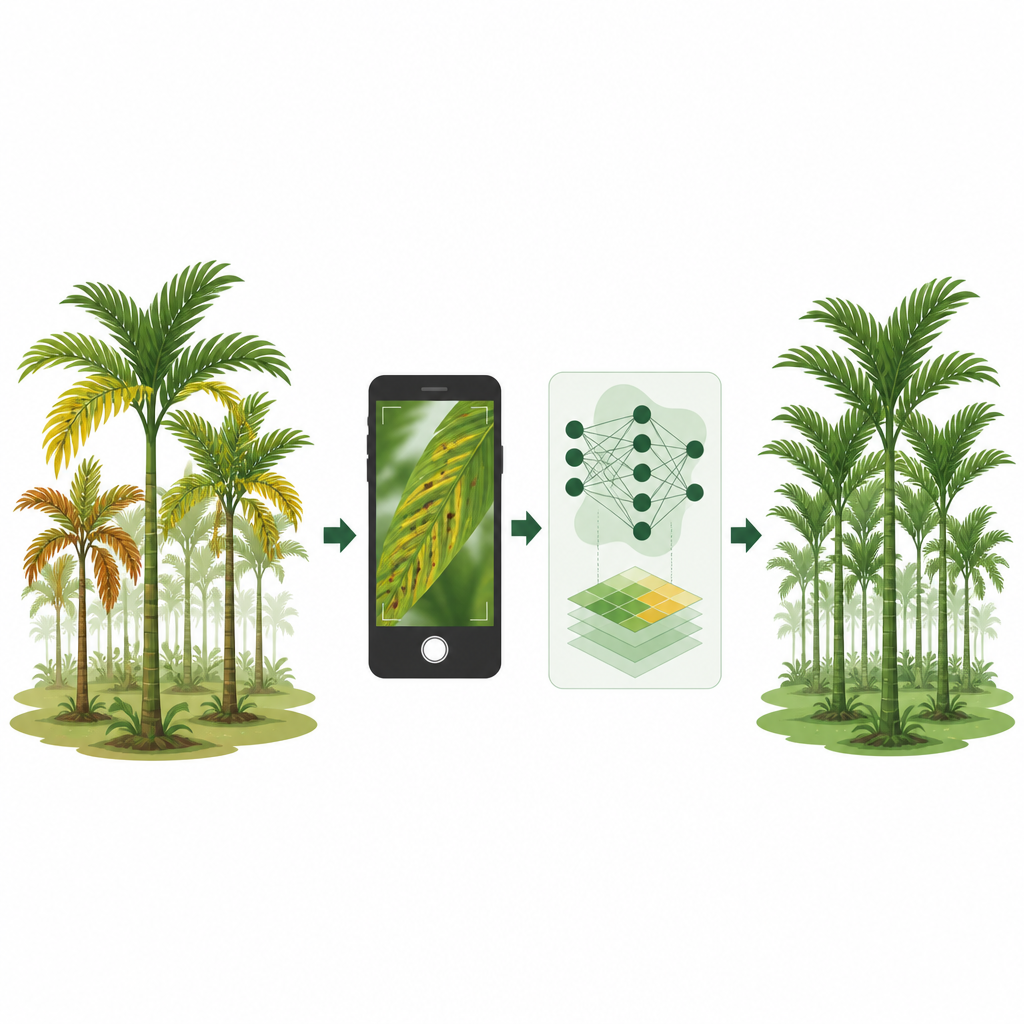
Turning pictures into networks
The researchers designed a new framework they call the GB model, which combines two ideas: graph-based learning and an optimization method inspired by the way bats navigate. First, each arecanut leaf photo is cleaned, resized, and gently distorted in many ways to mimic real field conditions such as different angles, brightness levels, and background clutter. The image is then broken into about one hundred small regions, each described by its color, texture, and location on the leaf. These regions become dots in a network, and nearby dots are connected, capturing how disease patches relate to one another across the leaf surface.
Letting the model learn and self-tune
On this network of leaf regions, a graph neural network learns to pass information along the connections and build up an overall picture of the leaf’s health. Instead of a human trial-and-error search for good settings, a Bat Algorithm explores many combinations of knobs such as learning rate, number of layers, and dropout strength. Each “bat” in this virtual swarm represents a candidate setting and moves through the search space guided by how well the model performs on validation images. Over time, the swarm converges on a configuration that keeps mistakes low while training quickly, cutting the tuning effort compared with usual grid or random searches.
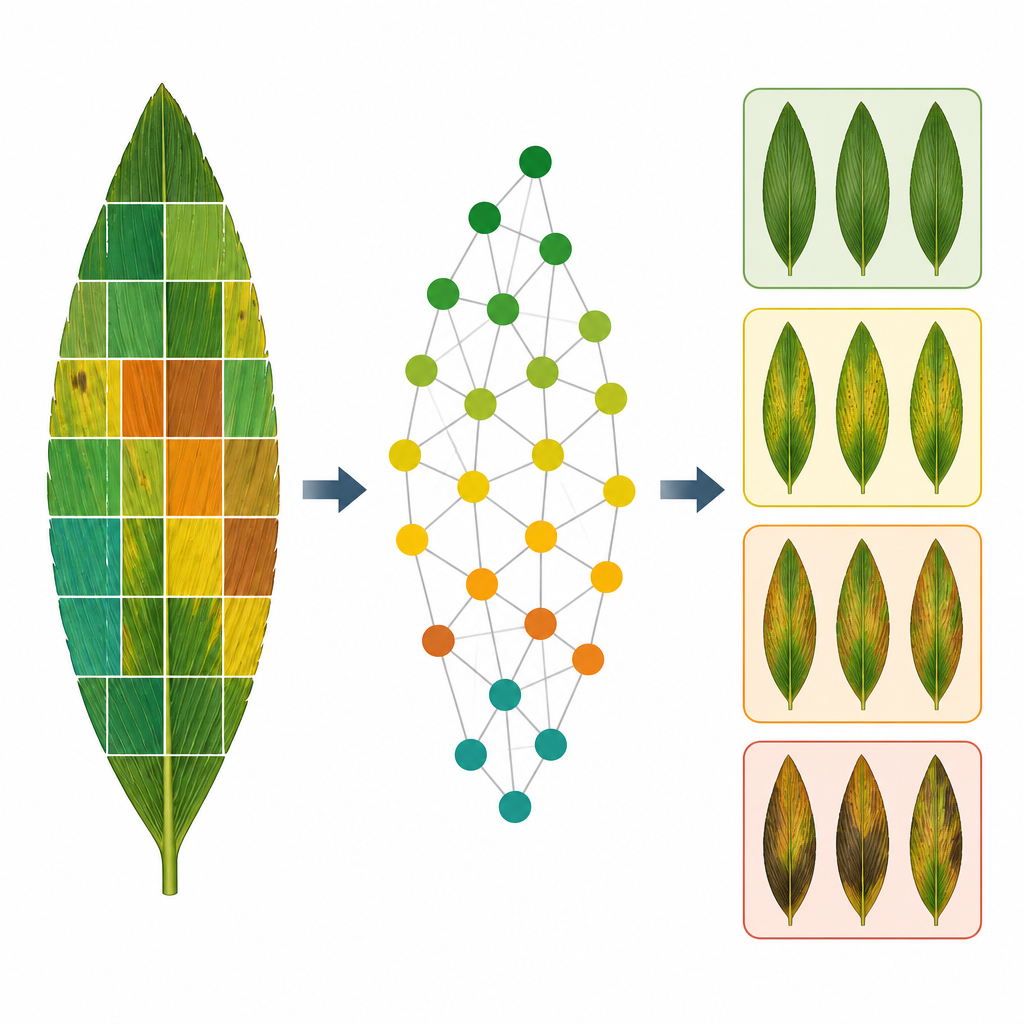
How well the smart scout performs
The GB model was tested on a carefully balanced set of 1000 arecanut images drawn from a larger public collection, representing nine categories that include healthy leaves, nuts, trunks, and several major diseases. Using standard measures of quality, the system reached about 98 percent overall accuracy and strong scores for precision, recall, and F1, beating several advanced alternatives by roughly four to six percentage points. It also processed a new image in about one eighth of a second, several times faster than competing models, while using fewer internal parameters and less computation. Importantly, by boosting rare classes through targeted data augmentation and weighted loss, the model maintained high performance even on less common diseases.
What this means for farmers and food security
For non-specialists, the main takeaway is that a camera and a modest computing device can now work together as a rapid field scout for arecanut health. By understanding patterns across the whole leaf rather than just local spots, and by tuning itself with a nature-inspired search strategy, the system can reliably flag problems early under messy, real-world conditions. While the current version still depends on regular color images and may struggle with extreme shadows or very unusual cases, it points the way toward phone or drone based tools that could help smallholder farmers monitor plantations, act sooner against outbreaks, and support more stable harvests in the face of plant disease.
Citation: Shadrach, F.D., Devasenapathy, D., Anitha, R. et al. Efficient deep learning framework for arecanut disease detection using graph neural network and Bat algorithm. Sci Rep 16, 15785 (2026). https://doi.org/10.1038/s41598-026-46535-5
Keywords: arecanut disease detection, plant health imaging, graph neural network, precision agriculture, deep learning in farming