Clear Sky Science · en
Numerical analysis and engineering application of bolt support technology for controlling coal body sliding
Why coal mine safety still matters
Deep underground coal mines power homes and industries, but they also hide violent hazards. One of the most dangerous is a coal bump, a sudden burst of energy that can shove coal sideways and damage tunnels. This study looks at a practical way to tame that force by rethinking how metal bolts are installed between coal and rock so that roadways stay stable and miners stay safe.
Sliding coal and hidden weak spots
In many high stress mines, the coal next to a tunnel does not simply crumble; it can slide as a solid block along the surface where coal meets harder rock. That sliding releases stored underground energy and can shatter equipment and threaten workers. The weak link is this coal rock interface, which often cannot resist strong sideways push. Traditional bolt support was mainly designed to hold roofs up, not to stop whole slabs of coal from gliding along this boundary.
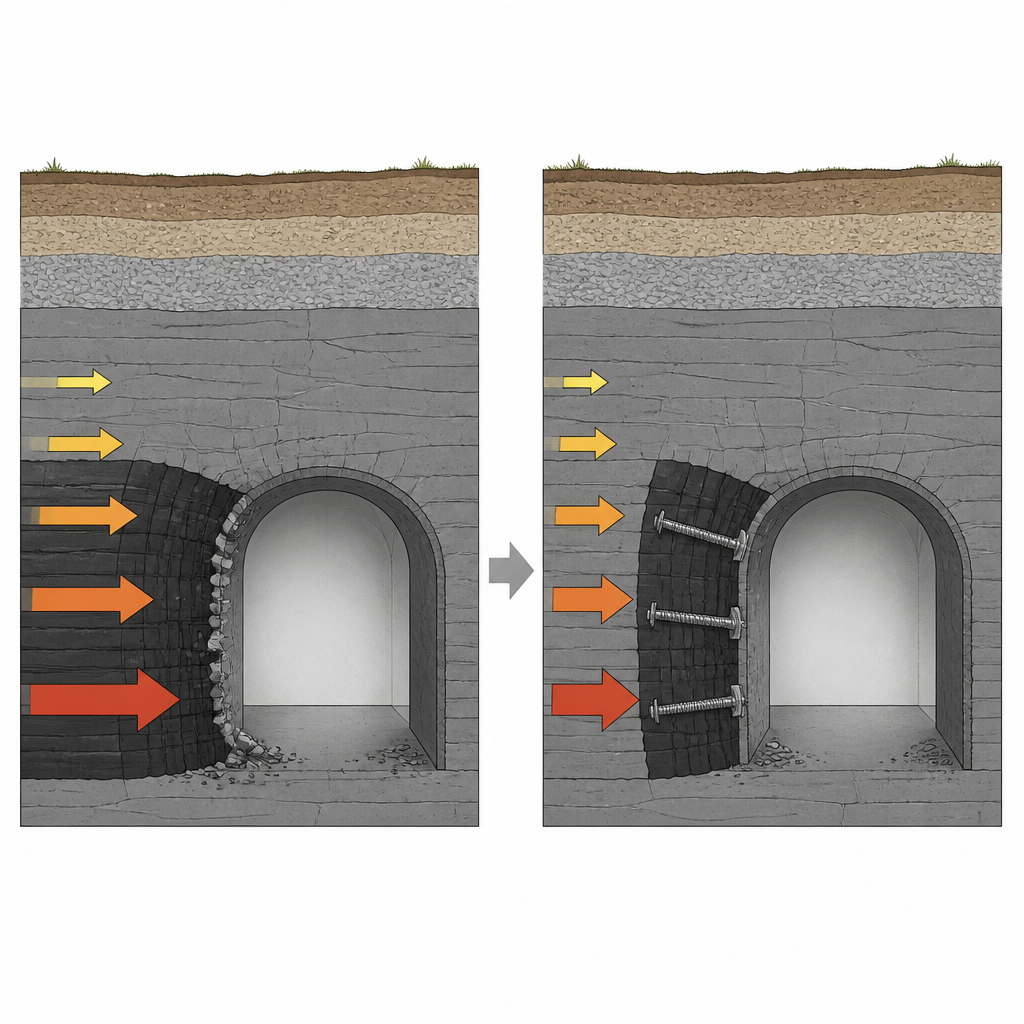
Bolts as quiet guardians
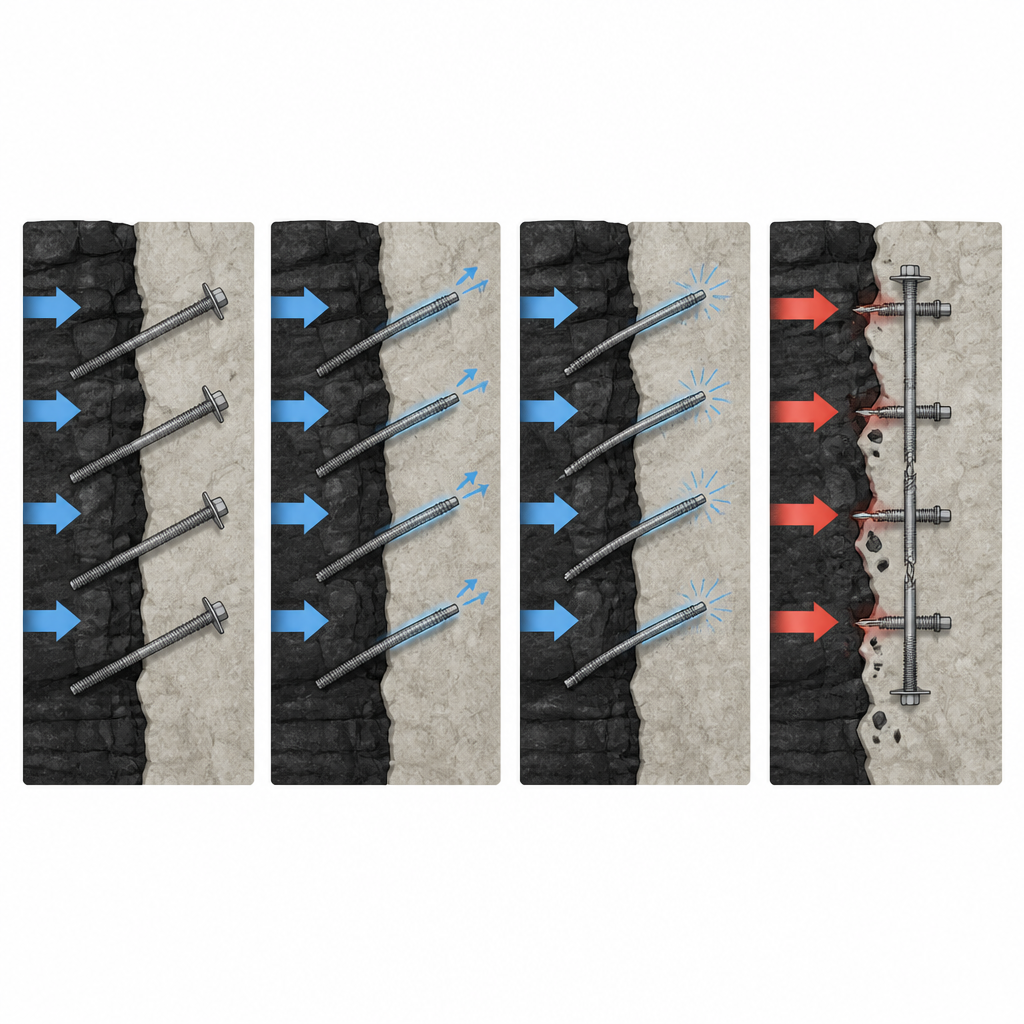
The authors focus on how bolts can knit coal and rock together so they move as one instead of separating. A bolt passing across the interface can work in two ways. First, it presses the surfaces together, increasing friction so they are less likely to slip. Second, when the coal tries to move, the bolt bends and stretches, building up a restraining force that resists sliding and spreads the load into stronger rock around the tunnel. The key question is how the angle of these bolts controls whether they pull safely in tension or get cut through by shearing forces.
Virtual tests of bolt angles
To explore this, the team built a detailed three dimensional computer model of a slice of coal and rock joined by a single bolt. Using numerical simulation software, they pushed the coal sideways and watched how the bolt behaved at four angles: 30, 45, 60, and 90 degrees to the coal rock surface. At 30 and 45 degrees, the bolt stretched along its length, thinned in the middle, and finally snapped in a classic tensile break. At 60 and 90 degrees, the bolt bent sharply and failed along a flat plane, a sign that it was being cut in shear rather than pulled apart.
Finding the sweet spot for strength and energy
The simulations showed that bolts fail more gently and carry higher loads when they are mainly in tension. At 30 and especially 45 degrees, the bolts reached greater peak forces, with larger safe stretching before breaking. They also absorbed more strain energy, which means they can soak up more impact from sudden ground movement. At steeper angles the bolts carried less load, deformed less before failure, and were more vulnerable to sudden shearing. This pointed to 45 degrees as the most effective compromise between geometry and strength for resisting coal sliding.
Putting the design to work in a real mine
The researchers then tested their design in a deep Chinese coal mine. In one section of a return airway, they kept the existing support system. In a nearby section with similar geology, they changed the sidewall pattern: the upper row of bolts was tilted to 45 degrees and combined with longer cables anchored into firmer layers above and below. Over the full cycle of tunnel excavation and later coal extraction, they tracked roof sag, sidewall movement, and separation layers in the roof to see how the rock mass responded.
Safer tunnels with less movement
Measurements showed that the optimized support clearly improved stability. During excavation, roof closure in the test section was smaller, and separation between roof layers stayed low. Sidewall movement in the improved section dropped by about 28.6 percent compared with the old design. After mining began and stresses increased further, sidewall displacement in the optimized roadway was about half that of the conventional support, and roof separation at deeper points grew much more slowly. These findings suggest that correctly angled bolts, backed by well placed cables, can effectively clamp coal and rock together and limit large scale sliding events.
What this means for mine safety
For a lay reader, the message is straightforward. By tilting bolts so they pull rather than shear, engineers can get more strength and energy absorption from the same hardware, turning the coal rock contact from a weak slip surface into a locked joint. The study points to 45 degrees as a practical target angle and shows in the field that this layout reduces tunnel deformation in a high stress mine. While more work is needed for other types of rock bursts, the approach offers a clear path to safer underground roadways where sliding coal bumps are a concern.
Citation: Wang, C., Ma, S. Numerical analysis and engineering application of bolt support technology for controlling coal body sliding. Sci Rep 16, 15566 (2026). https://doi.org/10.1038/s41598-026-46530-w
Keywords: coal bump, rock bolts, roadway support, numerical simulation, mine stability