Clear Sky Science · en
Insulator string defect detection method for transmission lines based on image color analysis and multi-scale feature compensation
Keeping the Power On
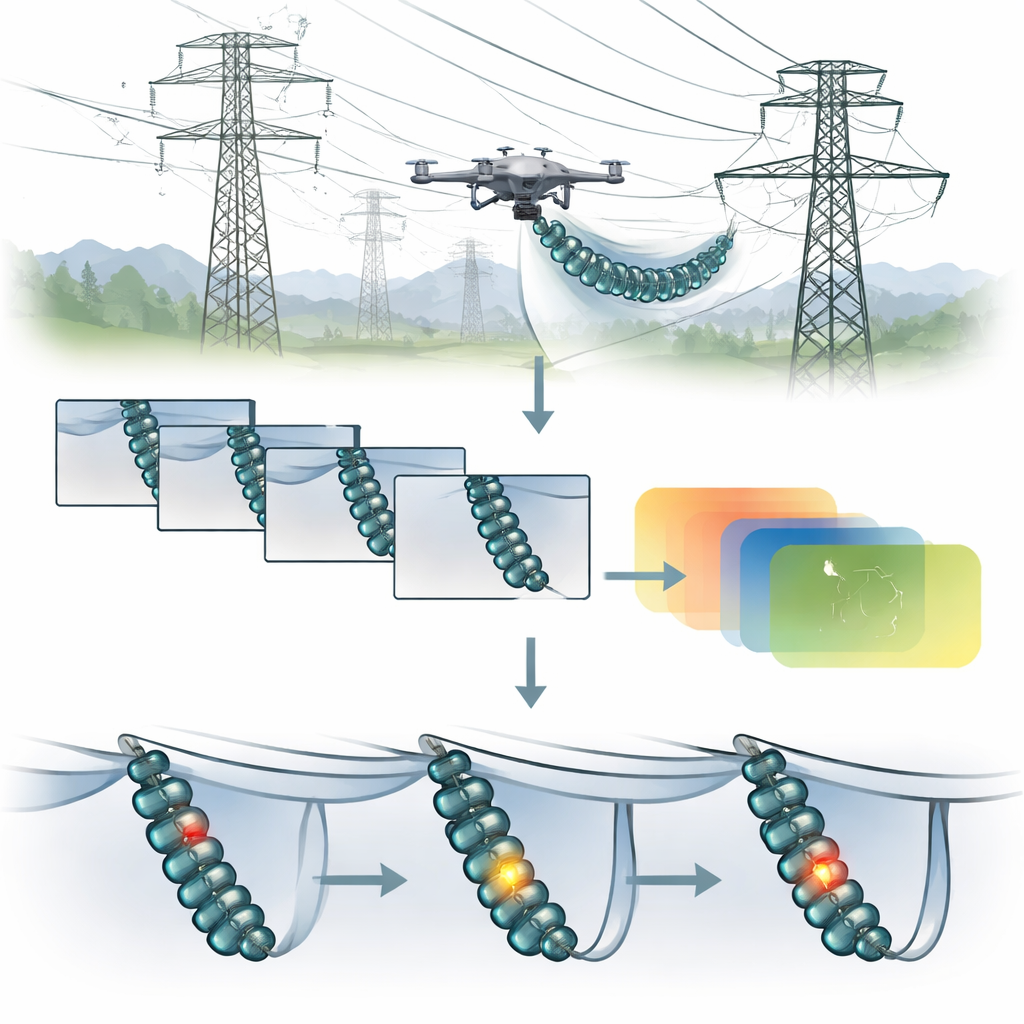
Modern life depends on long chains of glass and ceramic pieces—called insulator strings—that hang from high-voltage power lines and keep electricity safely away from metal towers. When these parts crack, burn, or break, they can trigger power failures and even fires. Inspecting thousands of kilometers of lines by hand is slow and risky, so utilities increasingly rely on drone photographs. This paper presents a smarter way for computers to scan those images and spot insulator defects more accurately and reliably than current methods.
Why These Chains Are Hard to Check
Insulator strings hang outdoors for decades, facing sun, rain, ice, pollution, and lightning. Over time they can develop small cracks, missing pieces, or burn marks that may lead to sudden failure. Drones can capture detailed images of these strings, but the pictures are cluttered: forests, clouds, towers, wires, bird nests, and shadows all crowd the frame. Defects may be just a few millimeters wide, easily lost in glare or blur. Existing computer vision tools either depend on hand-tuned rules—such as fixed color ranges or simple shape measures—or use general-purpose deep learning models trained on everyday scenes. Both approaches struggle when light, weather, viewing angle, and background change from image to image.
Finding the Right Pieces in a Noisy Picture
The first step in the new method is to clean up each drone photo before any deep learning takes over. The authors take advantage of two stable clues: the typical colors of a given line’s insulators and the regular texture of their repeated shapes. They first normalize brightness so that harsh sunlight or deep shadows have less effect, then use past inspection data from the same tower to define flexible red–green–blue color ranges where the insulators usually fall. This quickly removes large chunks of sky, vegetation, and steelwork. Because color alone can be misleading—rust, dirt, or shadows may look similar—the method then checks texture inside candidate regions. Insulators form neat, periodic patterns; background clutter usually does not. By sliding a grid of small windows across the region and measuring how often different gray levels occur together, the algorithm keeps only areas whose texture matches that of clean insulator samples and wraps them tightly in simple horizontal rectangles.
Teaching the Network What Details Matter
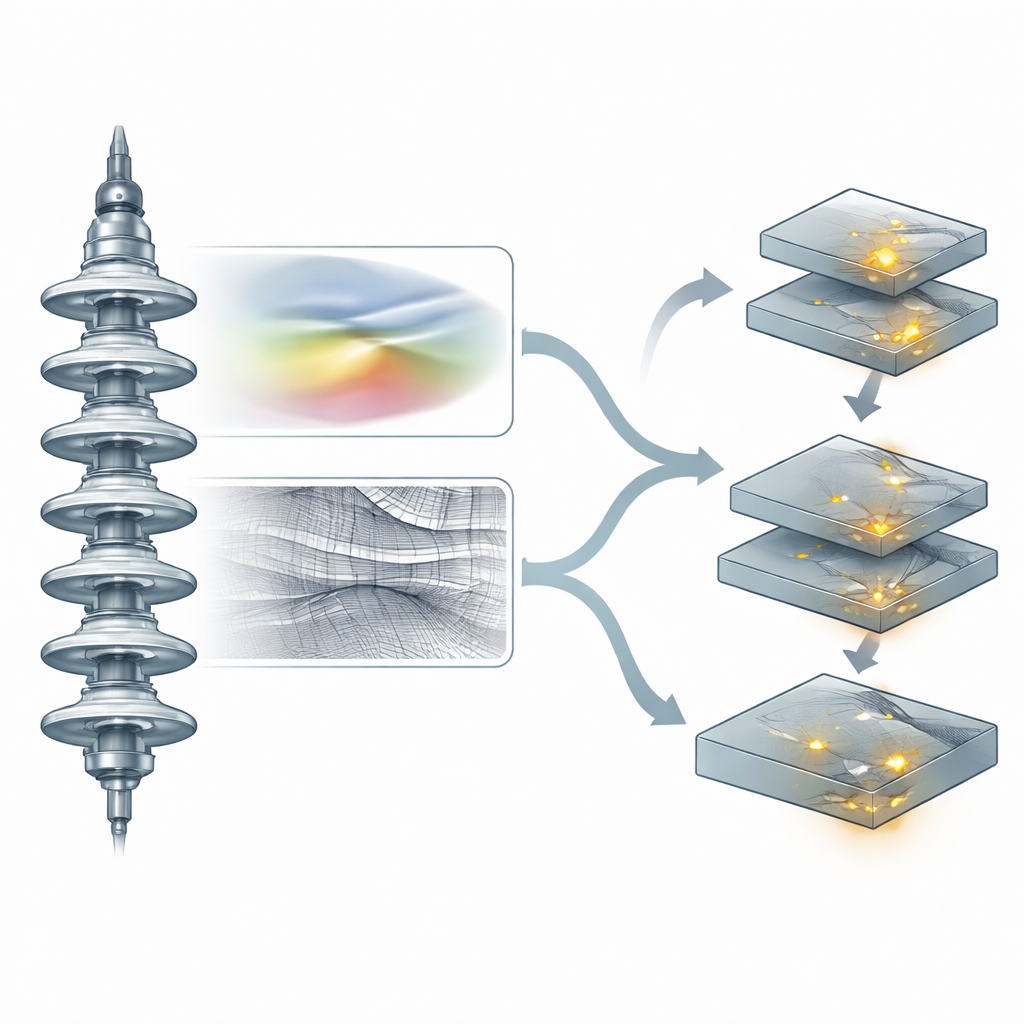
Once the insulator strings are isolated, the real challenge begins: spotting tiny defects on them. Conventional neural networks gradually compress image information as it flows from input to final prediction, which tends to wash out the very fine edges and hairline cracks that matter most. To counter this, the authors design a new detection network, MFCD-Net, that deliberately separates and strengthens different kinds of visual information. Using a Laplacian pyramid, it splits each cropped insulator image into a smooth component capturing overall shape and a detail component capturing sharp lines and textures. Three parallel paths then process the original image, the high-detail layer, and the smooth layer, each with lightweight attention modules that highlight features most relevant to defects or overall structure.
Putting Pieces Back Together at the Right Scale
Simply stacking all these features is not enough, because different defect types and sizes benefit from different blends of detail and structure. MFCD-Net therefore adds a dynamic compensation module that acts like a gatekeeper for each detection scale. For every level in the network—coarse for whole strings, finer for individual discs—it looks at the current feature map and decides, pixel by pixel, how much to borrow from the sharpened detail stream or the smoothed structural stream. A small residual block then refines this mixture before adding it back into the main pathway. In effect, the network can focus on extra sharpness where it suspects cracks, or on broader shape cues where it needs to distinguish insulators from confusing background patterns, without being locked into fixed fusion rules.
How Well the Method Works in Practice
The authors test their full pipeline—pre-segmentation plus MFCD-Net—on 5,793 drone images containing nearly 10,000 labeled insulator strings and over 100,000 annotated units. Their color-and-texture preprocessing correctly retrieves about 99% of strings and captures over 97% of true insulator pixels, even in scenes with dense vegetation or glaring skies. For defect recognition, they compare against eight leading object detection systems, including well-known models such as YOLO, RetinaNet, and transformer-based designs. Measured by mean Average Precision at a standard overlap threshold, their approach improves overall detection quality by about 4 percentage points over the best competitor, with especially strong gains for subtle damage and flashover traces that previous methods often missed or confused with shadows and stains.
What This Means for the Power Grid
In everyday terms, this work shows how combining simple physical clues—color and repeated patterns—with carefully structured neural networks can make drone-based inspection of power lines both more reliable and more informative. By first stripping away most of the irrelevant background and then steering the network’s attention toward the right mix of fine detail and overall shape at each scale, the system catches more dangerous defects without a flood of false alarms. While some challenges remain, such as insulators whose colors closely mimic surrounding materials and the higher computation cost of the multi-branch design, the method points toward smarter, safer, and more scalable monitoring of critical infrastructure.
Citation: Chen, X., Huang, L. & Shen, J. Insulator string defect detection method for transmission lines based on image color analysis and multi-scale feature compensation. Sci Rep 16, 10696 (2026). https://doi.org/10.1038/s41598-026-46525-7
Keywords: power line inspection, insulator defects, drone imagery, deep learning detection, grid reliability