Clear Sky Science · en
Glucose-driven intra- and inter-islet beta cell synchronization in pancreatic tissue slices
Why the body’s sugar rhythm matters
Every few minutes, your pancreas quietly sends out tiny bursts of insulin that help your body handle sugar efficiently. These pulses are not random: they rely on the coordinated activity of thousands of small cell clusters called islets. When this timing breaks down, the risk of insulin resistance and type 2 diabetes rises. This study explores how changes in blood sugar levels might help neighboring islets keep time with one another, and what that reveals about the hidden rhythm that keeps our metabolism on track. 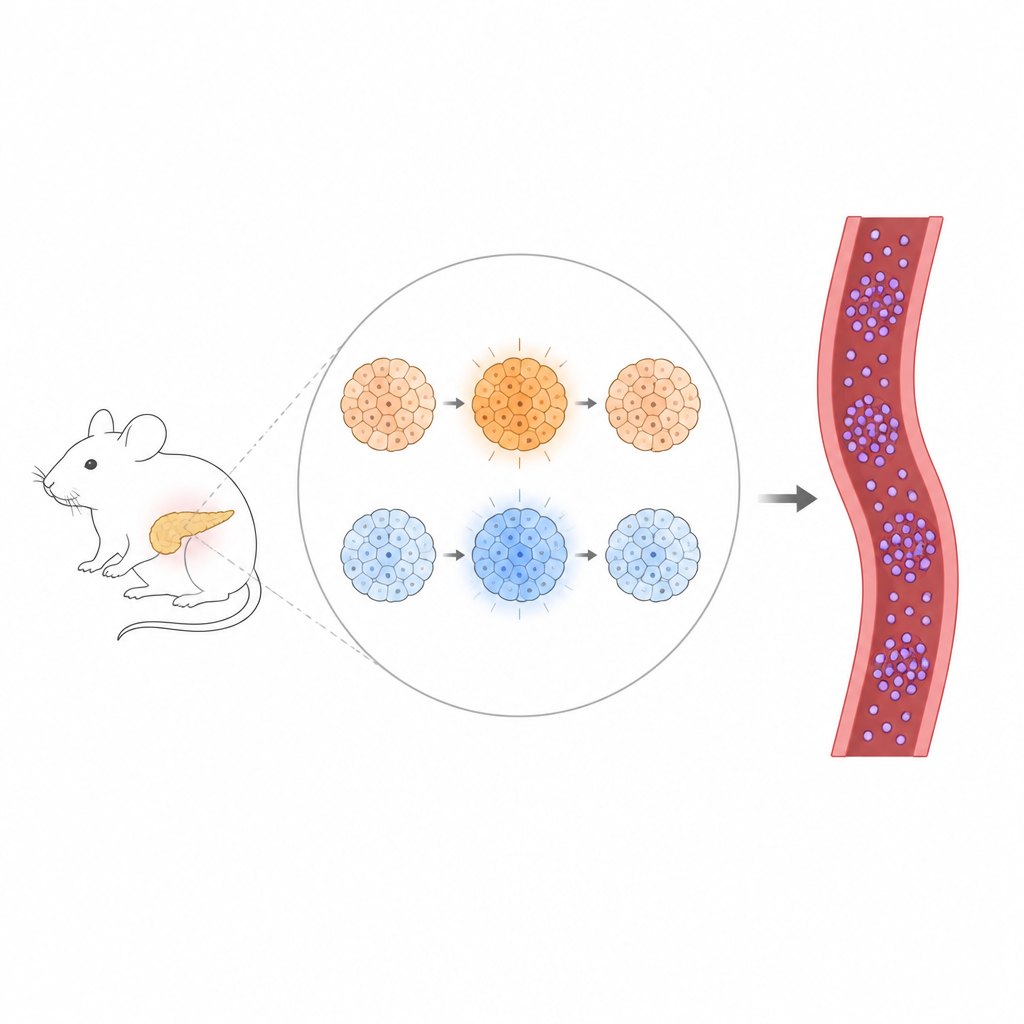
The tiny islands that guide insulin
Inside the pancreas, islets of Langerhans act like miniature control centers for blood sugar. Each islet contains beta cells that sense sugar and release insulin in bursts. These cells talk to one another within an islet, so their activity tends to be tightly coordinated locally. But the body needs many islets, scattered throughout the pancreas, to work together if the overall insulin signal in the blood is to stay nicely pulsed rather than flat and inefficient. Scientists know that communication inside an islet is strong, yet how separate islets coordinate across the organ has remained unclear.
Studying real tissue in a near-natural setting
To tackle this question, the researchers used thin slices of mouse pancreas that preserved the native structure and neighborhood of the islets. In many slices, two distinct islets could be seen in the same field of view. Using fluorescent dyes and confocal microscopy, they recorded calcium signals in hundreds of individual beta cells at once. Calcium activity in these cells is a reliable stand-in for insulin release. The team separated fast, second-scale calcium bursts from slower, minute-scale waves and then measured how tightly cells fired together within each islet and between neighboring islets.
What happens when sugar stays steady
First, the team bathed the slices in a constant level of glucose, the main sugar in the blood. Under these steady conditions, each islet behaved like an independent drummer. Fast calcium bursts were strongly synchronized inside each islet but showed no alignment between different islets. The slower, metabolism-related waves also stayed largely out of step from one islet to the next. In other words, stable sugar levels allowed each islet to follow its own internal rhythm, with no sign that neighboring islets were coordinating their timing.
How pulsing sugar can line up islets
Next, the researchers introduced rhythmic changes in glucose, switching the level up and down every few minutes. They tested gentle and strong swings, and centered them either near a more physiological level (around 8 millimoles) or a higher one (around 10 millimoles). The rapid calcium bursts remained stubbornly local: they still synchronized only within each islet. The slow waves, however, told a different story. Small sugar swings around the higher level did little to align the islets. But when the same small swings were centered near the more physiological level, neighboring islets began to show partial coordination. The strongest effect appeared when the sugar swings were large, spanning several millimoles: under those conditions, the slow rhythms of separate islets became robustly synchronized. 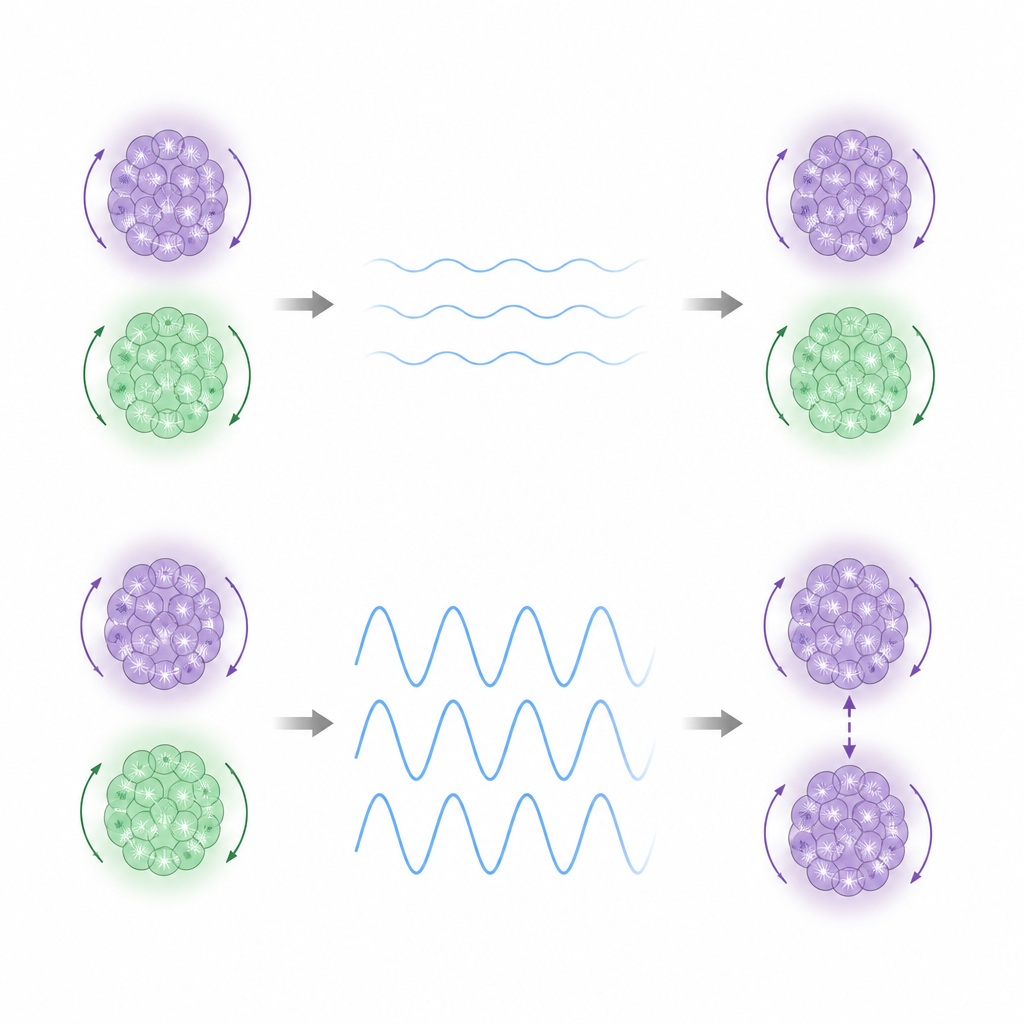
What this means for diabetes and health
These findings suggest that slow, metabolism-driven rhythms in beta cells can be tuned by how blood sugar rises and falls over time. Periodic changes in glucose can bring separate islets into step, but it takes either large swings or carefully tuned levels to do so. In everyday life, natural sugar fluctuations are usually modest, so glucose rhythms alone are unlikely to fully explain how all islets in a living animal stay coordinated. The work points to a layered control system in which local cell-to-cell links keep each islet internally coherent, while slower metabolic cues, together with signals from nerves and other hormones, help align islets across the pancreas. Understanding how these rhythms break down may offer new angles for thinking about why insulin pulses fade in type 2 diabetes and how they might one day be restored.
Citation: Križančić Bombek, L., Polšak, N., Dolenšek, J. et al. Glucose-driven intra- and inter-islet beta cell synchronization in pancreatic tissue slices. Sci Rep 16, 15808 (2026). https://doi.org/10.1038/s41598-026-46512-y
Keywords: insulin pulses, beta cells, pancreatic islets, glucose oscillations, calcium signaling