Clear Sky Science · en
Simultaneous Pi2 pulsation detected by CSES-01, Swarm, RBSP and Arase satellites
Why tiny space tremors matter
Far above our heads, Earth’s magnetic shield is constantly quivering in response to gusts from the Sun. Most of these vibrations are too subtle to notice on the ground, yet they carry clues about how energy flows through near‑Earth space and into our atmosphere. This study zooms in on one particular kind of magnetic “heartbeat,” called Pi2 pulsations, using an unusually rich fleet of satellites and ground sensors. By tracking the same event from many vantage points at once, the researchers reveal how these waves echo through the space around Earth and along invisible magnetic highways, helping scientists better understand space weather that can affect technology and power systems.
Catching a cosmic ripple in the act
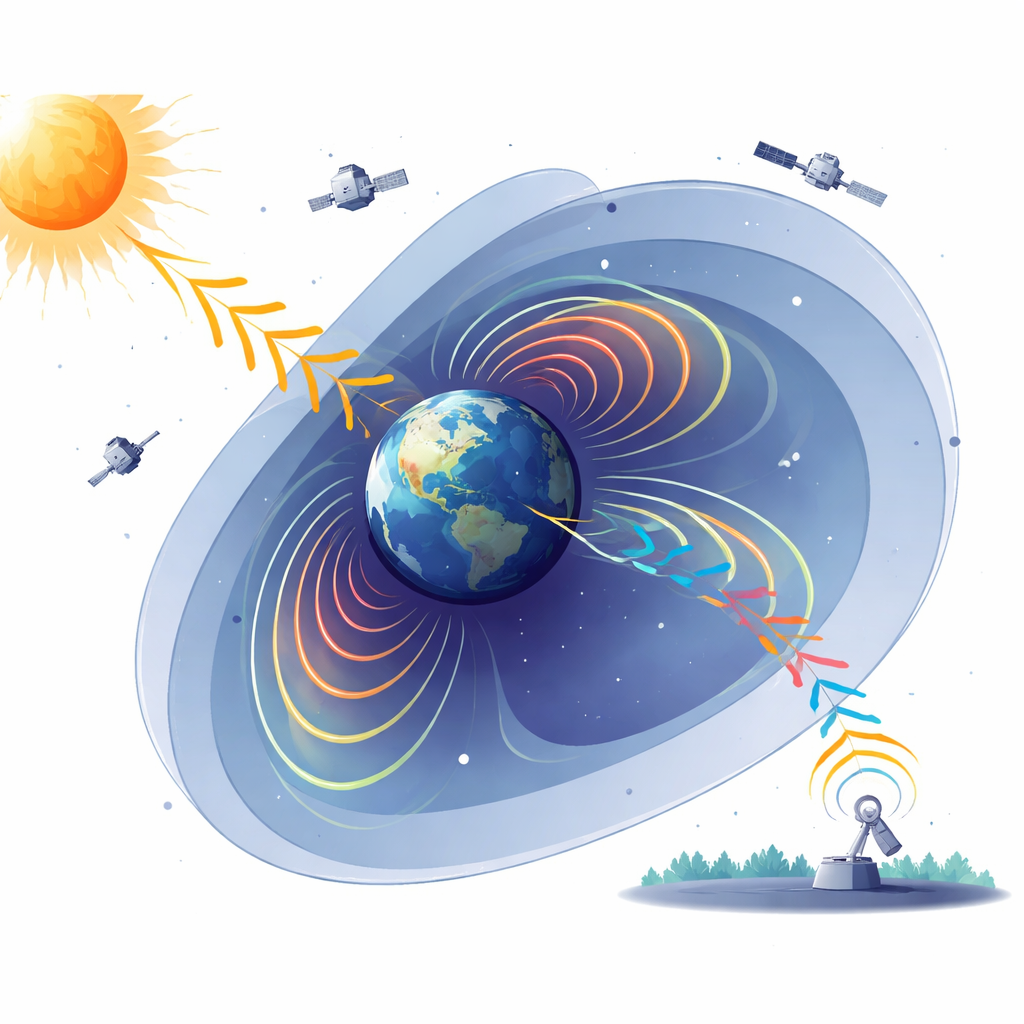
On January 12, 2019, a space weather disturbance known as a substorm kicked off shortly after 12:28 Universal Time. Substorms occur when energy stored in Earth’s magnetic tail is suddenly released, often triggering shimmering auroras. Around this time, a dozen minutes of rhythmic magnetic pulsations appeared, with each pulse lasting a little over two minutes. Remarkably, this same pattern was recorded simultaneously by several satellites and a ground observatory: China’s CSES‑01 and Europe’s twin Swarm satellites in the upper atmosphere, Japan’s Arase spacecraft and NASA’s twin Van Allen Probes deeper in the magnetic bubble, and the Kakioka magnetic observatory in Japan. Seeing the same wave across such a wide region allowed the team to treat Earth’s surroundings like a giant resonant instrument and watch how it “rang” during the substorm.
Viewing Earth’s magnetic shell from many angles
The satellites were scattered in different local time sectors, some on the nightside, some near dusk, and some on the dayside. Yet they all picked up nearly identical compressive magnetic wiggles—subtle squeezes and stretches of the magnetic field—matching the Pi2 frequency range. In the upper ionosphere, CSES‑01 and Swarm showed highly similar wave shapes to those seen on the ground at Kakioka, confirming that these ripples travel efficiently along Earth’s magnetic field lines from space down into the atmosphere. For a brief interval when both CSES‑01 and Swarm were flying in the Southern Hemisphere, their signals moved in step; as CSES‑01 crossed into the Northern Hemisphere, the pattern flipped out of step. This change in phasing provided a geometric clue about how the waves thread through the magnetic field above each hemisphere.
Listening for echoes in a magnetic cavity
Closer to the heart of the disturbance, the Van Allen Probes and Arase spacecraft flew near the boundary between dense, colder plasma close to Earth and more rarefied plasma farther out—a region often called the plasmapause. There, the team found a strong 90‑degree phase offset between different components of the magnetic and electric field on one of the Van Allen Probes, a classic sign that the spacecraft was inside a standing wave trapped in a sort of magnetic “cavity.” Advanced time–frequency tools, including the Hilbert–Huang transform and wavelet analysis, revealed that the event contained two main tones: a lower‑frequency fundamental mode and a higher‑frequency harmonic. The higher tone appeared only where the plasma density dipped, suggesting that small‑scale structure in the boundary region helps decide where certain wave notes can exist and how strongly they ring.
Following the path of low and high notes
By comparing observations from pairs of spacecraft and from widely separated ground stations, the researchers could estimate how fast and in what direction these waves traveled around the planet. The lower‑frequency Pi2 waves seemed to wrap almost simultaneously around large portions of the inner magnetic bubble, with a phase speed far higher than what would be expected if they simply crept along guided by the local magnetic field. This challenges a popular “waveguide” picture for these low‑frequency pulsations. In contrast, the higher‑frequency Pi2 waves between about 12:20 and 12:36 UT behaved more like guided modes: they propagated westward along the dusk flank at speeds comparable to the characteristic Alfvén speed in the plasma, and their phase relationships matched expectations for a second‑harmonic cavity resonance.
What this tells us about Earth’s space orchestra
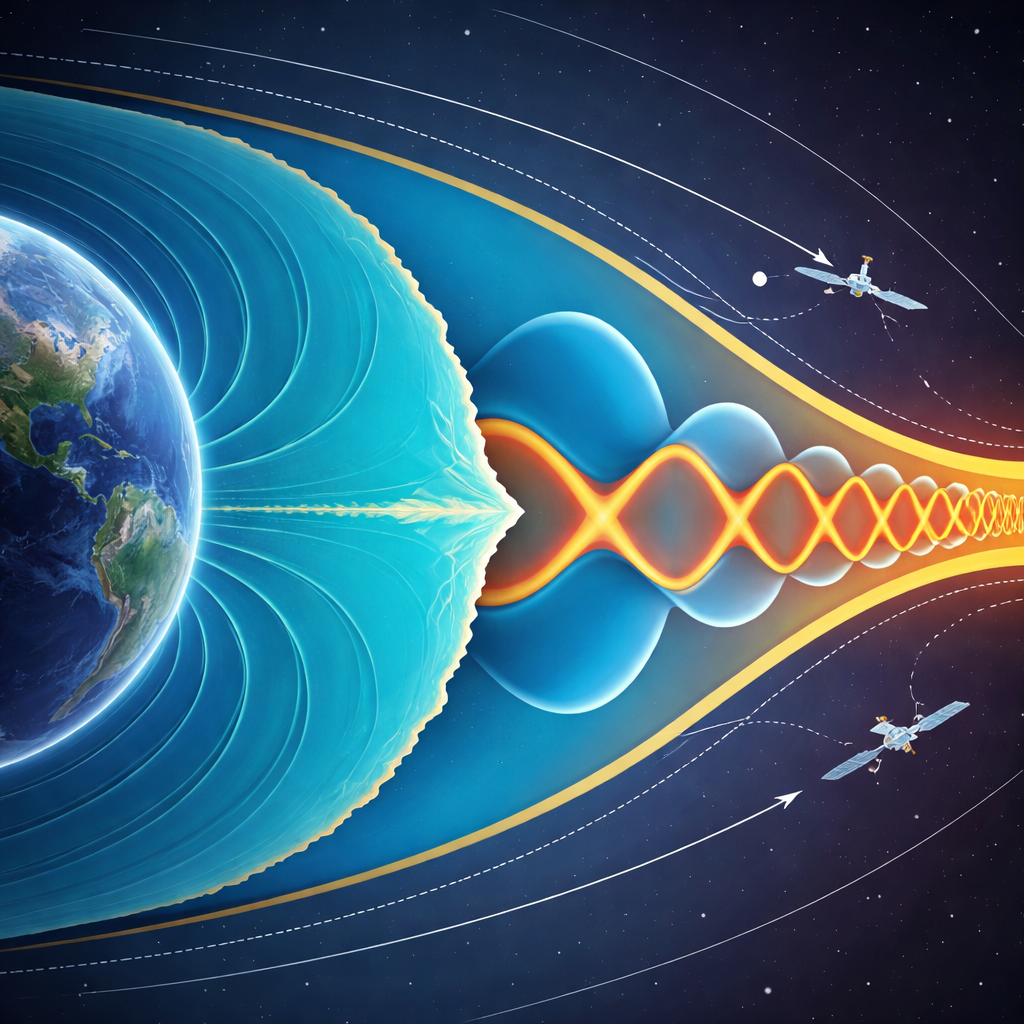
Taken together, the results show that these Pi2 pulsations are not isolated quirks but part of a coordinated vibration of the entire near‑Earth environment, linking the deep magnetosphere, the upper atmosphere, and the ground. The study provides the first fully coordinated picture of such an event using multiple satellites both in the magnetosphere and in low‑Earth orbit, anchored by ground observations. It shows that irregular patches in plasma density near the edge of Earth’s magnetic shell can turn different Pi2 “notes” on and off, and that higher‑frequency waves can indeed travel sunward along the dusk flank as a guided mode, while lower‑frequency waves behave more like global resonances. For non‑specialists, this means scientists are learning to read the subtle magnetic vibrations of our planet as a diagnostic tool, improving our ability to interpret and eventually forecast the complex space weather orchestra that surrounds Earth.
Citation: Ghamry, E., Yamamoto, K., Marchetti, D. et al. Simultaneous Pi2 pulsation detected by CSES-01, Swarm, RBSP and Arase satellites. Sci Rep 16, 12368 (2026). https://doi.org/10.1038/s41598-026-46510-0
Keywords: space weather, Earth magnetosphere, geomagnetic pulsations, satellite observations, ionosphere coupling