Clear Sky Science · en
Multi-strategy enhanced orchard algorithm for optimal integration of renewable energy sources and EV charging stations in microgrids
Why smarter charging matters for everyday life
As more people switch to electric cars and more homes and businesses add rooftop solar and wind power, local electricity networks are working harder than ever. If these technologies are connected without a plan, neighborhoods can face flickering voltages, higher energy losses, and extra strain on the wider grid. This paper explores a smarter way to decide where to place solar panels, wind turbines, and electric vehicle chargers in a microgrid so that drivers get reliable charging, the lights stay steady, and the system wastes less power.
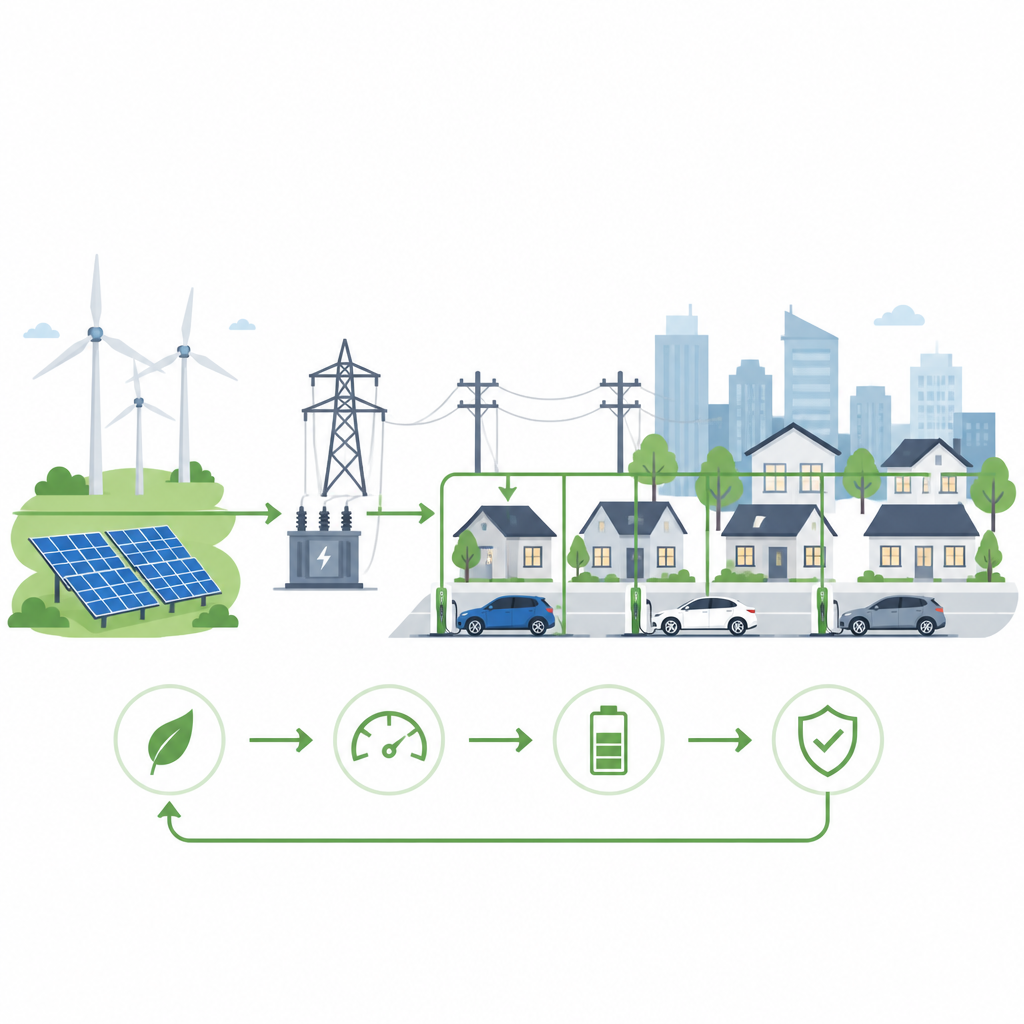
Growing challenge in clean power neighborhoods
Modern distribution networks are turning into active microgrids that must juggle household demand, solar roofs, small wind turbines, and clusters of electric vehicle charging stations. Solar and wind output rise and fall with the weather, while drivers plug in at unpredictable times and for different durations. Together, these swings can cause voltage to wander away from safe limits, overload certain lines, and force unwanted power flows back and forth between the microgrid and the main utility. Many existing planning methods treat each technology separately or assume steady, predictable conditions, so they struggle when all these moving parts interact at once.
New planning tool inspired by orchards
The authors introduce a planning method called the Multi-Strategy Enhanced Orchard Optimization Algorithm. In this approach, each possible design for a microgrid is treated like a tree in an orchard, and the algorithm lets these trees “grow” toward better solutions over many cycles. It combines several search tricks: local fine-tuning around good designs, mixing features of different candidates, and selectively replacing weak designs to keep diversity. All these steps are guided by a score that blends three goals: keeping voltages close to their ideal value, smoothing the power exchanged with the main grid, and cutting real power losses in the lines. Unlike simple trial-and-error or earlier metaheuristic methods, this multi-strategy version is built to avoid getting stuck in mediocre solutions when many objectives compete.
How electric cars and renewables are modeled
To test this planning tool realistically, the study builds detailed models of solar panels, wind turbines, and electric vehicles. Solar output depends on sunlight and cell temperature, wind output on changing wind speed and air conditions, and vehicle charging on how far people drive, when they arrive, how long they stay, and their battery state of charge. These behaviors are represented using probability distributions and many possible daily scenarios rather than a single fixed pattern. The optimization then chooses both the best locations and sizes for solar and wind units and the best spots and capacities for charging stations on a standard 33-bus test network, while also shaping charging behavior to better match renewable output and price signals.
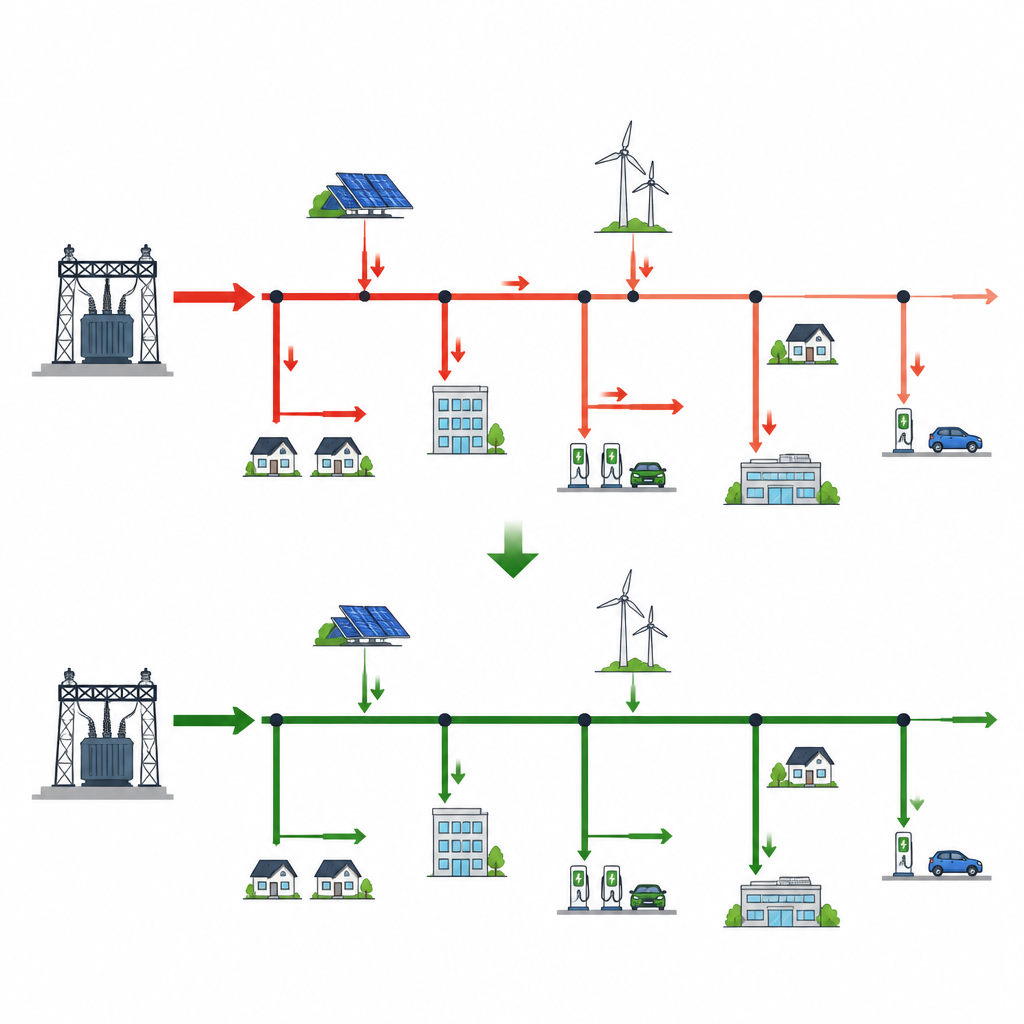
What the optimized microgrid looks like
Running the enhanced orchard algorithm on this test system gives a plan that places several mid-sized solar and wind units and ten charging stations at specific buses in the network. Compared with a setup based on a more basic orchard algorithm and with well-known methods such as genetic algorithms, particle swarm optimization, and whale optimization, the new method delivers lower voltage swings, smaller power losses, and steadier tie-line power. In numerical terms, voltage deviation and line losses fall by roughly one sixth, and tie-line power variation drops by about one eighth. The algorithm also reaches these solutions faster, needing fewer iterations and less computing time, which is important if planners want to explore many different future scenarios.
Why these results matter for future grids
For a non-specialist, the key message is that where and how we add clean energy and charging stations matters as much as how many we add. By treating the local grid as a whole system, and by accounting for uncertainties in sun, wind, and driver behavior, the proposed planning method finds layouts that keep voltages healthy, trim waste, and reduce stress on the connection to the main grid. This means electric vehicle drivers can charge more reliably, renewable energy can be used more efficiently, and utilities can delay expensive upgrades, helping communities move toward cleaner, more resilient power without sacrificing day-to-day performance.
Citation: V., K., Thirumalaisamy, S.K., M., M. et al. Multi-strategy enhanced orchard algorithm for optimal integration of renewable energy sources and EV charging stations in microgrids. Sci Rep 16, 15588 (2026). https://doi.org/10.1038/s41598-026-46503-z
Keywords: microgrids, electric vehicle charging, renewable energy integration, power loss reduction, optimization algorithm