Clear Sky Science · en
The future of power forecasting: neuromorphic-axolotl hybrid intelligence revolutionizing grid operations through bio-inspired missing data mastery
Keeping the Lights On in a Noisy World
Our power grids increasingly depend on precise forecasts of how much electricity homes, factories, data centers, and electric vehicles will use in the hours and days ahead. Yet the data behind these forecasts are full of gaps and glitches from broken sensors, bad weather, and communication hiccups. This paper presents an unusual blend of ideas from logic, salamander biology, and primate behavior that together create a new way to repair damaged data and dramatically sharpen power demand predictions.
Why Missing Numbers Threaten the Grid
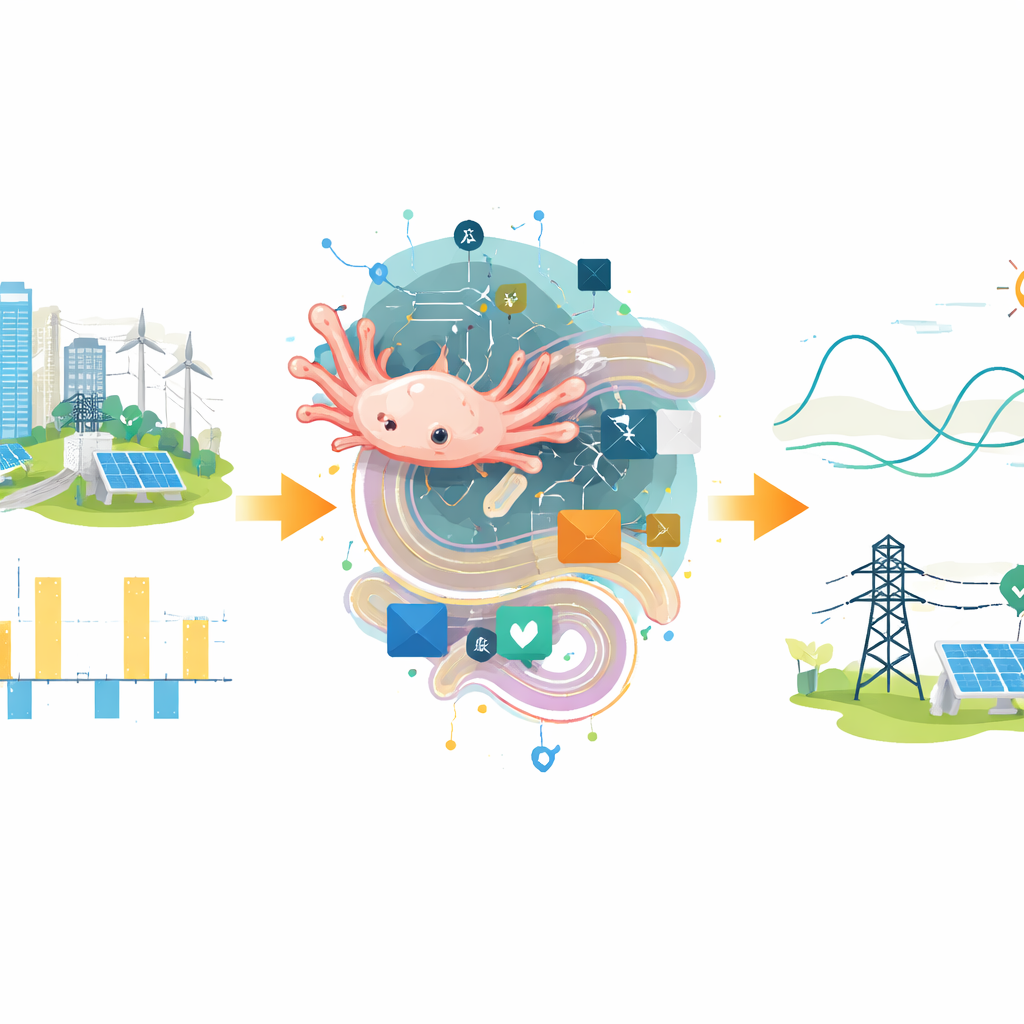
Modern electricity systems juggle rooftop solar panels, wind farms, electric vehicle charging, and energy-hungry data centers. To balance supply and demand safely and cheaply, grid operators rely on streams of measurements: temperatures, sunlight levels, and power flows in different zones. In reality, many of these numbers simply never arrive. Sensors fail, communication links go down, and storms can knock out entire sections of the network. If forecasting models are fed these broken time series “as is,” their errors grow, and operators are forced to keep extra backup power on standby, raising both costs and emissions.
A New Way to Think About Uncertain Data
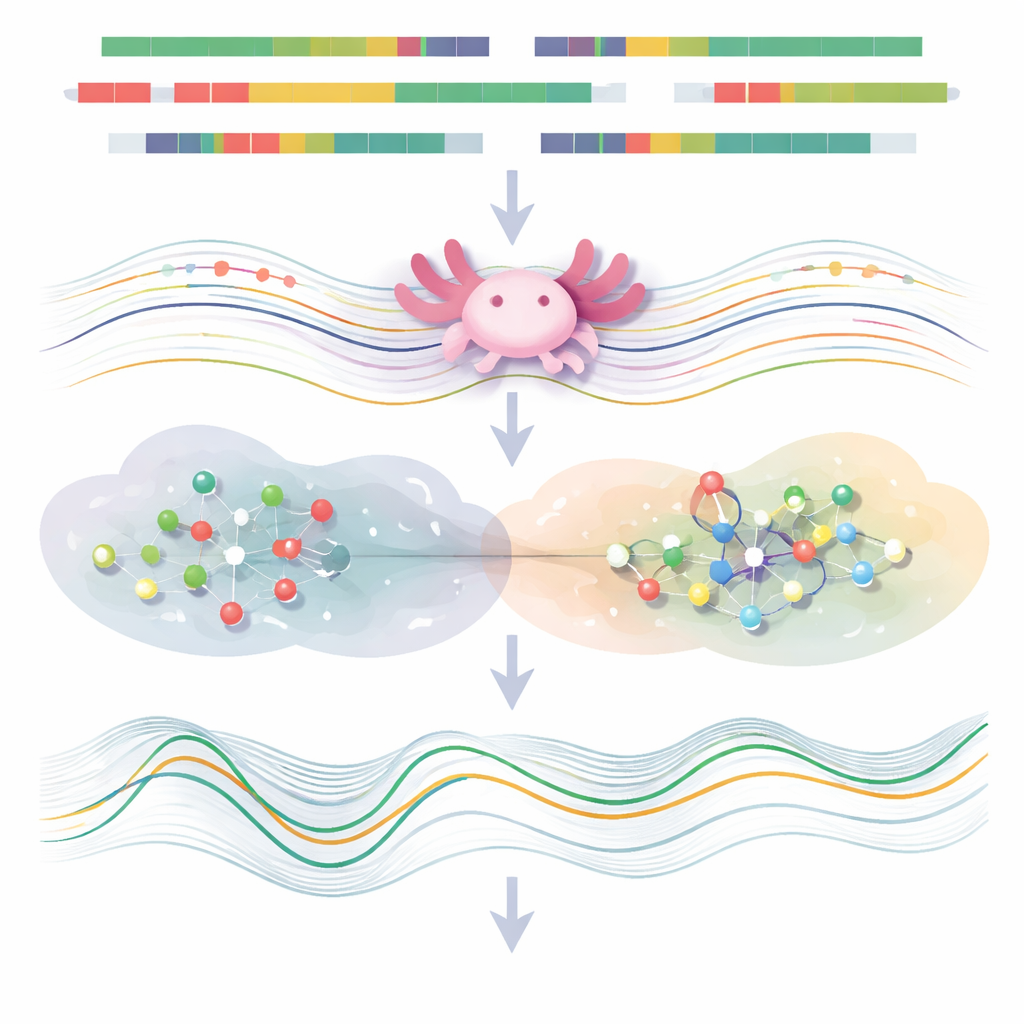
Most existing methods for filling in missing values treat numbers as either known or unknown and try to guess the blanks by looking at nearby values. The authors instead use a three-part description of every data point: how likely it is to be correct, how uncertain it is, and how likely it is to be wrong. This approach, drawn from a mathematical idea called neutrosophic sets, allows the system to represent noisy sensors, suspicious outliers, and genuinely reliable readings side by side. These three “degrees” then flow through a Markov-style model that tracks how certainty and uncertainty evolve over time along the power consumption curve.
Borrowing Repair Tricks from an Unusual Salamander
To actually reconstruct missing stretches of power demand, the framework takes inspiration from the axolotl, a salamander famous for regrowing lost limbs. In the model, missing chunks of data behave like damaged tissue. A regenerative module examines local patterns, seasonal cycles, and contextual cues such as temperature and time of day, and then “grows” plausible values into the gaps. It works at multiple time scales at once: fine detail for short outages and broader trends for longer breakdowns. Over time, the regenerative system also “remembers” which repair strategies worked best in similar situations, so it improves its own behavior as it sees more data.
Letting Virtual Monkeys Organize the Information
Even with missing values repaired, forecasting models can be overwhelmed by too many overlapping signals. To tackle this, the authors introduce a new optimization algorithm modeled on the territorial and social behavior of bald uakari monkeys. In the grid setting, each “territory” represents a candidate subset of features, such as particular weather variables or zones. These territories expand, contract, and compete for resources, while social interactions help the population of candidates explore many combinations. This process steadily homes in on a compact set of features that together give the best forecasts without wasting computing power.
From Complex Math to Practical Grid Gains
When the full hybrid system was tested on seven large real-world datasets—from households to industrial plants, microgrids, and electric vehicle charging—it consistently beat a wide range of traditional and modern techniques. Repairing missing data and selecting features jointly led to about a 31% boost in forecasting accuracy and nearly a 24% drop in reconstruction error, even when up to 40% of the data were missing. The approach transferred well to new regions and grid types with little extra training and ran fast enough for edge devices in substations. For a layperson, the takeaway is that this biologically inspired “healer” for broken data can help grids run closer to the edge with greater confidence, integrating more renewables and new electric loads while reducing waste, cost, and risk of failure.
Citation: Alhag, S.K., Elbaz, M., Moghanm, F.S. et al. The future of power forecasting: neuromorphic-axolotl hybrid intelligence revolutionizing grid operations through bio-inspired missing data mastery. Sci Rep 16, 11655 (2026). https://doi.org/10.1038/s41598-026-46498-7
Keywords: power demand forecasting, missing data, smart grid, bio-inspired algorithms, renewable integration