Clear Sky Science · en
A comparative evaluation of sustainable asphalt binder modifiers for enhanced performance
Why Better Roads Matter for Everyone
Modern life runs on asphalt roads, yet building and maintaining them quietly contributes a notable share of global climate-warming emissions. The black glue that holds roads together – asphalt binder – also ages, cracks, and deforms under sun and traffic, forcing costly repairs. This study asks a practical question with big implications: if we tweak that binder using waste materials and new mineral blends, can we build roads that last longer, perform better in harsh climates, and reduce environmental impact at the same time?
Turning Waste and Minerals into Smarter Road Glue
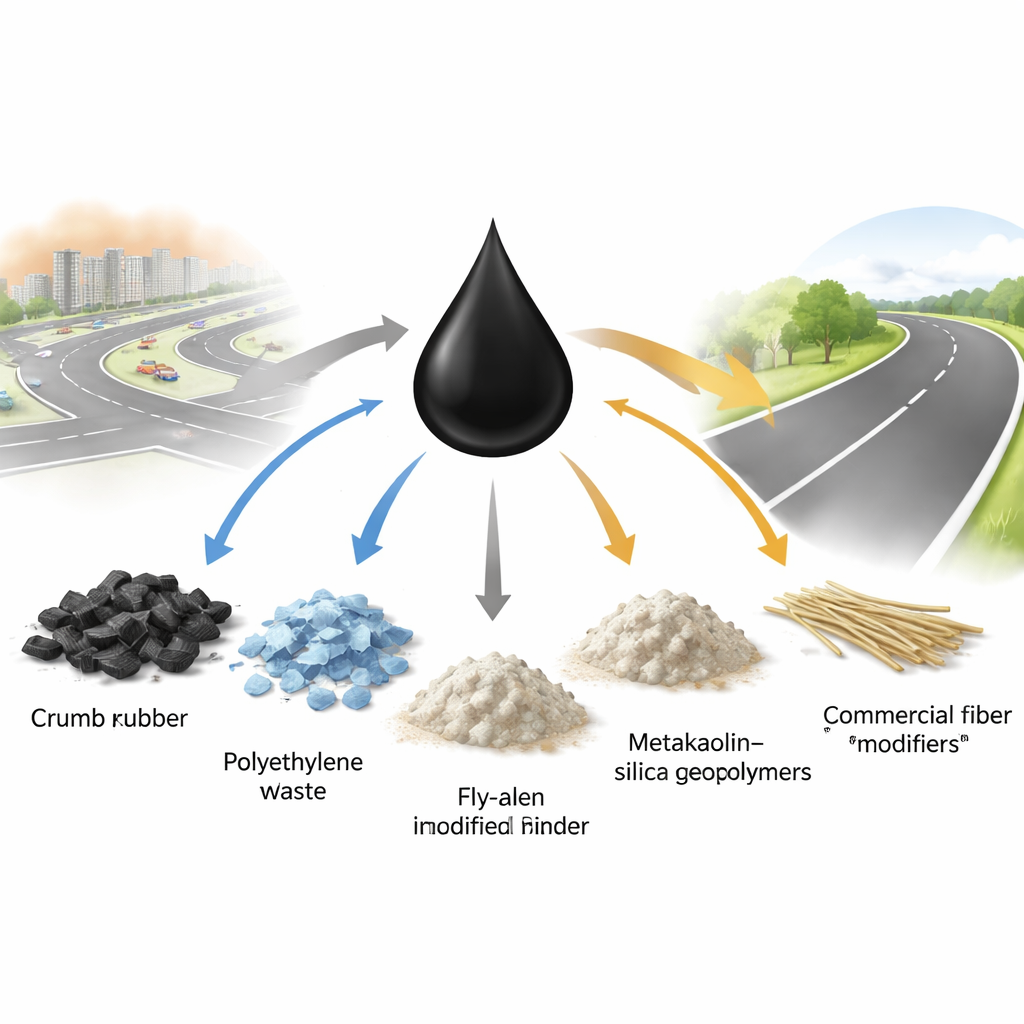
The researchers compared six different additives mixed into two common asphalt binders from Egyptian refineries. Three came from waste polymers: crumb rubber from old tires, low-density polyethylene from discarded plastic bags, and a blend of the two. Two were “geopolymers” – cement-like networks made from fly ash and from a lab-made mix of metakaolin and silica fume, both industrial byproducts. The last was a commercial fiber product already used in premium road surfaces. Rather than testing each in isolation, the team built a single, unified framework so every modifier was processed and evaluated in a consistent way, allowing for a true side‑by‑side comparison.
Looking Inside Asphalt Across Many Scales
To see how these additives really changed the binder, the team combined several powerful tools. Electron microscopes revealed how evenly each modifier spread and how the internal texture evolved as the binder aged. Infrared light measurements tracked the chemical fingerprints of oxidation – the slow “rusting” of asphalt that leads to brittleness. Thermal tests followed how the materials broke down when heated, mimicking construction and hot-climate service. Ultraviolet exposure and light absorption tests captured how sunlight drives additional damage. Finally, rheological tests – essentially high‑tech measurements of flow and stiffness – showed whether the modified binders would still be workable during paving and how their temperature ratings shifted.
What Worked Best and What Looked Risky
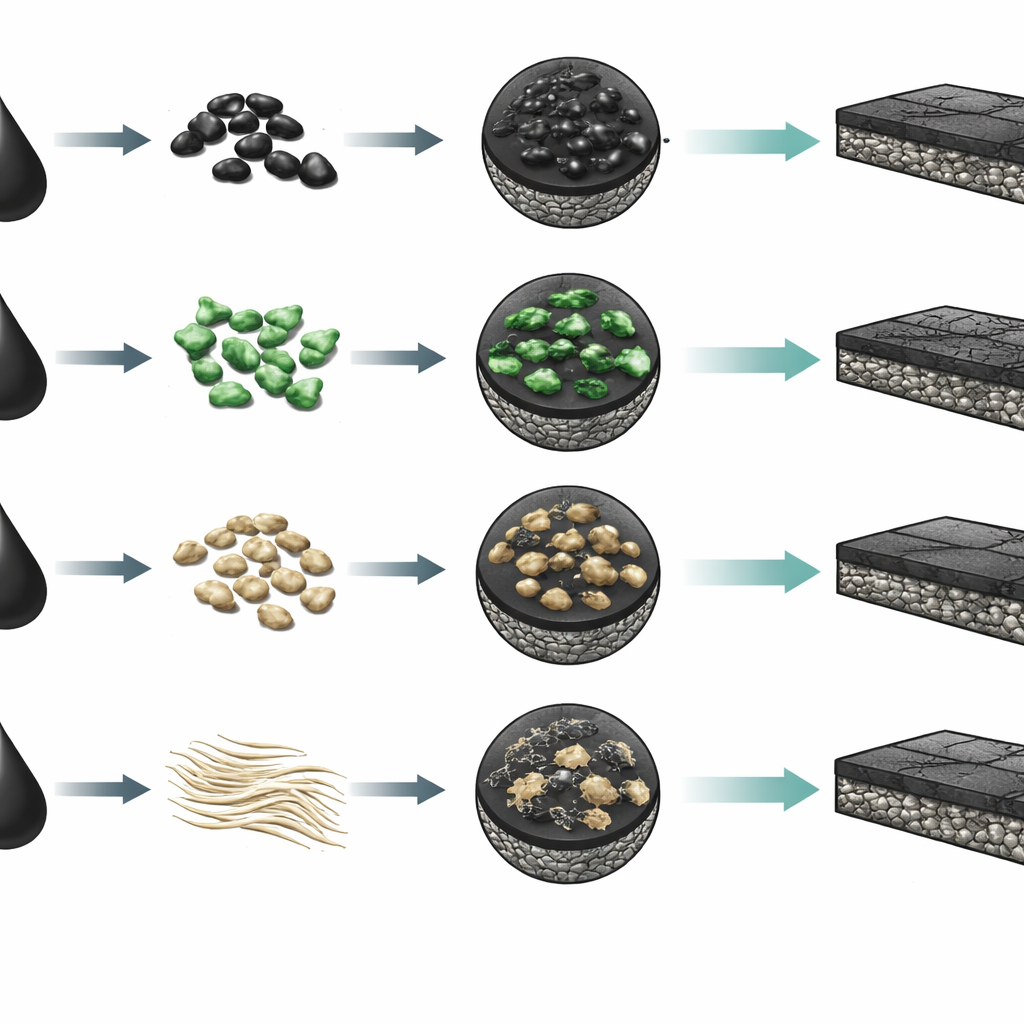
Across this multi-layered view, the geopolymer modifiers stood out as the most consistently beneficial. They raised the temperature at which the binder starts to break down by about 10–20 °C, resisted sunlight-driven chemical changes, and kept the internal microstructure smooth and uniform. Crucially, they did this while keeping the binder easy to pump and spread during construction, and only modestly increased its stiffness rating. Crumb rubber also performed well overall: it offered a moderate boost in high‑temperature performance and helped the binder resist both thermal and ultraviolet aging, without making it too thick to handle.
When Stiffer Is Not Necessarily Better
Some modifiers looked impressive if you only checked how stiff the binder became at high temperatures. The plastic (LDPE) and commercial fiber systems produced the largest jumps in performance grade – essentially saying the roads could, in theory, handle hotter climates. But the more detailed tests told a different story. These binders showed clumpy, uneven textures, higher levels of oxidation products, earlier thermal breakdown, and more sunlight‑driven damage. In other words, they delivered short‑term hardening rather than long‑term resilience. A hybrid of rubber and plastic landed in the middle: better than plastic alone, but still not as robust as pure rubber or the geopolymer systems.
Why the Original Binder Still Matters
An important lesson from this study is that not all base binders respond the same way. The two Egyptian sources started with different chemical makeups, and the one that seemed stronger on paper – with a higher standard temperature grade – actually aged faster and proved less stable in many tests. Some modifiers helped one source but were neutral or even harmful with the other. This means that choosing an additive in isolation is not enough; it must be matched thoughtfully to the specific binder chemistry used in a region or project.
What This Means for Future Roads
For a non‑specialist, the takeaway is clear: simply making asphalt stiffer is not a guarantee of longer‑lasting roads. The most promising paths involve turning industrial byproducts into geopolymer additives and using recycled tire rubber, both of which can strengthen binders against heat, oxygen, and sunlight without sacrificing workability. Plastic and fiber additives can offer quick gains in stiffness but may shorten pavement life if their compatibility with the base binder is not carefully engineered. By showing how to judge modifiers across chemical, structural, thermal, and mechanical lenses all at once, this work offers road agencies and designers a more reliable recipe for building durable, climate‑resilient pavements from materials that might otherwise be treated as waste.
Citation: Saudy, M., Guirguis, M., ELBadawy, S. et al. A comparative evaluation of sustainable asphalt binder modifiers for enhanced performance. Sci Rep 16, 12213 (2026). https://doi.org/10.1038/s41598-026-46495-w
Keywords: sustainable asphalt, waste-based modifiers, geopolymer binder, crumb rubber, pavement durability