Clear Sky Science · en
Impact of reinforcement additives on physical and electrical properties of fly ash-based geopolymer materials
Turning Waste into Better Building Blocks
Modern buildings quietly leave a big carbon footprint, largely because making cement and concrete is energy-hungry and polluting. This study explores a cleaner alternative: "geopolymers" made from industrial waste, especially fly ash from coal power plants. By smartly adding tiny fibers made from waste cotton and modified plant cellulose, the researchers show how to turn a dusty by-product into solid blocks that can be either strong electrical insulators or smart, electricity-conducting materials for future structures.
From Coal Dust to Green Stone
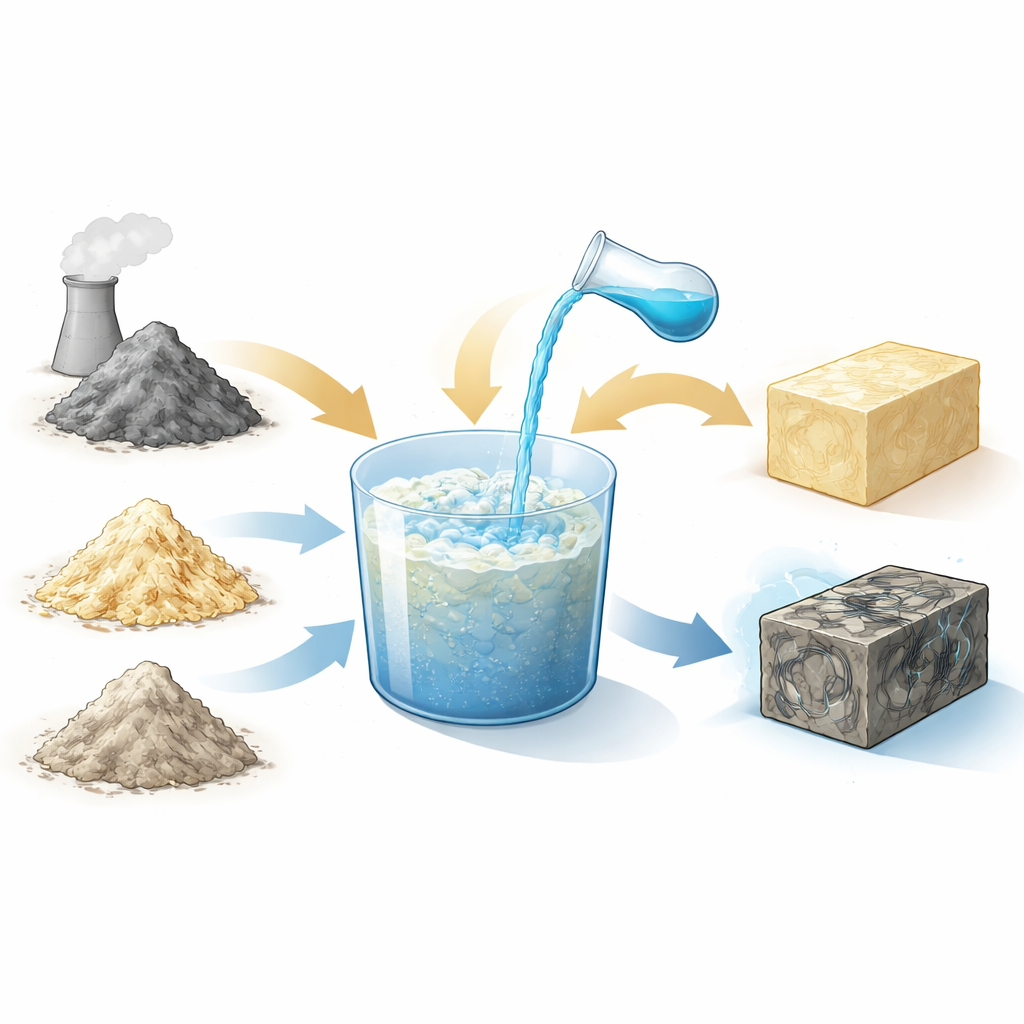
Fly ash is a fine powder left over when coal is burned. Instead of dumping it in landfills, it can be chemically "activated" and hardened into a stone-like material called a geopolymer, which can replace traditional cement in some uses. In this work, fly ash was mixed with a carefully treated form of quartz and an alkaline liquid to trigger a setting reaction at relatively low temperatures. The goal was to see how different carbon-based additives—carbon fibers from waste cotton and thermally stabilized microcrystalline cellulose from plant material—would change the strength and electrical behavior of the resulting blocks.
Designing the Mix: Fibers, Minerals, and Hidden Pores
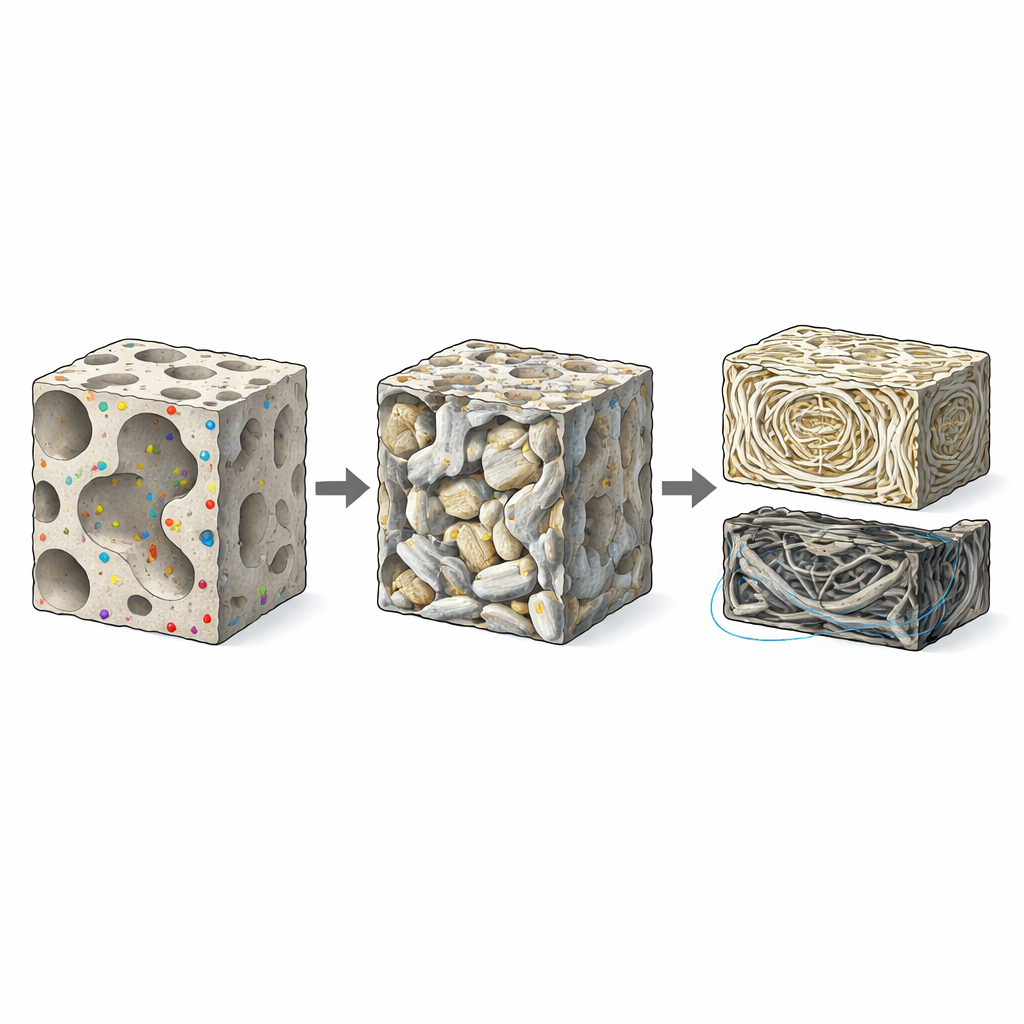
The team prepared a series of small cubes with different recipes: plain fly-ash geopolymer, fly ash combined with activated quartz, and versions reinforced with either carbon fibers or stabilized cellulose at low and higher contents. They examined the internal structure with electron microscopes and X-ray techniques. Plain fly-ash geopolymer showed many voids and unreacted particles, like a loosely packed sponge, which limits its strength. Adding activated quartz made the internal matrix denser and reduced porosity, as angular quartz grains and new gel-like material filled the gaps. When more carbon fibers or stabilized cellulose were blended in, the material developed a tightly knit, amorphous network that linked the fly ash, quartz and additives into a more continuous solid.
How the Additives Change Strength
The mechanical tests revealed that the right additives dramatically improve how much load the material can carry. Plain fly-ash geopolymer had very low compressive strength, meaning it would crack easily. Introducing activated quartz raised the strength several times by helping pack the structure and promoting further reaction. Adding 3% carbon fibers to the quartz-containing mix boosted strength even more, as the fibers helped bridge microcracks and supported the growing network. The biggest improvement came from 3% stabilized cellulose: this version reached a strength of 18.1 megapascals, comparable with or better than some lightweight concretes. The cellulose appears to act as an internal curing agent and micro-filler, guiding water movement, filling tiny voids, and fostering a dense, continuous framework inside each block.
Tuning Electricity: From Insulators to Smart Conductors
Beyond strength, the researchers looked at how easily electricity moves through these materials, which matters for applications like sensing cracks, shielding electronics, or preventing corrosion in steel-reinforced structures. In porous, under-reacted samples, ions left from the activating chemicals can move relatively freely, giving higher conductivity. When activated quartz is added and the structure becomes denser, the paths for ion motion shrink, and the conductivity drops while resistance increases. The sample with 3% stabilized cellulose and quartz showed the lowest conductivity and dielectric response, making it a promising electrical insulator. In contrast, when 3% carbon fibers were added to a fly-ash geopolymer without quartz, the connected network of conductive fibers produced a sixfold (and in practice, several orders of magnitude over some other mixes) increase in conductivity, ideal for materials that must respond to electric fields or carry signals.
What This Means for Future Buildings
In simple terms, the study shows that industrial waste like fly ash and discarded cotton or plant fibers can be transformed into tailored building materials by careful chemistry and mixing. By choosing the right additive and quartz content, engineers can decide whether a geopolymer block behaves more like a sturdy insulator or a smart, self-sensing material that conducts electricity. These waste-based geopolymers not only help reduce the environmental burden of both coal ash and traditional cement, but also open the door to multifunctional components in future infrastructure—walls and elements that are lighter on the planet while quietly monitoring their own health.
Citation: Abas, K.M., Ngida, R.E.A. & Abbas, S.M. Impact of reinforcement additives on physical and electrical properties of fly ash-based geopolymer materials. Sci Rep 16, 12207 (2026). https://doi.org/10.1038/s41598-026-46494-x
Keywords: fly ash geopolymer, carbon fiber concrete, cellulose-reinforced materials, green construction, electrically conductive cement