Clear Sky Science · en
Effect of geotextile on ballast fouling under cyclic loading in seasonal freeze–thaw conditions
Why spring thaw can trouble train tracks
In many cold regions, railway lines ride out long winters only to face their toughest test in spring. As frozen ground thaws from the top down, hidden changes in water and soil beneath the tracks can weaken the stones that hold the rails in place. This study explores how a thin fabric layer called geotextile can help railways withstand these seasonal stresses by keeping fine soil from clogging the coarse stones and by reshaping how water moves at the boundary between them. 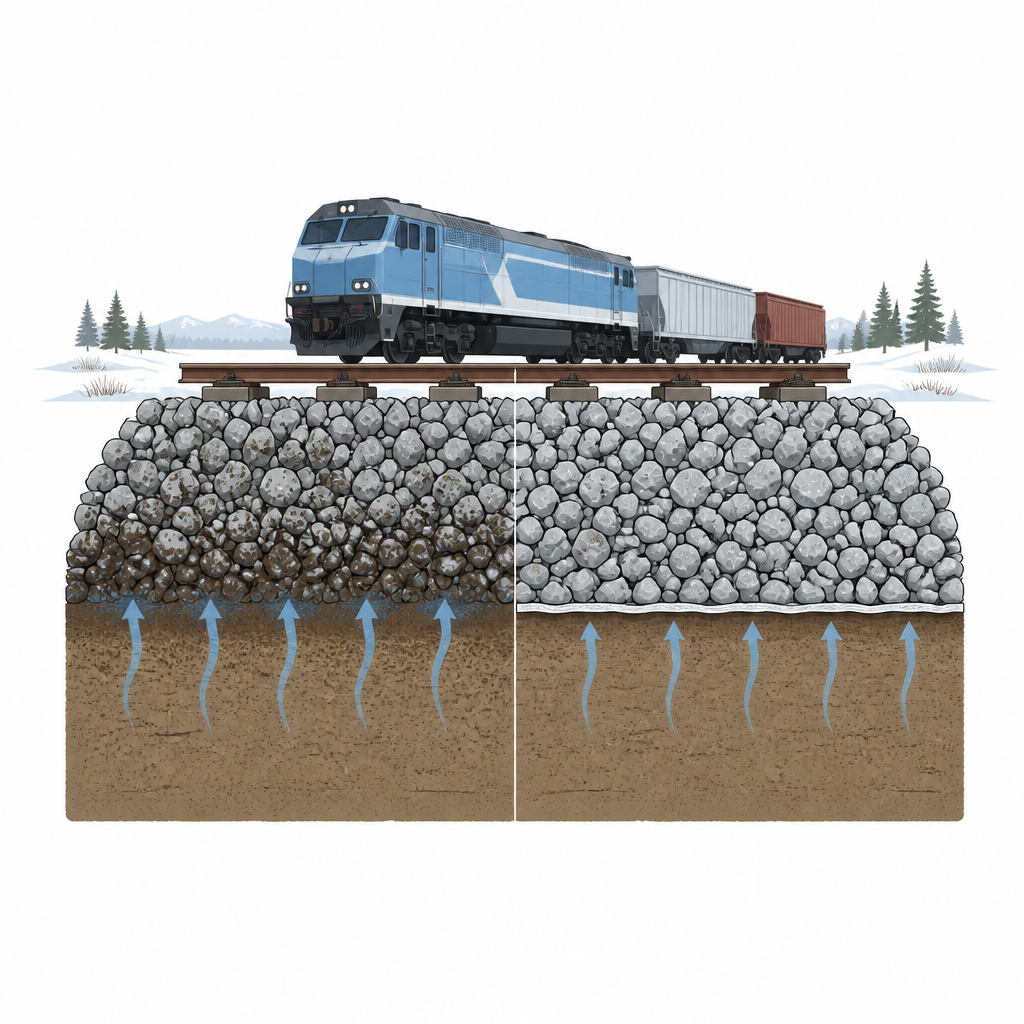
What happens under the tracks when ice melts
Railway tracks in cold climates usually rest on a layer of coarse crushed stone, known as ballast, which spreads the train load and lets water drain away. Beneath that lies finer soil, or subgrade. During winter, this soil freezes from the top down. As it freezes and thaws repeatedly, water is drawn upward and tends to collect near the top of the soil. When spring arrives, that upper zone often stays wetter than the deeper ground, with pockets of water-rich, softened soil sitting just below the ballast.
Why wet soil leads to clogged stones
Once trains begin to pass over this wet interface, each wheel load squeezes the water and fine soil particles trapped there. The repeated loading raises water pressure in the pores of the soil and can push fine grains up into the voids between ballast stones, a process often called mud pumping. Over time, this creates a dense, dirty layer that reduces drainage and makes the track bed less stiff. The study shows that higher water content in the upper soil sharply increases ballast penetration, upward movement of fines, and the thickness of this fouled layer, especially at very wet conditions that resemble late spring thaw. 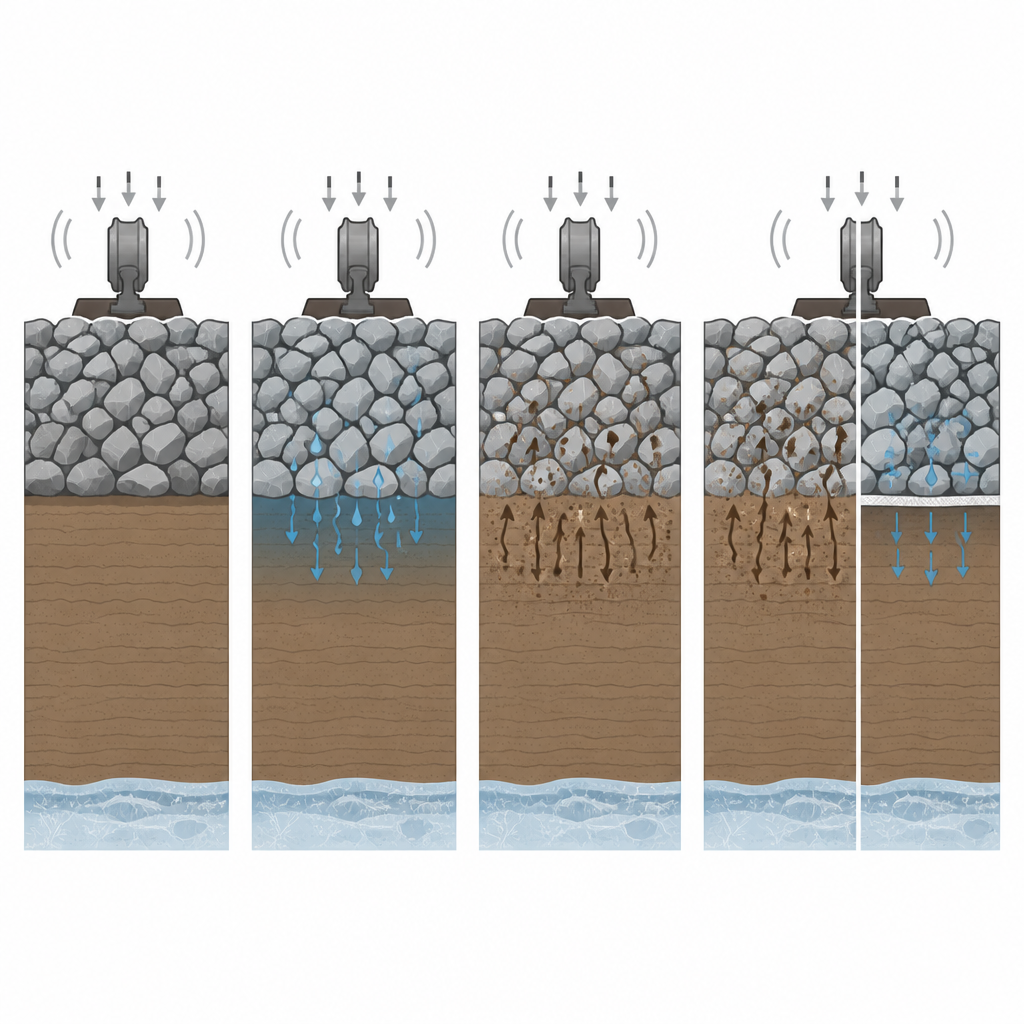
How a thin fabric layer changes the story
Engineers often place a geotextile between ballast and subgrade. This fabric is strong yet permeable, so water can pass through while most fine soil particles cannot. In the experiments, the geotextile acted both as a physical barrier and as a subtle valve for water flow. It lowered pore-water pressure in the deeper soil and reduced the upward pressure gradient that drives seepage near the interface. At the same time, it delayed how quickly pressure near the fabric dropped after each load cycle. Despite this slower local pressure release, specimens with geotextile ended the tests with less water in the top soil layer than those without it.
Cleaner stones and a more stable base
The visual and sieve tests after loading revealed a stark contrast. Without geotextile, fines invaded the ballast, first filling the lowest stone layer and then spreading upward until the entire ballast thickness was contaminated under the wettest conditions, sometimes with clear mud pumping to the surface. With geotextile, almost no fine soil was found among the stones, and the grain-size distribution of the ballast remained close to its original state across all depths. Any reduction in ballast thickness in the reinforced cases came mainly from the stones packing more tightly, not from soil squeezing upward.
What this means for railways in cold regions
For non-specialists, the main message is straightforward: in seasonally frozen areas, spring thaw can quietly turn clean, free-draining ballast into a clogged, water-sensitive layer that undermines track stability. This research shows that a simple fabric sheet placed between the stones and the underlying soil can greatly slow that clogging by blocking soil movement and reshaping how water and pressure behave at the interface. However, because the geotextile also changes local water pressures, it should be paired with good drainage rather than seen as a cure-all. Together, these findings offer practical guidance for designing more durable tracks where freeze and thaw are yearly facts of life.
Citation: Zhang, D., Li, Q., Li, S. et al. Effect of geotextile on ballast fouling under cyclic loading in seasonal freeze–thaw conditions. Sci Rep 16, 15261 (2026). https://doi.org/10.1038/s41598-026-46491-0
Keywords: railway ballast, geotextile, freeze thaw, ballast fouling, mud pumping