Clear Sky Science · en
Using magnetic nanoparticles to explore symbiotic interactions
Why tiny magnets in squid blood matter
Most animals, including humans, depend on friendly microbes to stay healthy, but it is surprisingly hard to watch these partnerships in action inside a living body. This study shows how tiny magnetic particles can be used as harmless tags on immune cells in the Hawaiian bobtail squid, allowing scientists to follow where those cells go and how they react when they meet helpful bacteria. The work hints at new ways to trace and gently steer the conversations between animals and their microscopic partners.
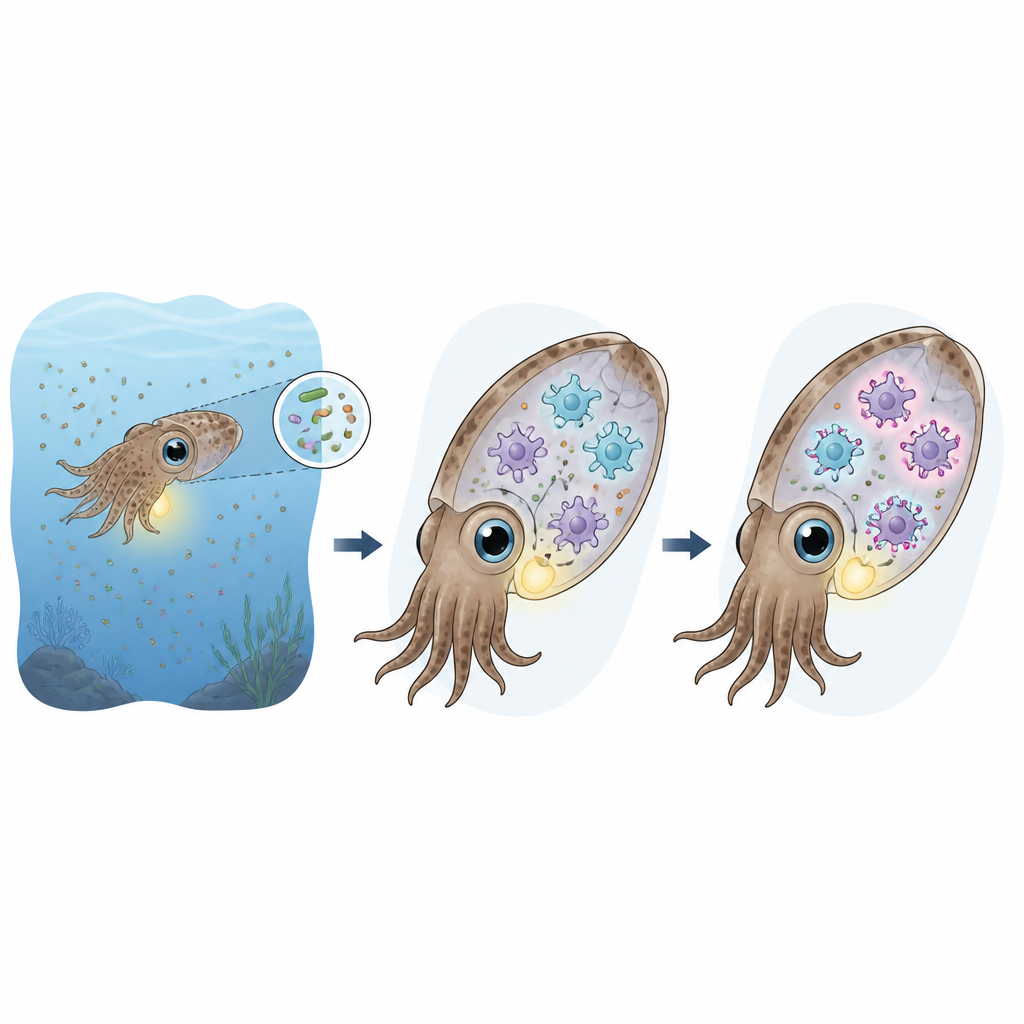
A small squid with a big microbial story
The Hawaiian bobtail squid lives in coastal waters and hosts glowing bacteria that help it hide from predators at night. These bacteria settle inside special body structures and, in return for shelter and food, produce light that masks the squid’s shadow. The squid’s immune cells, called hemocytes, play a key role in deciding which bacteria are welcomed and how the partnership is maintained. Because similar alliances between animals and microbes shape health in many ecosystems, the squid and its luminous partner Vibrio fischeri have become a favorite model for exploring friendly microbe relationships.
Tagging immune cells with magnetic specks
The researchers tested whether commercially available magnetic nanoparticles, which are tiny iron oxide spheres coated to make them safe in living tissues, could label squid immune cells without harming them. They isolated hemocytes from adult squid, mixed them with fluorescent magnetic particles, and observed them with powerful microscopes. The cells readily swallowed the particles, which collected inside their main body area. At higher particle levels, nearly all the immune cells were labeled, and checks over several days showed that the cells remained alive and active, suggesting that the particles were not toxic.
Checking that the tags do not upset cell chemistry
To see whether the magnetic tags quietly rode along or disturbed the cells, the team compared thousands of proteins and small molecules inside labeled and unlabeled hemocytes. Using advanced mass spectrometry tools, they detected nearly four thousand proteins and over seven thousand chemical features, then looked for differences between tagged and untagged cells. Overall, there were no statistically significant changes in the broad protein or metabolite patterns. Only a few individual molecules shifted slightly, many linked to cell membranes and fat handling, and even these changes were modest. The results indicate that the magnetic particles left the core workings of the immune cells largely unchanged.
Do friendly bacteria change the picture?
Because the squid’s immune cells behave differently when they encounter their glowing partners, the scientists also exposed hemocytes to Vibrio fischeri with and without magnetic labeling. Again, broad chemical profiles of the cells remained similar whether or not they carried particles. The main source of variation came from whether the cells had met the bacteria, not from the presence of magnets. The tagged cells did not appear to spit out the particles or respond in a harmful way, even when symbionts were present, suggesting that the particles do not disrupt the natural friendly interaction.
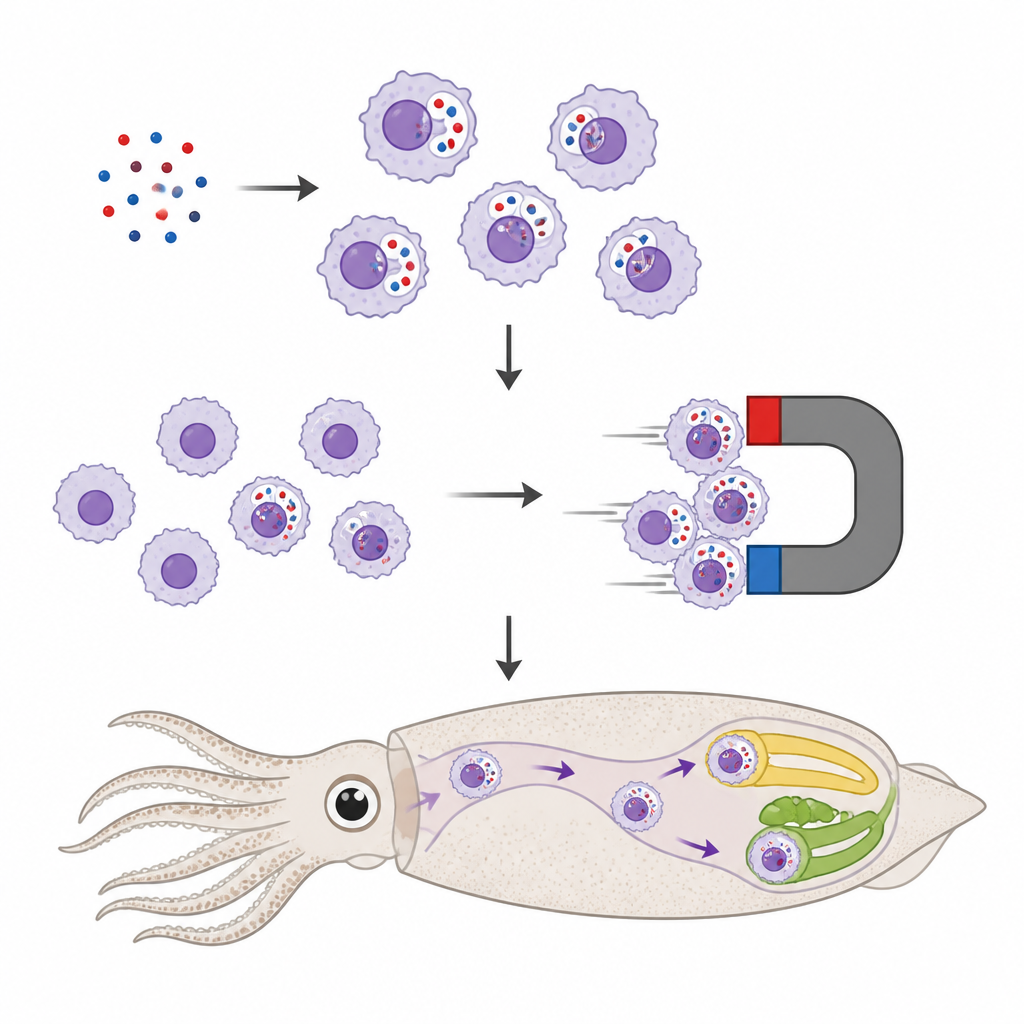
Watching tagged cells and particles move inside the squid
The team then asked whether they could see where magnetic particles go inside a living squid. They injected either tagged immune cells or free particles into a major blood vessel of anesthetized adults and used a special imaging technique called magnetic particle imaging to detect the iron signals through the body. The particles spread through the circulation and built up in key organs, including the squid’s light organ and an accessory gland that also hosts microbes. While the exact distribution was uneven and the method needs refining, the clear signals showed that these particles can be tracked noninvasively inside an intact animal, and that they reach the very tissues where symbiosis occurs.
What this means for studying hidden partnerships
This work shows that magnetic nanoparticles can safely label squid immune cells, be followed inside the body, and leave the cells’ internal chemistry and their friendly dealings with bacteria largely intact. For a lay reader, this means scientists now have a kind of gentle, invisible ink to mark and track the cells that manage partnerships with microbes in the ocean. In the future, similar approaches could be used not only to watch how such relationships form and change, but also to nudge specific cells or signals to certain spots using magnets, opening new windows into the quiet but vital alliances between hosts and their microscopic allies.
Citation: Guillen Matus, D.G., Koch, E.J., Vijayan, N. et al. Using magnetic nanoparticles to explore symbiotic interactions. Sci Rep 16, 15377 (2026). https://doi.org/10.1038/s41598-026-46489-8
Keywords: magnetic nanoparticles, squid symbiosis, immune cells, magnetic particle imaging, host microbe interactions