Clear Sky Science · en
Sustainable synthesis of bimetallic Cu–Ag nanoparticles using waste-derived chitosan and citrus extract: a green approach to combat antimicrobial resistance
Turning Everyday Waste into Germ Fighters
Orange peels and discarded snail shells usually end up in the trash, but this study shows they can be transformed into tiny particles that help fight harmful bacteria. By finding ways to reuse common waste instead of relying on harsh chemicals, the researchers explore how we might tackle the growing problem of drug resistant infections while also reducing environmental impact.
Why Drug Resistant Germs Are a Growing Worry
Antibiotics have saved countless lives, but many bacteria are learning to survive these medicines. This worldwide trend, known as antimicrobial resistance, makes infections harder to treat and increases the risk of serious illness. At the same time, many modern materials used to kill germs are made with toxic chemicals or energy hungry processes. The study looks for a gentler path, asking whether powerful germ killing materials can be made from natural leftovers instead of hazardous substances.
Giving Orange Peels and Shells a Second Life
The team focused on two types of waste that are common in their region: peels from sweet oranges and shells from a large edible snail. From the shells, they produced chitosan, a natural substance already known to be friendly to living tissues and able to cling to bacterial surfaces. From the orange peels, they made a water based extract rich in plant compounds that can donate electrons, which helps turn dissolved metal salts into solid metal particles. In a single warm water step, they mixed the peel extract, chitosan solution, and simple copper and silver salts to form a dark powder made of copper–silver nanoparticles held within a chitosan framework. 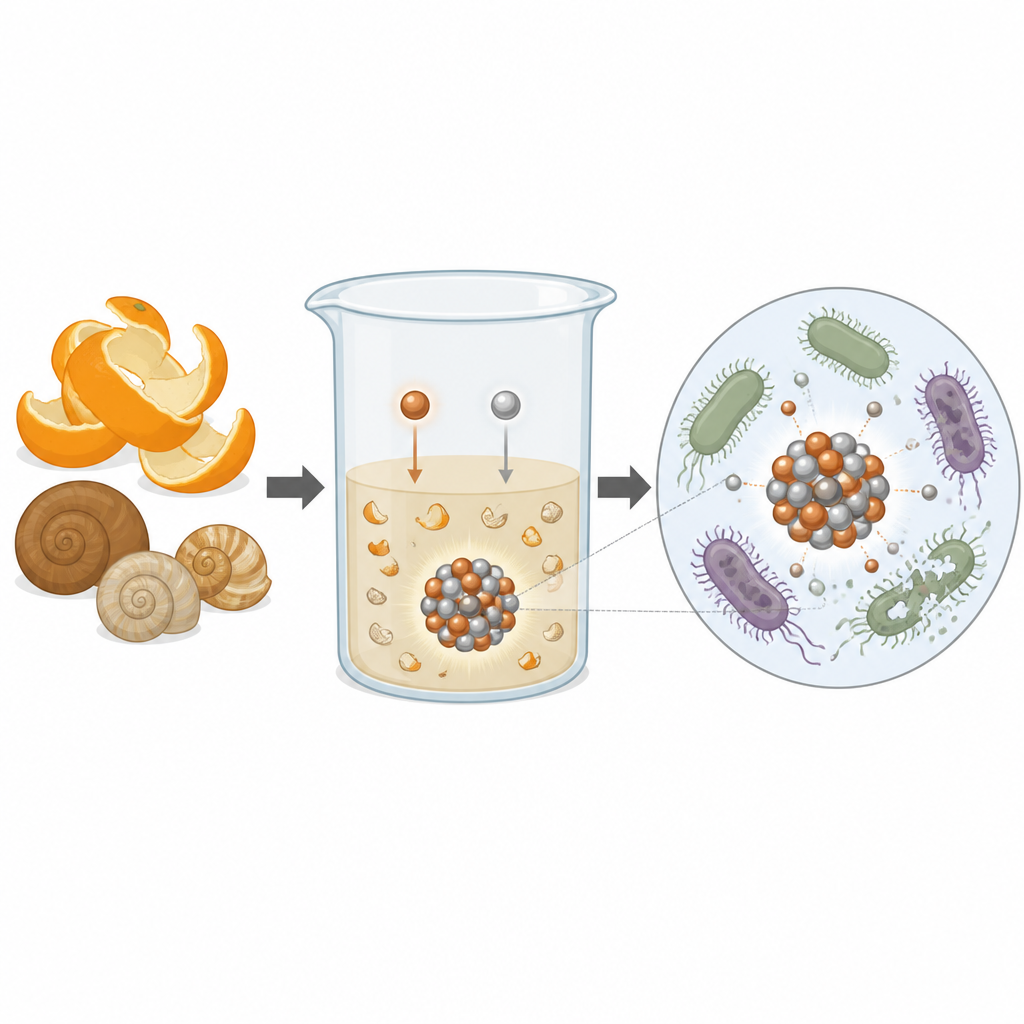
Checking the Nature of the New Material
To understand what they had made, the researchers used a suite of standard lab tools. Light absorption tests showed a clear signal typical of metal nanoparticles containing both copper and silver, rather than each metal forming separate particles. Patterns from X ray scattering revealed a tightly packed metal structure where copper atoms appear to sit inside a mainly silver layout, and analysis of peak shapes suggested that the crystal lattice is slightly compressed, likely due to the mix of the two metals. Electron microscope images showed mostly irregular, near round particles tens of billionths of a meter across, while elemental analysis confirmed that copper, silver, carbon, nitrogen, and oxygen were all present, consistent with metal particles embedded in a chitosan and plant based coating. Heat tests indicated that the organic part burns away only at fairly high temperatures, leaving a stable metal rich residue.
How Well the Particles Challenge Bacteria
The team then tested how the new material performed against several disease related bacteria, including two strains of Staphylococcus, two types of gut related bacteria, and one known for serious infections. Placing disks loaded with the particles on bacterial lawns produced clear zones where most strains could not grow, with especially strong effects against a dangerous strain of Escherichia coli. One strain of Klebsiella, however, was not affected at the highest amount tested. Further tests in liquid growth media found that only small amounts of the composite were needed to halt growth of the sensitive strains, lower than is usually reported for chitosan alone, suggesting that the embedded copper and silver add to the germ killing power. When performance was compared with a standard antibiotic, the drug produced larger clear zones, but at a far lower mass and through a very different, highly targeted mode of action. 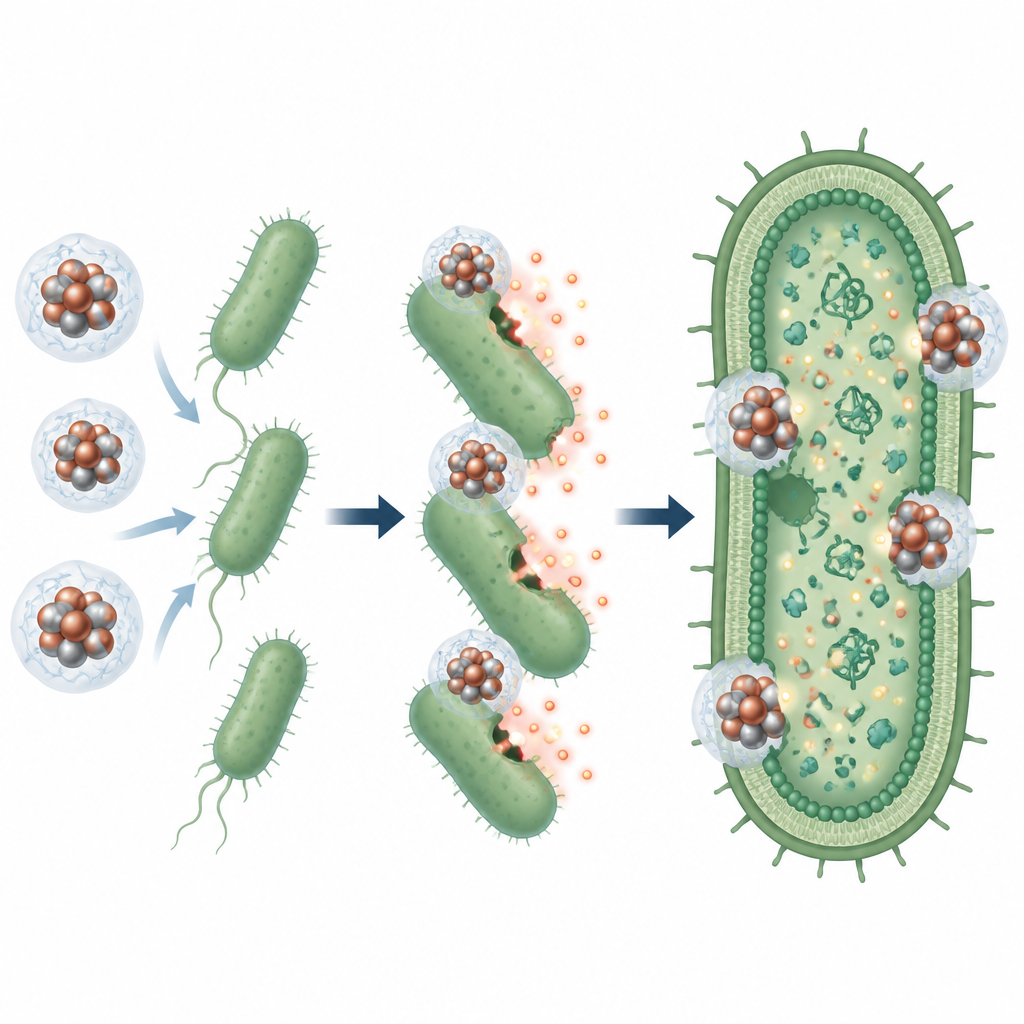
What May Be Happening at the Micro Scale
Based on their measurements and other studies, the authors outline a possible step by step picture of how these particles trouble bacteria. The chitosan coating carries positive charges in water, which likely draws the particles toward the negatively charged bacterial surface. Once close, the metal rich core can slowly release copper and silver ions that bind to the cell wall and disturb its structure. These ions, along with the particle surface, may also spark the formation of reactive forms of oxygen that damage membranes, proteins, and genetic material. The rough shape and nanoscale size of the particles increase the contact area, making it easier for them to cling to and disrupt cells. However, the study stresses that these explanations are still proposals rather than proven facts and call for follow up tests to directly track ion release, membrane damage, and oxidative stress.
Promise and Open Questions for Real World Use
To a lay reader, the main outcome is that two kinds of low value waste can be turned into a single material that shows notable activity against several harmful bacteria under gentle, water based conditions. This approach hints at a way to address pollution and drug resistant germs at the same time. Yet the work is an early step. One major pathogen in the study was untouched by the particles, and there is still no data on how safe these materials are for human cells or the wider environment. The authors argue that future research must carefully examine safety, long term stability, detailed mechanisms, and real costs before such waste derived germ fighters could be considered for wound dressings, coatings, or water treatment. For now, the study serves as a proof of concept that everyday waste can be engineered into useful tools in the ongoing fight against infection.
Citation: Atanda, S.A., Agunbiade, F.O. & Shaibu, R.O. Sustainable synthesis of bimetallic Cu–Ag nanoparticles using waste-derived chitosan and citrus extract: a green approach to combat antimicrobial resistance. Sci Rep 16, 15893 (2026). https://doi.org/10.1038/s41598-026-46470-5
Keywords: antimicrobial resistance, green nanomaterials, copper silver nanoparticles, waste valorization, chitosan