Clear Sky Science · en
A Lie group-based hybrid optimization framework for multi-objective UAV path planning using L-VGWO
Smarter Flight Paths for Drones in Tough Places
When drones are sent into risky situations—such as fire scenes, disaster zones, or crowded cities—they must find paths that are not only safe and short, but also smooth and stable. Abrupt turns or shaky motion can ruin camera readings or even cause crashes. This paper presents a new way to plan three-dimensional drone paths that keeps the vehicle’s position and orientation well behaved, even in cluttered environments, while using a powerful search strategy inspired by animal groups.
Drawing Curved Paths on a Curved World
Most path planners treat a drone’s motion as if it lived in ordinary flat space, specifying its orientation with simple angle triples. That approach breaks down when the drone has to swing through large rotations, leading to awkward flips and sudden jumps in its attitude. The authors instead lean on a more geometric description of motion borrowed from modern robotics and mechanics. They represent each step along the path as a small change in both position and orientation within a mathematical structure that naturally describes rigid motion in three dimensions. By chaining these small changes together, the method builds a continuous path where the drone’s pose evolves smoothly, without angle singularities or discontinuities.
Balancing Safety, Smoothness, and Accuracy
Real missions demand more than just reaching the goal: drones must avoid obstacles, end up exactly where and how they are needed, and move in a way that onboard sensors and actuators can handle. To capture this, the authors blend several requirements into one overall score for any candidate path. This score penalizes missing the desired final position or facing the wrong way, but it also measures how gently the drone’s orientation and speed change from one point to the next. Additional penalties discourage flying too close to walls or objects and taking unnecessarily long detours. By adjusting the relative weights of these ingredients, the planner can prioritize safety, smooth motion, or pinpoint accuracy, depending on the mission.
Letting Wolves and Vultures Search Together
Searching for the best path in this geometric setting is a hard problem, because early choices along the route can ripple forward and interact in complex ways. Instead of relying on calculus-based methods, the authors design a hybrid search algorithm that mimics how animal groups hunt. One part of the method, inspired by griffon vultures, roams widely to explore new parts of the search space. Another part, modeled after grey wolf packs, focuses on tightening in around promising options. In each round, the vulture-like step proposes bold changes to the path, and the wolf-like step then refines these candidates locally. An extra mechanism gently pulls weaker candidates toward a cluster of the current best, improving focus without getting stuck too early.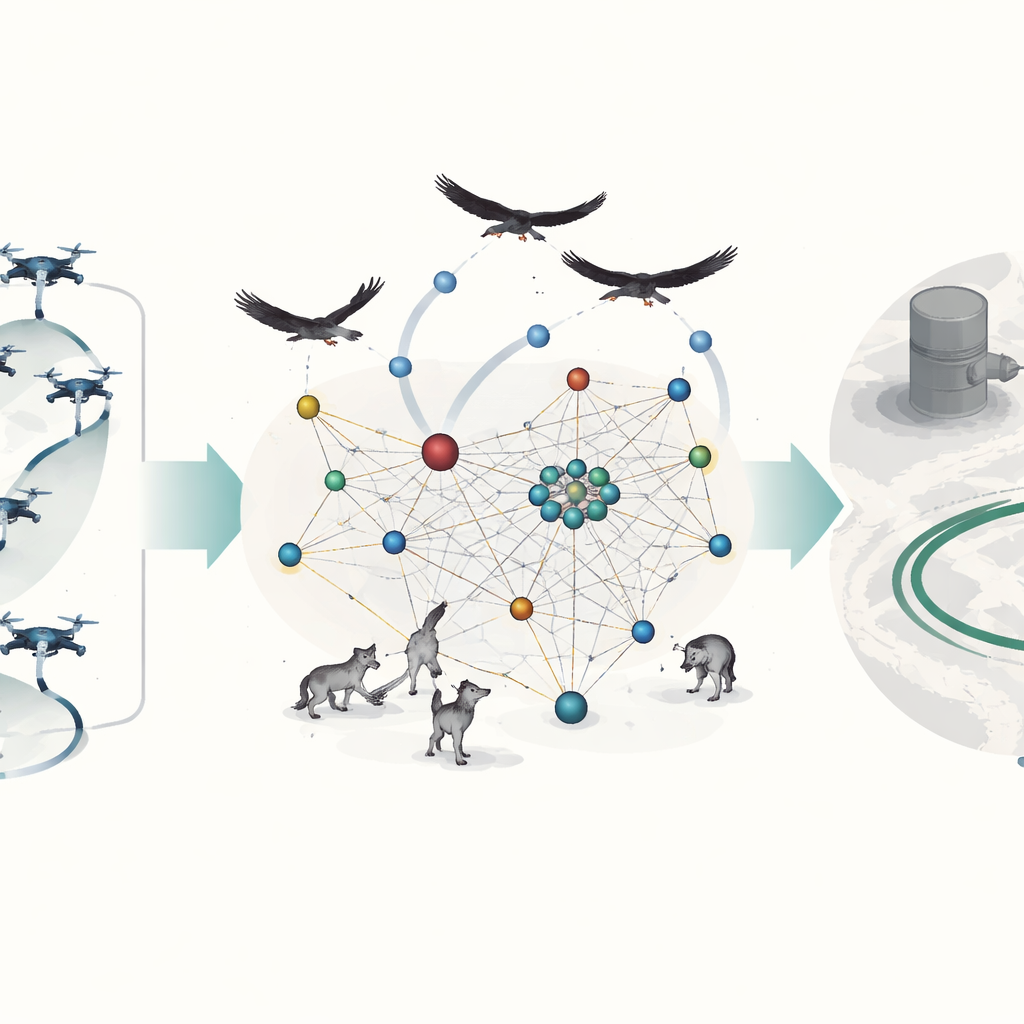
Putting the Method to the Test
The researchers test their framework in simulated three-dimensional environments filled with a mix of spherical, cylindrical, and box-shaped obstacles. The drone must fly from a fixed start point to a goal location while ending with different final headings. They compare their hybrid approach, called L-VGWO, to several well-known swarm-inspired optimizers, and also to versions that use conventional angle-based representations. Under the geometric representation, all algorithms behave better, but the hybrid method stands out: it finds shorter, safer, and smoother paths, converges faster, and shows more stable velocity profiles. Statistical tests across many repeated runs confirm that its advantage is not due to chance but reflects genuinely better performance.
What This Means for Real-World Drone Missions
In plain terms, the work shows how to combine a more realistic description of drone motion with a clever search strategy to get flight paths that are both safe and flyable. By building paths from small, well-structured pose changes, the method avoids sudden twists and turns; by using a coordinated search inspired by wolves and vultures, it efficiently discovers routes that keep clear of obstacles while meeting strict end-point requirements. Though demonstrated in simulation, the approach points toward more reliable autonomous drones that can navigate demanding 3D tasks—such as precision inspection or emergency response—without sacrificing stability or safety.
Citation: Wang, Y., Guo, C., Shao, Y. et al. A Lie group-based hybrid optimization framework for multi-objective UAV path planning using L-VGWO. Sci Rep (2026). https://doi.org/10.1038/s41598-026-46462-5
Keywords: UAV path planning, drone navigation, metaheuristic optimization, trajectory smoothness, obstacle avoidance