Clear Sky Science · en
Genetic variation in seed dormancy, soil tolerance, and pH response jointly shape early establishment in Lupinus species
Why early plant life matters for farmers
Before a crop can protect soil, feed animals, or enrich the land, its seeds must first wake up, sprout, and survive the tricky days after germination. This study looks at three lupin species widely used as cover crops in Mediterranean orchards and asks a simple but vital question: which seed types and soil conditions let young plants get off to a strong start, even when soils are harsh and the climate is unpredictable?
Seeds that sleep and when they choose to wake
Lupin seeds often have very hard coats that keep water out, a built in shield that can delay germination for months or even years. The researchers tested many lines of narrow leafed lupin by gently scratching some seeds and leaving others intact. Scarified seeds almost all germinated quickly, while intact seeds showed huge differences in how long they stayed dormant, from a few days to many months. This showed that dormancy is not a simple yes or no trait but a sliding scale that differs among genetic lines, and that breaking the seed coat can erase most of these differences.
Soils that help or hinder young roots
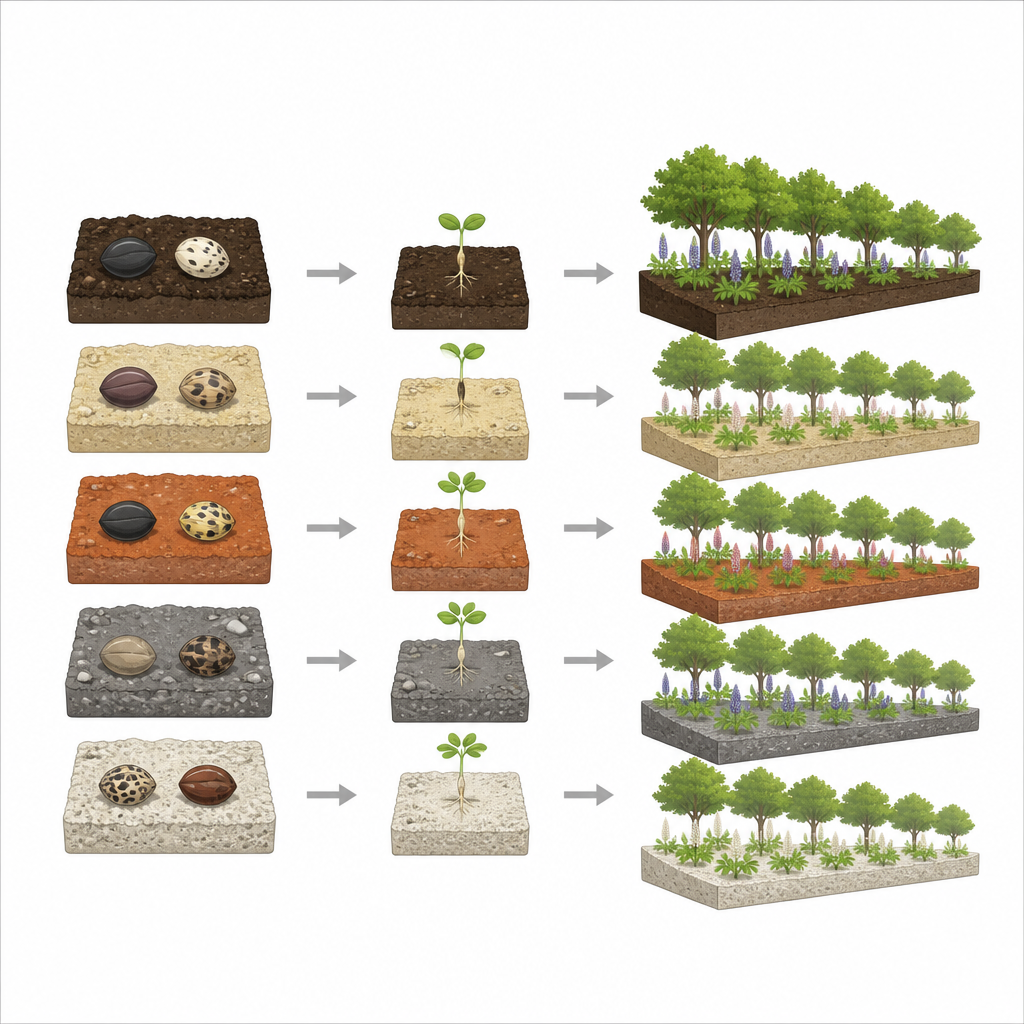
Next, the team sowed seeds from 48 lupin lines of three species into five real agricultural soils that differed in features such as acidity, organic matter, salt levels, and nutrient content. They watched the seeds move from swelling to root emergence to small, established seedlings. Surprisingly, the richest, most fertile soil produced some of the worst results because high salt and potassium levels likely stressed the seedlings. By contrast, an acidic soil rich in organic matter and an alkaline soil with moderate organic content supported strong establishment, especially for white and yellow lupins. Dormancy level on its own did not explain which lines did well in soil, showing that the physical and chemical nature of the soil is a powerful filter on early plant life.
How soil acidity shapes early growth
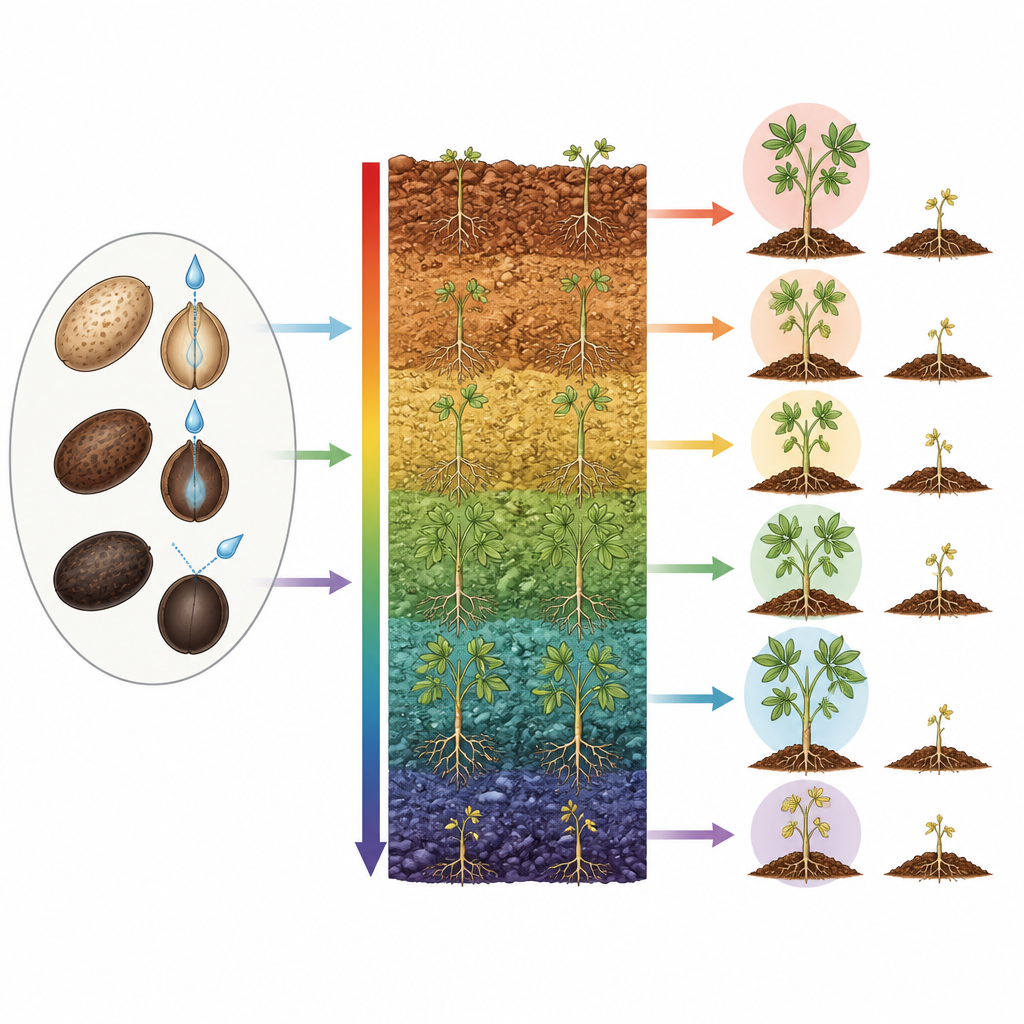
To isolate the role of acidity, the researchers germinated seeds on moist paper with nutrient solution adjusted to three pH levels: acidic, neutral, and alkaline. Most seeds eventually germinated at all pH levels, but seedling growth told a different story. Seedlings grew longest at neutral and mildly acidic pH, while strongly alkaline conditions slowed shoot growth and reduced the number of seedlings that reached a healthy size, with yellow lupin being especially sensitive. Measurements of stem segments showed that young plants shift growth from the lower stem to the upper shoot over time, and that very alkaline conditions disrupt this balance. These patterns help explain why some soils in the earlier experiment were much less welcoming to new plants.
Piecing together many filters at once
By combining data from dormancy tests, soil trials, and pH experiments, the authors showed that seed hardness, soil type, and pH tolerance each act as mostly independent filters. A seed line that wakes up quickly is not guaranteed to thrive in salty or very alkaline soil, and a line that grows well across different pH levels may still fail in a soil with poor structure or low organic matter. Using multivariate statistics, they grouped lupin lines into clusters with similar behavior and created a simple selection index that blends establishment success, seedling length, and stability across pH conditions. This index highlighted white and yellow lupin lines with robust performance in several soils, and a few narrow leafed lupin lines that handled alkaline conditions relatively well.
What this means for real fields
For growers managing citrus and other Mediterranean orchards, the study shows that reliable lupin cover crops cannot be chosen by a single trait such as low dormancy. Instead, seeds must be matched to the local soil and pH so that they not only germinate but also grow steadily through the vulnerable early stage. The selection framework presented here helps breeders and farmers identify lupin lines that combine modest dormancy, good soil compatibility, and tolerance of pH variation. Such lines are better able to establish consistent ground cover, protect soil from erosion, and support nutrient cycling in orchards facing increasing climate variability.
Citation: Pesqueira, A.M., González, A.M., Gallardo, M. et al. Genetic variation in seed dormancy, soil tolerance, and pH response jointly shape early establishment in Lupinus species. Sci Rep 16, 15317 (2026). https://doi.org/10.1038/s41598-026-46460-7
Keywords: lupin cover crops, seed dormancy, soil pH, Mediterranean orchards, early plant establishment