Clear Sky Science · en
Fine reconstruction of badminton swing dynamic trajectory assisted by event camera
Why fast swings are hard to see
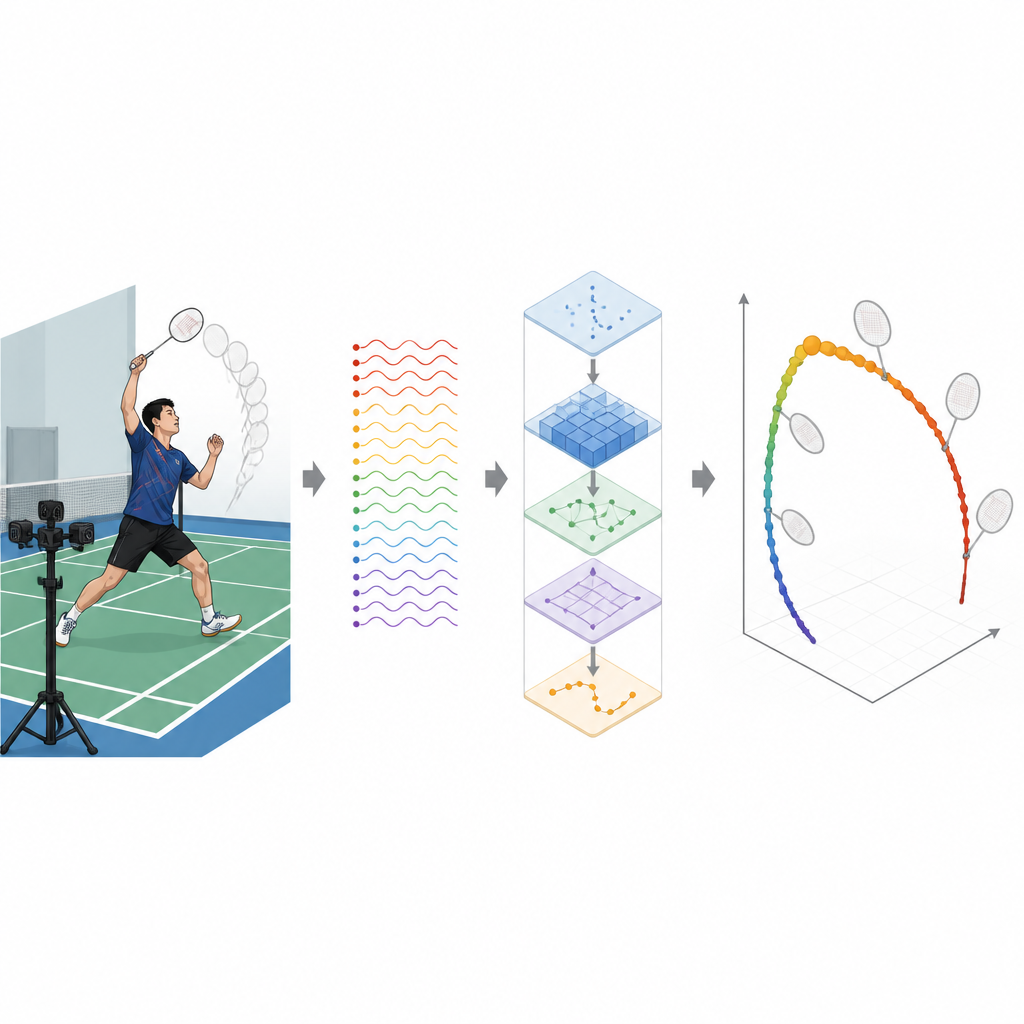
Anyone who has watched a powerful badminton smash knows how hard it is to see what the racket is actually doing. The racket head can move faster than 100 meters per second, far too quick for the naked eye or many ordinary cameras. This study shows how a new kind of camera and smart data fusion can slow those movements down in digital form, giving coaches and players a precise picture of every swing in three dimensions.
New eyes for very fast motion
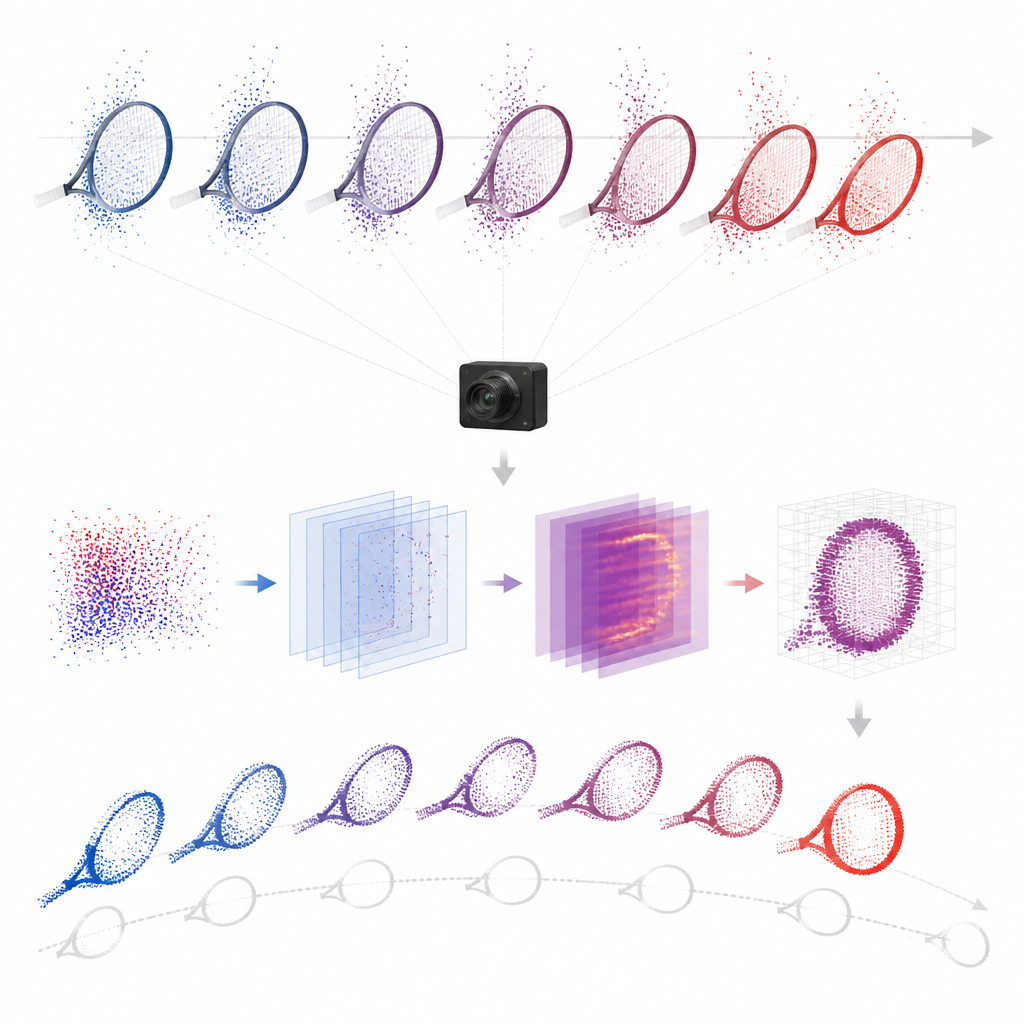
Traditional video cameras record full images at fixed frame rates, which leads to blurred pictures and missing details when objects move extremely fast. The researchers instead rely on an event camera, a sensor that reacts only when the brightness at a pixel changes. Each tiny change is logged with microsecond timing and very wide light sensitivity, so quick racket movements create dense streams of events instead of smeared frames. This gives the system a much sharper and more finely sliced view of the swing, even under bright lights or shadows where normal cameras struggle.
Combining many streams into one clear swing
The system does not depend on the event camera alone. It also uses a high speed color camera and a small inertial sensor that records how the arm is moving. First, the event data are packed into a form that deep learning networks can handle, and a special network estimates how every point in the view is moving over time. In parallel, another deep network finds the player’s body joints in the video frames, while the inertial sensor tracks acceleration and rotation of the arm. All of these clues are then merged by a mathematical filter that keeps track of position, speed, and orientation of the racket in three dimensions, while weighing how noisy each source of data is.
How accurate and useful is the replay
To check how well this works, the authors compared their reconstructed racket paths with measurements from a laboratory grade motion capture system that uses reflective markers. On a dataset of 960 swings from 12 athletes, their system reached an average position error of 8.34 millimeters, cutting error by more than forty percent compared with a strong traditional optical flow method and still running in real time. Tests showed that the event based motion signal provided over half of the accuracy gain, and the careful fusion of all sensors added more than a third again. The method held up even when lighting and court conditions changed, with only a modest loss of precision.
What it reveals about better players
With these precise 3D swing paths, the team could look beyond simple speed numbers. They studied how joint angles at the shoulder, elbow, and wrist changed through the swing, how quickly the racket sped up, and how smooth the follow through was. Professional players showed sharper peaks in racket speed, shorter and more explosive acceleration phases, and more coordinated joint motion than amateurs. The system could also generate easy to read score charts that summarized smoothness, timing, coordination, and hitting point accuracy for each athlete, clearly separating skilled players from recreational ones.
What this means for training
In plain terms, the study shows that event cameras combined with smart algorithms can capture badminton swings with fine detail and speed that older tools could not manage. The approach turns blindingly fast racket moves into clear 3D curves and joint patterns, accurate to the scale of a few millimeters and a few degrees. This opens the door to practical, near real time feedback systems that help coaches and players see exactly how a swing differs from expert form and how it changes with training, without needing a full motion capture lab.
Citation: Wang, Y., Shi, B. & Lv, B. Fine reconstruction of badminton swing dynamic trajectory assisted by event camera. Sci Rep 16, 15444 (2026). https://doi.org/10.1038/s41598-026-46443-8
Keywords: badminton swing, event camera, motion tracking, sports biomechanics, sensor fusion