Clear Sky Science · en
Breaking HER limits with Ni@B40’s single-atom catalytic prowess
Why clean hydrogen needs better helpers
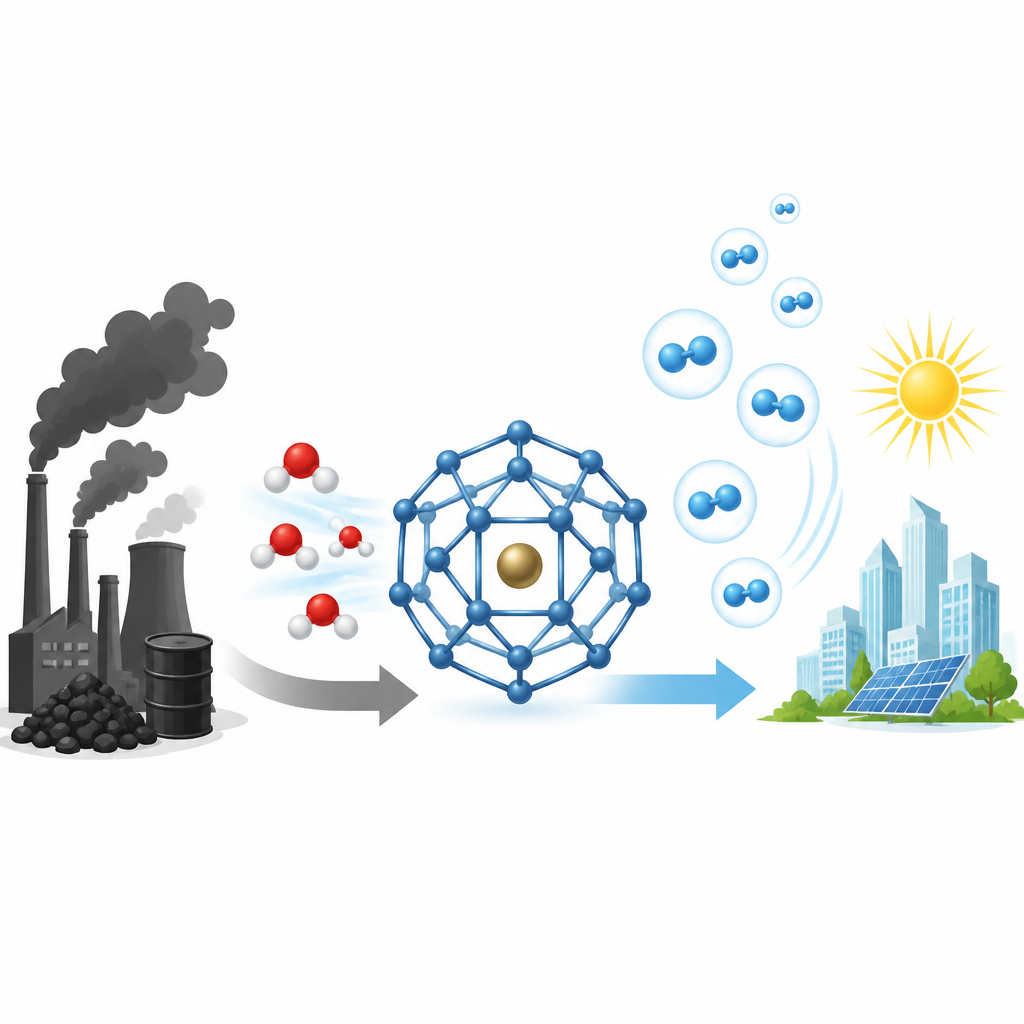
Hydrogen is often called a clean fuel because it burns without releasing carbon dioxide, but making hydrogen in an efficient and affordable way is still a challenge. The most attractive method uses electricity to split water into hydrogen and oxygen, yet this process depends on special materials called catalysts to help the reaction along. Today, many of the best catalysts use precious metals like platinum, which are expensive and scarce. This study explores whether tiny clusters of boron, decorated with single atoms of common metals such as nickel and copper, could offer a cheaper, durable route to clean hydrogen.
A tiny boron cage as a new playground
At the heart of the work is a hollow cluster of forty boron atoms known as a B40 nanocage. This cage looks a bit like a molecular soccer ball built from small rings of boron. Because boron is light, stable, and flexible in how it shares electrons, the B40 cage offers a sturdy scaffold on which a single metal atom can sit. The researchers examined how late first row metals zinc, iron, cobalt, nickel, and copper interact with this cage, creating structures written as TM@B40. Using advanced quantum calculations rather than lab experiments, they first checked whether these metal-on-cage combinations would form easily and remain stable in both gas and water-like environments.
Testing which metal makes the best partner
The team found that all five metals bind to the boron cage strongly enough to make robust complexes, especially in water, which is important for real electrochemical devices. They then probed the electronic properties of each complex, such as how tightly electrons are held and how easily they can move. These features control how well a catalyst can shuttle charge during the hydrogen evolution reaction, where protons from water gain electrons and pair up to form hydrogen gas. Doping the cage with metals shrinks the gap between filled and empty electronic states, boosting conductivity. Nickel- and copper-decorated cages, in particular, develop new electronic states near the energy levels involved in bonding to hydrogen, making them promising active sites.
How the cage grabs and releases hydrogen
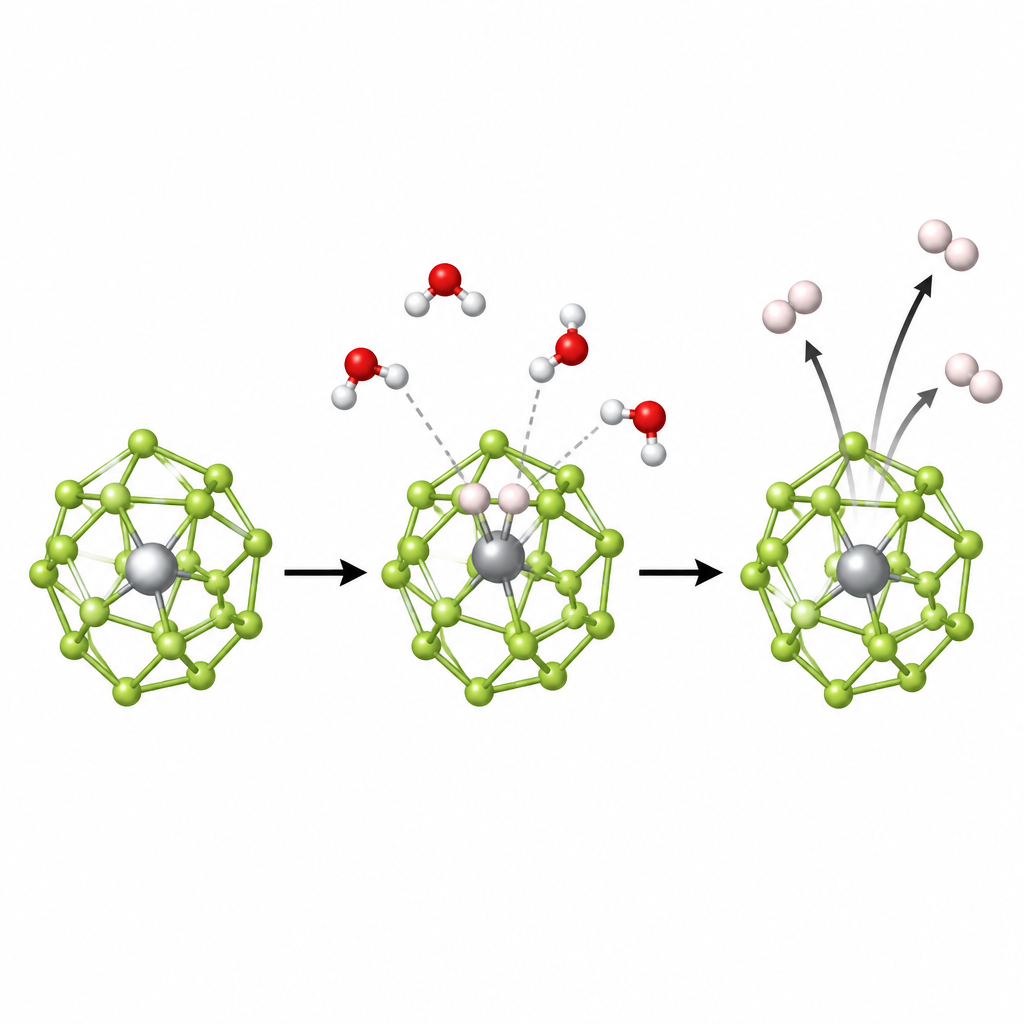
For a hydrogen-evolving catalyst, it is not enough to grab hydrogen strongly; it must also let go at just the right moment. To capture this balance, the authors computed the free energy change for a single hydrogen atom binding to each metal-on-boron cage in water. Values close to zero mark an ideal catalyst, because hydrogen is neither too reluctant to adsorb nor too stubborn to leave. Nickel@B40 and copper@B40 stand out, with nearly perfect near-zero values of about -0.01 and 0.01 electron volts, respectively. These results mean that hydrogen intermediates are stabilized just enough to form but can still combine and depart as hydrogen gas without wasting extra energy.
Peering inside the reaction steps
Going further, the study followed the individual steps that turn protons in solution into hydrogen gas, known as the Volmer, Heyrovsky, and Tafel steps. For each pathway, the researchers tracked how much energy is needed as hydrogen atoms land on the catalyst, pair up, and depart. Nickel@B40 repeatedly showed the lowest barriers across these steps, indicating fast reaction rates, while copper@B40 also performed very well in water. Simulations that mimic atomic motion at room temperature confirmed that the nickel-on-boron structure remains intact and stable, an important sign that such single-atom catalysts could survive the harsh conditions inside an operating electrolyzer.
What this means for future hydrogen technologies
In simple terms, this work suggests that a single nickel or copper atom anchored on a tiny boron cage could rival or even match much more expensive noble metal catalysts for making hydrogen from water. By combining strong structural stability with nearly ideal hydrogen binding, these designs offer a blueprint for building efficient, low-cost, and metal-sparing catalysts. While the study is theoretical, it points experimental chemists toward concrete targets and design rules for next-generation materials that may help make clean hydrogen a more practical part of the future energy mix.
Citation: Kosar, N., Rafiq, S., Ansari, S.M. et al. Breaking HER limits with Ni@B40’s single-atom catalytic prowess. Sci Rep 16, 15569 (2026). https://doi.org/10.1038/s41598-026-46437-6
Keywords: hydrogen evolution reaction, single atom catalysts, boron nanocage, nickel catalyst, water splitting