Clear Sky Science · en
Hydrostatic pressure promotes odontoblast differentiation via PIEZO1-dependent activation of RUNX2 and WNT16 in SHED
Why tooth pressure matters
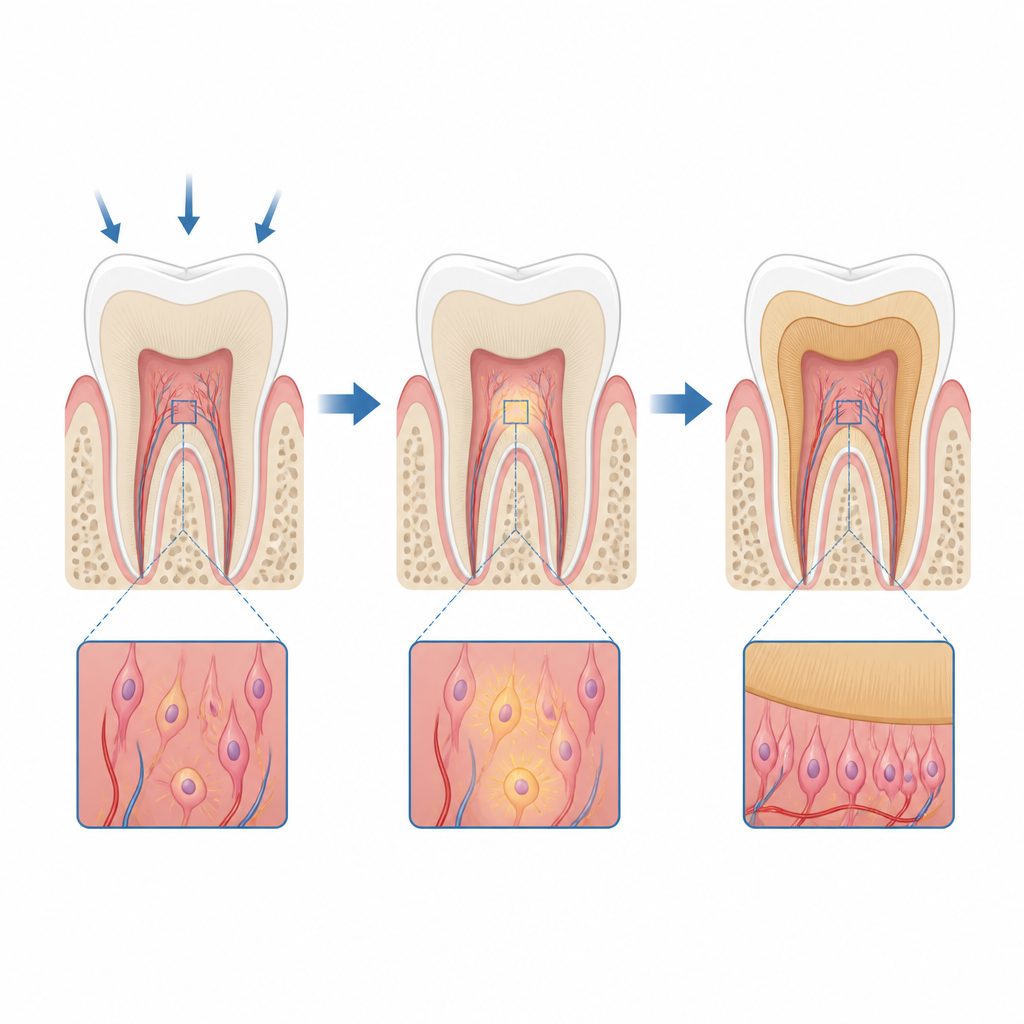
Everyday actions like chewing or grinding your teeth quietly shape the living tissue inside them. This study asks a simple question with big implications for dental health: how does gentle mechanical pressure deep in a tooth help stem cells turn into hard tissue forming cells that repair and reinforce dentin, the layer beneath enamel? Understanding this hidden process could one day guide new ways to protect sensitive teeth and encourage natural repair instead of drilling and filling.
How teeth sense physical forces
Teeth are not rigid stones; they are packed with living cells. Just beneath the hard dentin layer sit odontoblasts, specialized cells that lay down new dentin during growth and in response to stress. When we bite, fluid inside tiny channels in dentin shifts, creating pressure on these cells. Researchers have suspected that this pressure is converted into biological signals, but the exact chain of events linking force to new tissue formation has remained unclear. In particular, scientists have been eager to learn which molecules inside tooth stem cells sense pressure and switch on the genes needed for odontoblast formation.
A pressure sensor in tooth stem cells
The team focused on stem cells from baby teeth, known as SHED, which can mature into odontoblast-like cells. Earlier work showed that a protein channel called PIEZO1, known in many organs as a sensor of mechanical forces, is present in these cells. In this study, the researchers mimicked the mild hydrostatic pressure caused by fluid movement in a tooth. When SHED were exposed to this pressure under conditions that encourage odontoblast development, they produced higher levels of early and late dentin markers and formed more mineralized nodules, tiny clumps that signal new hard tissue. When PIEZO1 was silenced using small RNA molecules, both marker genes and mineral buildup dropped sharply, showing that this channel is essential for pressure-driven maturation.
From pressure to gene control switches
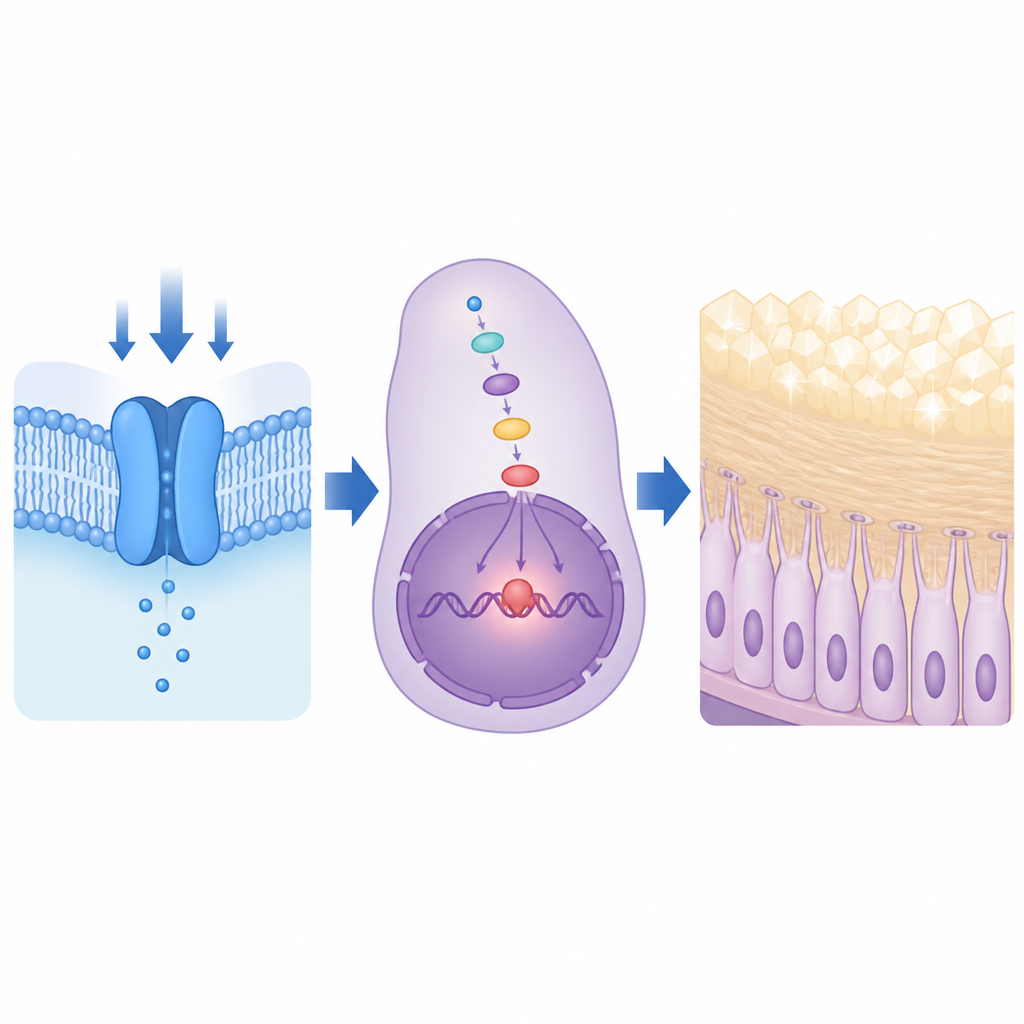
To trace what happens after PIEZO1 senses pressure, the scientists turned to two key players: RUNX2, a gene control protein already known to guide tooth and bone formation, and WNT16, a signaling molecule linked to bone strength. They found that only one version of WNT16, called WNT16b, is made in these tooth stem cells. Pressure raised WNT16 levels, but this boost was dampened when PIEZO1 was blocked and even more strongly reduced when RUNX2 was silenced. At the same time, lowering WNT16 impaired pressure-induced mineralization, confirming its importance for building dentin-like tissue. These results suggested a simple order: PIEZO1 responds to pressure, activates RUNX2, and RUNX2 in turn raises WNT16.
Zooming in on the molecular handoff
To test whether RUNX2 truly acts as a direct switch for WNT16, the researchers used two classic gene regulation tools in human kidney cells grown in the lab. First, they attached the control region of the WNT16 gene to a light-emitting reporter. Adding RUNX2 made the reporter glow several times brighter, and higher amounts of RUNX2 drove even stronger activity, indicating that RUNX2 turns up the WNT16 promoter. Second, they used a method that pulls out DNA regions bound to tagged RUNX2 protein. This experiment showed that RUNX2 physically grips specific sites in the WNT16 control region. Together, these tests confirmed that RUNX2 sits directly on the WNT16 gene and acts as a volume knob for its activity.
What this means for tooth repair
By piecing together these experiments, the study outlines a clear pathway inside tooth stem cells: pressure activates the PIEZO1 channel, which helps move RUNX2 into the cell nucleus, where it binds the WNT16 gene and boosts signals that drive odontoblast differentiation and mineral deposition. While other pressure-sensitive routes likely work alongside this one, the PIEZO1–RUNX2–WNT16 chain appears to be a central link between everyday mechanical forces and the tooth’s natural ability to thicken and repair its dentin. In the future, fine-tuning this pathway could help dentists harness gentle forces or targeted drugs to encourage the tooth to heal itself from within.
Citation: Miyazaki, A., Narwidina, A., Sugimoto, A. et al. Hydrostatic pressure promotes odontoblast differentiation via PIEZO1-dependent activation of RUNX2 and WNT16 in SHED. Sci Rep 16, 15389 (2026). https://doi.org/10.1038/s41598-026-46415-y
Keywords: odontoblast differentiation, mechanosensitive ion channel, PIEZO1, WNT16, dentin formation